
John Wrory Ficklin was just seven years old when he discovered his father held an extraordinary position of trust and responsibility.
The year was 1963, and America grieved the assassination of President John F. Kennedy. Young Wrory sat with his mother and brother in their Washington apartment, watching the somber funeral proceedings unfold on television, when his mother suddenly drew in her breath.
There on the screen stood his father, James Woodson Ficklin, dressed in formal morning attire and positioned alongside Kennedy’s coffin with the White House ushers. Though he served as a White House butler, Jackie Kennedy had specifically requested his presence among the ushers for that historic day.
James Woodson Ficklin dedicated an extraordinary 44 years to the White House residence staff. His son, Wrory Ficklin, also built an impressive White House legacy, spending four decades with the National Security Council.
While presidents typically serve four or eight-year terms, the Ficklin family maintained an almost constant presence at the White House for nearly 80 years. Woodson Ficklin, his wife, several siblings, and son Wrory served under 13 different presidents, spanning from Franklin D. Roosevelt through Barack Obama.
This single family stood beside America’s leaders for one-third of the nation’s 250-year history.
When Wrory retired in 2015, he became the final Ficklin to work full-time at the White House, ending a family service record he chronicles in his book, “An Unusual Path: Three Generations from Slavery to the White House.”
“The book is my family’s history, it’s African American history and it’s our country’s history,” Wrory told The Associated Press during an interview. “My dad and I both stand on my grandfather’s shoulders, and I like to think that we both contributed a lot to our country.”
Wrory describes their saga as a “truly American story” that begins with his grandfather, James Strother Ficklin, born into slavery around 1854 in Virginia’s Rappahannock County.
During the Civil War, Strother served as a water carrier for Confederate forces. Following emancipation, he performed various tasks for his former owners.
After losing his first wife during childbirth, Strother remarried in 1894 and relocated to Youngstown, Ohio, seeking to escape Virginia’s racial hostility while pursuing opportunities in the thriving coal and steel sectors. Historical records indicate the family eventually returned to Rappahannock County, though the reasons remain unclear.
By 1901, Strother and his second wife, Helen, had accumulated sufficient savings to purchase 37 acres in Amissville, Virginia. He constructed a home and cultivated crops to support his family. Following Helen’s death during childbirth, Strother wed Vallie Lee Davenport in 1907. Together, they raised 10 children — five daughters and five sons.
John Woodson Ficklin was among those sons.
At age 15 in 1934, Woodson Ficklin moved to Washington to live with his older sister and her spouse. He balanced various jobs while attending evening high school classes, earning his diploma in 1939 — the same year his older brother Charles began working as a White House butler. Charles helped secure Woodson a part-time role washing dishes and handling tasks the butlers couldn’t complete themselves.
World War II military service temporarily interrupted their White House careers, but both brothers received promotions upon their return. Charles Ficklin advanced to head butler while Woodson Ficklin became a butler. On his second day in the butler role, Woodson Ficklin served breakfast to President Harry Truman and first lady Bess Truman.
Additional promotions came during Dwight Eisenhower’s presidency, with Charles Ficklin ascending to maître d’ — the highest butler position — while Woodson Ficklin became head butler, overseeing six full-time butlers.
When Charles Ficklin retired in March 1967, Woodson Ficklin again stepped into his brother’s role.
As maître d’, Woodson Ficklin managed the planning and coordination of White House social functions, from intimate luncheons and formal state dinners to birthday celebrations and casual South Lawn barbecues.
His responsibilities encompassed visits from British royalty, annual Christmas celebrations, Tricia Nixon’s 1971 White House wedding, and Gerald Ford’s daughter Susan’s decision to hold her high school prom at the executive mansion.
Throughout his tenure, Woodson Ficklin gained the confidence and respect of presidents and first ladies who depended on his professional knowledge. Many sent appreciation letters following successfully executed events.
In October 1969, first lady Patricia Nixon wrote about “the great number of complimentary remarks we receive following each White House social event,” according to a letter copy featured in the book. “Our family is most grateful to you for the time and interest you devote to make each occasion so enjoyable and memorable for our guests and for us.”
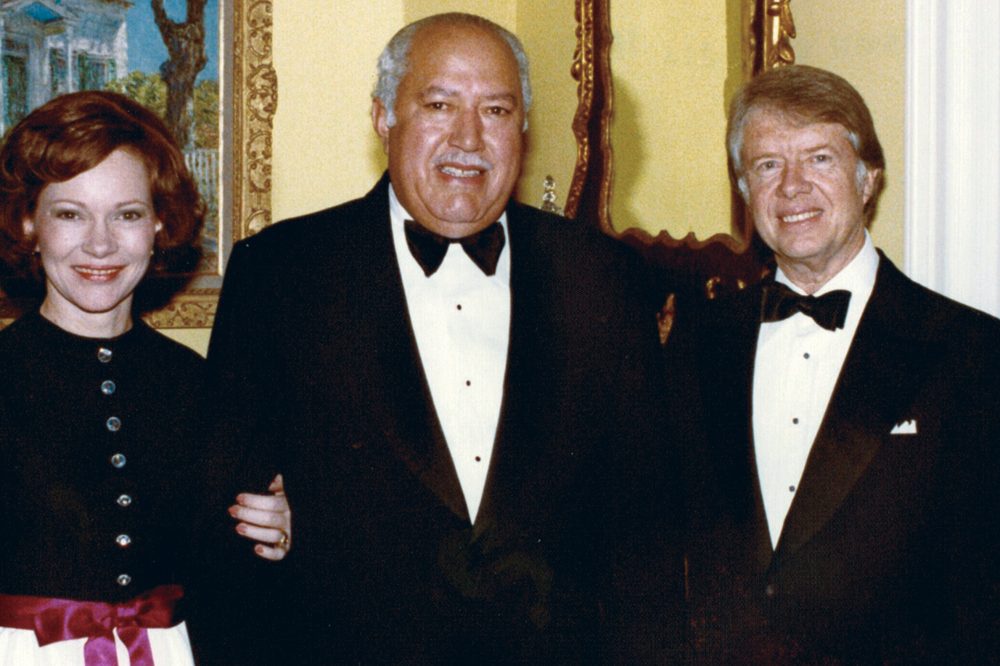
President Jimmy Carter sent a March 1979 letter thanking Woodson Ficklin and his staff for their work during the Egypt-Israel peace treaty signing ceremony.
“Everything was perfect and we are grateful,” Carter wrote.
Woodson Ficklin stepped down in May 1983. In what may represent the greatest tribute to his 44-year service, the Reagans invited him and his wife, Nancy, as guests to that year’s state dinner honoring Bahrain’s emir.
He likely became the first White House residence staff member to attend a state dinner as a guest, generating significant media attention. Woodson Ficklin dined at the first lady’s table and later told reporters she “put me at ease and made me feel like a guest.” When asked about the evening’s service, he responded, “Those are my boys. I trained them.”
Woodson Ficklin passed away in December 1984 at age 65.
“Seeing my Dad on television was a big deal, and to see him participating in our president’s funeral service was beyond my youthful comprehension,” Wrory Ficklin wrote. He noted that years elapsed before he grasped “the severity and the importance” of his father’s contributions.
Despite this, Wrory Ficklin also pursued meaningful White House work, starting with a high school summer position delivering confidential documents between the White House and Watergate special prosecutor. He also assisted his father in the pantry during state dinners and major events.
Wrory Ficklin joined the NSC staff in 1975, launching a 40-year career that overlapped with his father and other relatives. He initially worked evening shifts as a clerk while attending college during daytime hours, and by 1987 was responsible for training new personnel.
During Obama’s administration, Wrory Ficklin earned promotion to special assistant to the president for national security affairs. Before retiring in 2015, he made a special request to his supervisor, national security adviser Susan Rice: Could he attend a state dinner, following his father’s example?
Wrory Ficklin and his wife, Patrice, received invitations to the 2015 state dinner for Chinese President Xi Jinping. With slight modifications, he wore the same tuxedo jacket and cummerbund his father had worn in 1983.
He described the dinner as his career’s pinnacle.
“Just to experience firsthand the quality of the service, the precision of the butlers, the type of service that they provided, was a legacy to my dad, actually,” Wrory Ficklin said during the interview.