
Burning fuel facilities releasing toxic smoke. Wreckage contaminating the Persian Gulf. Military installations under bombardment.
Environmental scientists warn that the ongoing conflict in Iran has created a dangerous cocktail of pollutants, toxic metals, and harmful chemicals that pose serious threats to farming, water supplies, and public health — with environmental consequences that may last for generations.
“All the burning of oil and gas fields in the coastal areas, all the ships that are there, the oil tankers that are being burned or (sunk) — all of these mean pollution,” stated Kaveh Madani, an Iranian scientist serving as director of the United Nations University Institute for Water, Environment and Health. “For someone like me who has fought for sustainability and protection of the environment in that region, this is like going many years backward.”
Recording the full extent of environmental harm has proven challenging, with complete assessment currently impossible, according to Doug Weir, who leads the Conflict and Environment Observatory, a United Kingdom-based organization tracking environmental impacts from military conflicts.
The organization employs satellite monitoring and open-source intelligence gathering to identify environmental damage and assess risks to communities, natural habitats, and farmland. Their research has documented over 400 environmentally harmful incidents connected to the conflict, though significant gaps remain due to delayed satellite data and Iran’s internet shutdown, Weir explained.
Strikes targeting petroleum and natural gas infrastructure pose the greatest environmental dangers through air quality degradation and contamination of soil and groundwater, along with direct health hazards. More difficult to measure are the risks from bombed military installations, some located deep underground and others near residential areas, creating “huge uncertainties” about potential consequences, Weir noted.
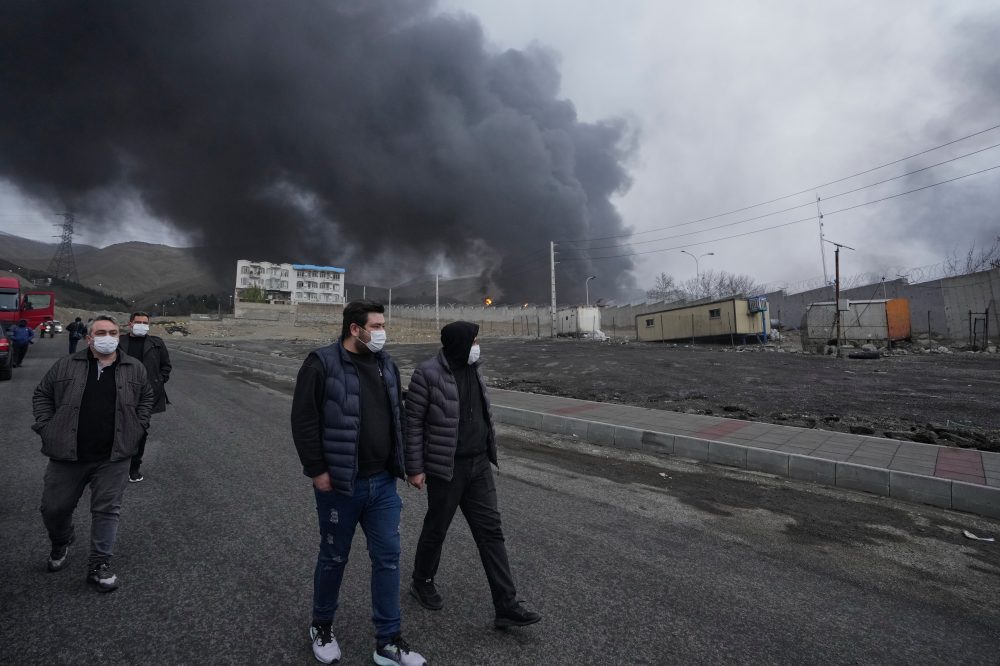
The conflict’s most memorable visuals may be the blackened skies from burning oil infrastructure hit by air attacks, including an incident two weeks ago when contaminated rainfall occurred near Tehran, Iran’s capital city.
Particles, ash, and poisonous compounds from attacks on fuel storage areas and a refinery mixed with atmospheric moisture and returned to ground level as greasy, acidic precipitation that led authorities to advise residents to remain inside. Tiny soot particles increase risks for respiratory and cardiovascular disease, while dangerous chemicals create long-term cancer threats and toxic metals from the contamination could poison soil and water sources, scientists explained.
Wreckage and pollution from missile strikes, along with possible attacks on manufacturing plants and other critical infrastructure, could also spread dangerous contamination across the region, researchers warned.
“If you hit an ammonia-producing plant for fertilizer or for food production … those release chemicals that are absolutely toxic and harmful if they spread,” explained Mohammed Mahmoud, who heads Middle East Climate and Water Policy at the United Nations University Institute of Water, Environment and Health and established the Climate and Water Initiative.
Heavy fossil fuel burning is also dramatically increasing greenhouse gas levels that drive climate change, scientists noted. Carbon tracking firm Greenly calculated that U.S. military operations alone produced nearly 2 billion metric tons of greenhouse gases during just the conflict’s first six days, indicating the total emissions from all fighting are substantially higher when including Israeli and Iranian activities plus infrastructure damage.
This represents a substantial amount for such a brief period, considering approximately 50 billion metric tons of greenhouse gases are released globally each year, based on National Oceanic and Atmospheric Administration data.
Worldwide petroleum shortages are also forcing some nations to restart or expand coal usage, generating additional air pollution that harms human health and increases greenhouse gas output.
Nations throughout the dry Persian Gulf area depend on hundreds of water treatment facilities for drinking supplies, creating health and security concerns if plants suffer damage or water becomes contaminated, experts warn.
Iran has claimed a U.S. airstrike harmed one of its water treatment plants, while nearby Bahrain has blamed Iran for damaging one of its facilities. Scientists worry additional plants could become targets as the conflict continues.
Regional residents “struggle with having access to clean drinking water, even at peace times,” noted Madani, the Iranian scientist and U.N. official. “Any damage to water infrastructure can have long-lasting impacts.”
Weir expresses concern that contamination, including petroleum from sunken vessels and other sources, might block water treatment plants or that facilities could be shut down by attacks on electrical generation sites.
Scientists say pollution could also harm fishing industries and critical ecosystems. While some contaminants will spread and become diluted by water circulation through the gulf, heavy metals and toxic substances may still accumulate in bottom sediments.
“It’s an enclosed basin, quite shallow,” Weir observed. “There are sensitive habitats there, coral reefs, seagrass meadows, sensitive species which could be impacted.”
The U.N. nuclear monitoring agency has been denied access to Iranian nuclear installations, including sites attacked in June by the United States and Israel, leaving their condition largely undetermined.
Potential strikes on major and minor nuclear facilities throughout the area represent “another thing to worry about,” due to immediate and lasting health and environmental effects, Madani said. Radiation exposure can cause skin injuries and acute radiation syndrome, while long-term dangers include cancer, cardiovascular disease, and genetic harm.
American and Israeli leaders have stated that destroying Iran’s nuclear weapons capability is among the conflict’s objectives.
Following joint Israeli and U.S. bombing of an Iranian uranium processing facility this month, Iran responded by launching missiles at two Israeli communities, including one housing a nuclear research facility. Israel reported the installation sustained no damage.
“We are hearing that there is no major radiation or change in the level of pollutants so that makes us hopeful that nothing has gone wrong,” Madani said. “But the risk is always there.”
Following the conflict’s end, as Iran and neighboring countries begin reconstruction, environmental restoration may receive limited attention, experts predicted.
Priority will go to power and water systems, industrial facilities, and food production sites, Mahmoud said. Some contamination, particularly affecting the gulf or other waterways, “I doubt will be addressed soon, and in some cases, not at all.”
Weir said environmental restoration receives inadequate attention following most conflicts due to high costs and because “humanitarian needs come first,” despite potentially severe environmental risks.
In heavily populated Tehran, for instance, numerous strikes have targeted not only petroleum infrastructure but also buildings and neighborhoods, creating harmful contamination from crushed construction materials. Residents face exposure to dust and chemicals that may persist long after the conflict ends and reconstruction efforts begin.