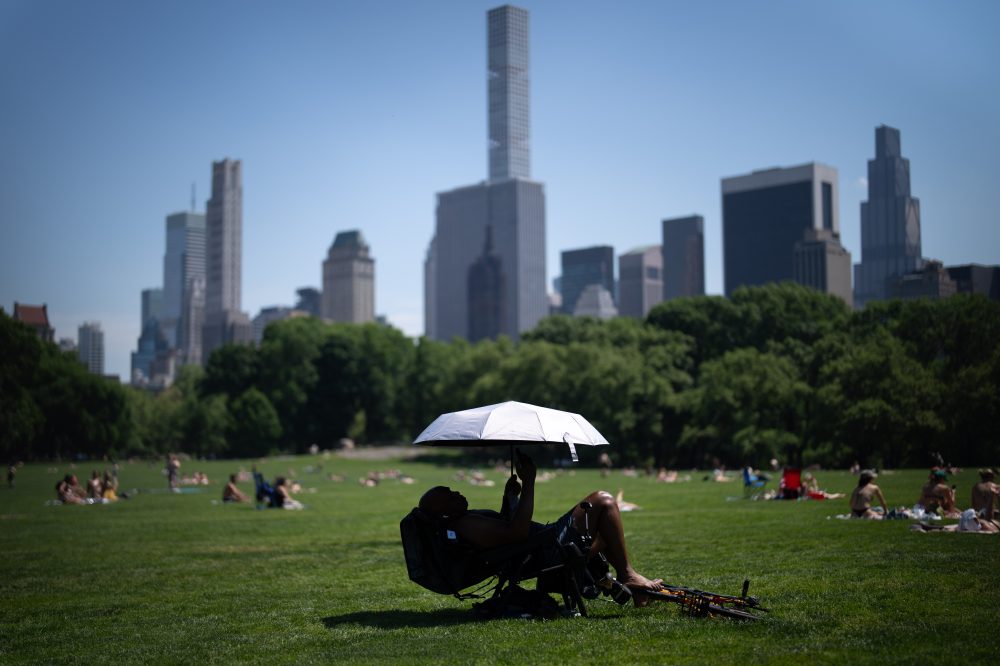

A dangerous heat dome that baked parts of the central and eastern United States is now being blamed for at least 19 deaths in New Jersey, even as powerful storms swept in behind it, cutting power to nearly one million homes and businesses across the region.
New Jersey health officials said Saturday that heat-related fatalities began appearing as early as Thursday, with the majority concentrated in the central and northern portions of the state.
State Health Commissioner Dr. Raynard Washington addressed reporters Saturday, saying, “Unfortunately, many of these individuals were found in homes without air conditioning. A few were outside their residences, some on the street and some even in parked cars.”
New Jersey Gov. Mikie Sherrill described the event as “the hottest stretch we’ve seen in over 14 years,” and stressed that the danger extended beyond the elderly or those with existing medical conditions. “The heat’s hitting all of us, not just seniors, not just with underlying health conditions, people of all ages,” Sherrill said.
The scorching temperatures shattered records across the area. On Thursday, LaGuardia Airport in New York reached a new high of 104 degrees Fahrenheit (40 degrees Celsius), surpassing the previous record of 101 F (38.3 C) that had stood since 1966, according to Bryan Jackson, a meteorologist with the National Oceanic and Atmospheric Administration’s Weather Prediction Center. Trenton, New Jersey, hit 101 F, breaking a record of 100 F (37.7 C) that dated back to 1901. Newark climbed even higher, reaching 105 F (40.5 C) on Thursday.
Atlantic City also smashed records, reaching 103 F (39.4 C) on Thursday — topping its previous record of 100 F set in 1966 — then climbing to 105 F on Friday and 106 F (41.1 C) on Saturday, Jackson confirmed.
Jackson explained why heat domes are so dangerous, combining extreme temperatures with high humidity. “In a lot of cases they also had direct sunshine,” he said. “It was relentless. It was multiple days. It was not as cool overnight, as well. The low Friday morning in Atlantic City was 80. The body can’t recover as well. You just have that multiple day buildup and too much added stress on the body.”
As the heat gradually pushed eastward, severe thunderstorms moved in with powerful winds that toppled utility poles and brought trees crashing down onto power lines. By early Sunday afternoon, roughly 900,000 utility customers across parts of the central, eastern, and southern United States were without electricity, according to PowerOutage.com.
Michigan saw more than 223,000 customers lose power, while close to 170,000 customers in Pennsylvania were also affected. PPL Electric reported 121,417 customers without power Sunday morning, including approximately 47,000 in the Harrisburg, Pennsylvania, area. In New York State, Central Hudson reported more than 430 downed wires on Sunday, with about 50,000 customers impacted, though roughly 650 were still without service by Sunday.
In the Detroit area, Amanda Vesper, 40, of Commerce Township, was putting her children to bed Friday evening when the first round of storms hit and cut her power. “It didn’t seem that awful. It got quite windy,” she recalled. By late Sunday morning, her electricity had still not been restored.
“We’ve been going back and forth between a hotel and our home because we have dogs there,” Vesper said. “We really can’t stay there. I have a small child with autism. Our well runs on an electric pump.” The ongoing outage also forced the family to cancel their Fourth of July plans. “We had planned on having company over at the house, but had to cancel,” she said. “I went grocery shopping. I’m hoping my freezer holds.”
Jackson warned that heavy thunderstorms are expected Sunday in and around the Cleveland area before shifting east into Pennsylvania, New Jersey, and New York, where the risk of flash flooding remains a concern.