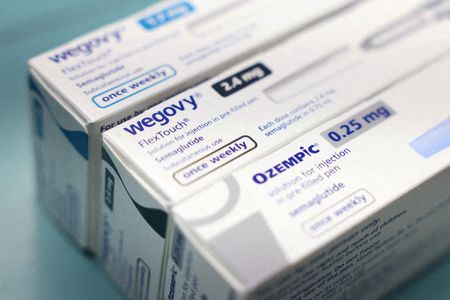

Danish pharmaceutical company Novo Nordisk is experiencing strong initial sales for its new weight-loss pill, but the company must prove that robust prescription numbers can withstand an aggressive pricing battle in the obesity medication sector.
The company is scheduled to release first-quarter financial results on Wednesday, with investors closely watching whether the pill can help recover market share in the weight-loss drug industry. Declining prices in the United States and increased competition have raised questions about previous projections that global sales could hit $150 billion annually in the early 2030s.
The pressure is mounting for Novo Nordisk, which has faced significant challenges over the past year. The company has dealt with disappointing clinical trial results for its next-generation obesity medication, reduced financial outlooks, executive changes, and a dramatic stock price decline that eliminated over $400 billion from its market capitalization since reaching its 2024 high.
“We are in the middle of the exam period, let’s put it that way,” stated Mikael Bak, who leads the Danish Shareholders’ Association representing 17,000 members, most of whom hold Novo investments.
“What I will be looking for is whether they are increasingly able to go from being rather defensive to being more offensive,” Bak added.
Early prescription data for Novo’s oral Wegovy pill has surpassed projections. Research firm IQVIA tracked approximately 721,000 U.S. prescriptions during the first quarter, according to BMO Capital Markets analyst Evan Seigerman.
However, Novo’s exclusive position as the sole oral obesity pill available in the U.S. market ended in early April when Eli Lilly received regulatory clearance for its competing pill Foundayo, creating direct competition between the two companies.
In encouraging news for both pharmaceutical companies, Lilly reported stronger-than-anticipated first-quarter earnings last week, which boosted share prices for both firms. The positive results were driven by robust sales volume for Lilly’s weight-loss and diabetes medications Zepbound and Mounjaro.
Seigerman advised caution in making definitive assessments so early after the product launch, explaining that IQVIA’s data doesn’t capture prescriptions dispensed through certain approved telehealth services, suggesting actual patient numbers might be higher.
Industry experts also note that impressive prescription volumes might be concealing weaker revenue performance. Approximately 450,000 prescriptions were for the lowest-priced 1.5 mg starting dose, which costs $149 monthly. BMO Capital Markets projects that first-quarter pill revenue could fall roughly 12% short of the analyst consensus estimate of about $1 billion.
“The initial launch has gone better than people thought,” explained Barclays analyst James Gordon. “But are some people just starting on the cheap low dose and staying on it because it’s cheaper and they don’t need the higher efficacy and cost delivered by higher doses? There are still quite a lot of moving parts, even before Lilly’s competing oral product makes an impact.”
Patients generally begin with lower doses and gradually increase to higher amounts over several months as their bodies adapt. A slower-than-anticipated progression would impact revenue even if overall prescription growth remains strong.
Novo Nordisk declined to provide comments during the regulatory quiet period before earnings announcement.
Gordon noted that prescriptions for the starting dose had leveled off, while higher-dose prescriptions had increased more gradually than expected if patients were advancing after one month.
The most probable explanation combines patients remaining on the less expensive dose longer and others discontinuing treatment entirely, according to Gordon.
Novo shareholder Lukas Leu commended the pill’s successful launch but highlighted concerns about escalating price competition as rivalry increases and U.S. President Donald Trump advocates for reduced drug costs.
“The launch is definitely strong – I think no one wants to debate about that,” Leu commented. “What we don’t know yet is whether it will compensate Novo for the price decline, which is faster.”
Several investors anticipate Novo will maintain its full-year financial guidance while awaiting clearer data on how the pill compares to Lilly’s alternative. Two investors predicted Novo would raise the lower end of its guidance range.
The competitive comparison with Lilly significantly influences investor sentiment toward Novo, with some observers suggesting the American pharmaceutical company has acted more aggressively in both product development and business acquisitions.
“We see early but preliminary signs of progress. But it is still early stage – the future will show whether it is actually enough,” Anders Schelde from Novo shareholder AkademikerPension told Reuters.