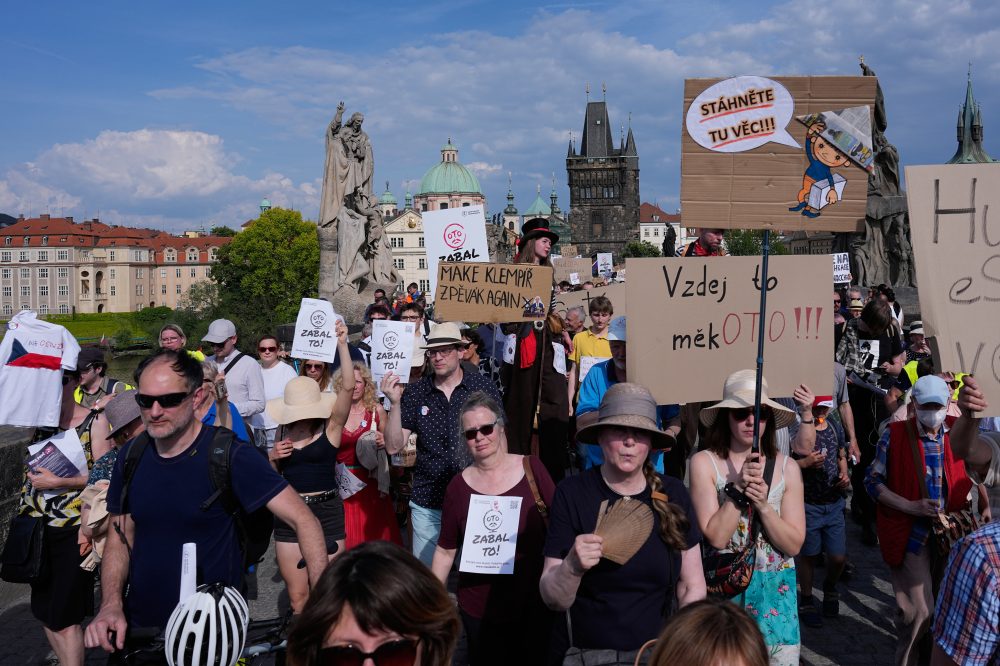

PRAGUE (AP) — Employees at Czech public radio, including journalists and other staff members, formed a human chain around the broadcaster’s Prague headquarters on Monday as part of a 24-hour warning strike aimed at pushing back against a government proposal to restructure how public media is funded.
The proposal, put forward by the government of populist Prime Minister Andrej Babiš, has sparked widespread concern about the potential erosion of media independence in the country.
Under the plan, which the government approved last week, public radio and television would no longer be supported through fees collected from individuals, households, and businesses. Instead, both broadcasters would receive their funding directly from the state budget beginning next year.
Opponents of the change argue it would hand the three-party coalition government significant leverage over public media outlets. They point to similar situations in neighboring countries, drawing comparisons to the influence populist governments have exerted over media in Slovakia under Prime Minister Robert Fico and in Hungary under former Prime Minister Viktor Orbán.
The financial impact would also be considerable. According to the proposal, public broadcasters would see their funding cut by roughly 15% this year. The heads of both public radio and television warned that such a reduction would force them to lay off hundreds of employees, scale back production, and cancel programming.
Protesters dressed in black as they stood shoulder to shoulder outside the radio station’s building, symbolically forming a barrier to defend its independence. Some broadcasts were delayed by a minute during the action, and the station’s online and social media activity was scaled back as part of the demonstration.
Strike organizers indicated that additional actions are being planned, though they did not provide specific details about what those next steps might involve.