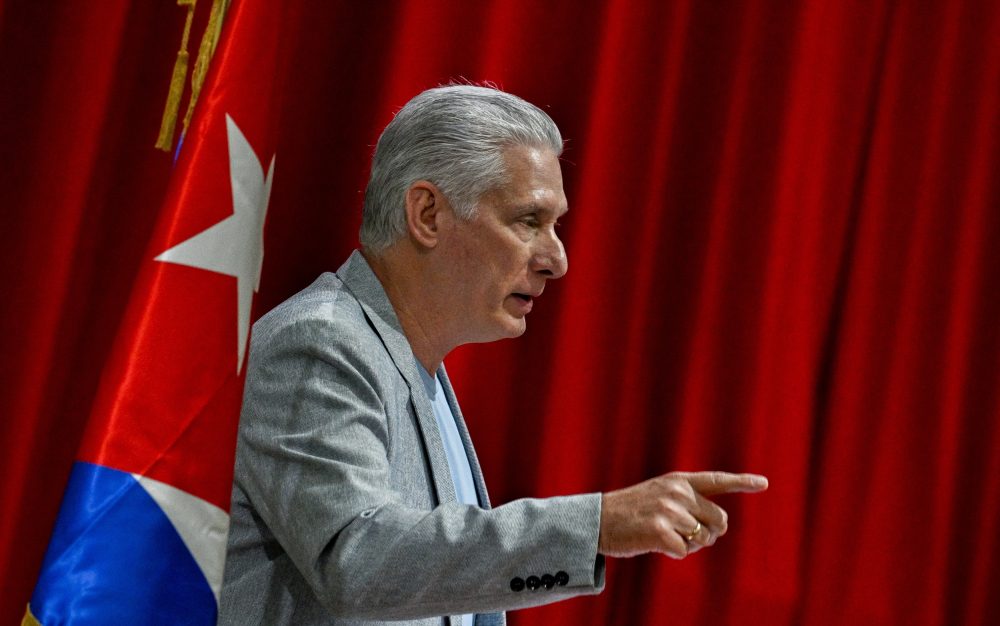

Cuban President Miguel Díaz-Canel issued a stern warning to the United States, stating there would be no legitimate grounds for military intervention against his nation or efforts to remove him from office.
During an appearance on NBC News’ Meet the Press, Díaz-Canel emphasized that any invasion would prove expensive and destabilize the region. However, he made clear that his people would resist any such action.
“If the time comes, I don’t think there would be any justification for the United States to launch a military aggression against Cuba, or for the U.S. to undertake a surgical operation or the kidnapping of a president,” Díaz-Canel stated through an interpreter.
The Cuban leader went further, declaring: “If that happens, there will be fighting, and there will be a struggle, and we will defend ourselves, and if we need to die, we’ll die, because as our national anthem says, ‘Dying for the homeland is to live’.”
These remarks surface amid ongoing strain between the two countries, though both nations have confirmed discussions are taking place without revealing specifics.
Díaz-Canel has criticized what he calls America’s “hostile policy” toward Cuba and claimed the U.S. lacks “moral authority to demand anything from Cuba.” He expressed Cuba’s willingness to participate in unconditional talks on any subject, “not demanding changes from our political system as we are not demanding change from the American system, about which we have a number of doubts.”
The island nation attributes its mounting difficulties to what it describes as an American energy embargo, with fuel shortages impacting healthcare, public transit, and the production of essential goods and services.
Cuba generates merely 40% of its required fuel supply and lost crucial oil deliveries from Venezuela following a U.S. military operation in early January that resulted in the capture of President Nicolás Maduro, who was transported to New York to face drug trafficking accusations. Subsequently, with assistance from Venezuelan political leaders, the Trump administration initiated a gradual plan to address Venezuela’s ongoing crisis.
A Russian vessel delivered 730,000 barrels of crude oil to Cuba in March, representing the nation’s first petroleum shipment in three months. Russia has committed to sending an additional tanker.
Although the Trump administration threatened tariffs in January against nations selling or supplying oil to Cuba, officials permitted the Russian tanker to proceed.
“Cuba’s finished,” President Donald Trump declared at that time. “They have a bad regime. They have very bad and corrupt leadership and whether or not they get a boat of oil, it’s not going to matter.”
Díaz-Canel indicated his administration interprets Trump’s statements as a threat.
“You hear that Cuba is next, that Cuba is going to be next, that there are, there’s a way out, that they’re going to take over Cuba,” he explained. “So, from the position of responsibility within the leadership of the country, that is a warning. And we need to responsibly protect our people, protect our project and protect our country.”