
CARACAS – Cuban security personnel and medical staff are withdrawing from Venezuela as the nation’s interim leadership confronts escalating demands from Washington to dissolve one of Latin America’s most significant leftist partnerships, according to eleven sources with knowledge of the situation.
Interim President Delcy Rodriguez has shifted to Venezuelan bodyguards for her personal security, four sources confirm, breaking from the pattern established by ousted leader Nicolas Maduro and his predecessor Hugo Chavez, who both depended on elite Cuban protection forces.
The January 3 U.S. military operation that resulted in Maduro’s capture claimed the lives of 32 Cubans, the Cuban government reported. These personnel were integral to an extensive security partnership between Caracas and Havana that took shape in the late 2000s, with Cuban intelligence operatives integrated into Venezuela’s military structure and the powerful DGCIM counterintelligence agency, which played a crucial role in suppressing internal opposition.
Alejandro Velasco, a New York University history professor specializing in Venezuelan affairs, emphasized the significance of this relationship: “The Cuban influence was absolutely essential” to the survival of the Chavista government.
Within DGCIM, certain Cuban advisers have been dismissed from their positions, a former Venezuelan intelligence official revealed. Multiple sources indicated that Cuban medical personnel and security consultants have departed Venezuela for Cuba on recent flights.
A source connected to Venezuela’s governing party indicated the Cubans are leaving under Rodriguez’s directive due to American pressure. Other sources remained uncertain whether the departures resulted from Venezuelan leadership demands, voluntary Cuban decisions, or recall orders from Havana.
This move to exclude Cubans from presidential protection and counterintelligence operations has not been publicly disclosed before.
TRUMP SEEKS TO END VENEZUELA-CUBA ALLIANCE
Before the operation removing Maduro, thousands of Cuban healthcare workers, nurses, and athletic instructors served in Venezuela through social programs initiated under Chavez. Venezuela reciprocated by supplying Cuba with essential oil resources.
After the U.S. intervention, President Donald Trump pledged to terminate the security partnership between Venezuela and Cuba. On January 11, he posted on Truth Social: “Cuba lived, for many years, on large amounts of OIL and MONEY from Venezuela. In return, Cuba provided ‘Security Services’ for the last two Venezuelan dictators, BUT NOT ANYMORE!”
When asked about U.S. pressure on Venezuela to sever Cuban ties, a White House representative stated the U.S. maintains “a very good relationship with the leaders of Venezuela” and believes Rodriguez’s “own self-interest aligns with advancing our key objectives.”
Breaking Venezuela’s Cuban connection forms part of Washington’s comprehensive approach to undermining Havana’s communist administration. Since mid-December, Washington has prevented Venezuela from delivering oil to Cuba, creating severe economic hardship for the island nation.
The U.S. government is “talking to Cuba, whose leaders should make a deal,” the official stated.
Cuban leadership has expressed willingness for dialogue on equal footing while denouncing the oil embargo and pledging to resist American interference.
Both Cuban and Venezuelan governments declined to respond to comment requests. The nations have publicly reaffirmed their ongoing partnership.
Rodriguez, whose father was a former Marxist revolutionary, has maintained long-standing ties with Maduro and membership in Venezuela’s ruling Socialist Party. She also maintains personal connections with Cuban leadership, ten U.S. and Venezuelan sources confirmed.
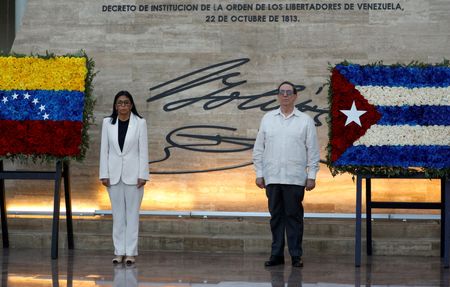
On January 8, Rodriguez joined Cuban Foreign Minister Bruno Rodriguez at a flower-covered memorial ceremony in Caracas honoring victims of the U.S. operation.
Bruno Rodriguez declared at the gathering: “To the brave Venezuelan people, we express Cuba’s deepest solidarity,” before invoking the famous words of Cuban revolutionary Ernesto “Che” Guevara: “Hasta la victoria siempre.”
Later that month, Delcy Rodriguez conducted a phone conversation with Cuban President Miguel Diaz-Canel, afterward stating the nations remained “united.” Following the same call, Diaz-Canel expressed Cuba’s commitment to “continue strengthening the historic relations of brotherhood and cooperation.”
Addressing the bilateral relationship, the White House official commented: “President Trump understands that they have to make certain statements for domestic political reasons.”
RETURN FLIGHTS TO CUBA
A source knowledgeable about Cuban government perspectives revealed that some military personnel wounded in the U.S. operation have returned to Cuba, while others continue serving in Venezuela. The source also noted that numerous Cuban physicians remain active in Venezuelan healthcare.
Cuban state media reported in early January that suspended commercial flights and closed Venezuelan airspace created delays preventing Cuba from repatriating doctors from leave or completing their Venezuelan assignments. These flights restarted the week following the January 3 U.S. operation, according to those reports.
A U.S. source familiar with developments indicated that while Cuban presence is decreasing, some covert intelligence operatives likely remain to monitor the evolving political landscape.
Frank Mora, who served as U.S. ambassador to the Organization of American States during the Biden presidency, observed that “Rodriguez is treading very carefully.”
“She wants to keep the Cubans at a distance until this situation calms down, until her hold on power is clear, but not entirely throw them under the bus, either,” Mora explained.
At least some Cuban military consultants continue operating in Venezuela, four informed sources confirmed. Cuban educators also maintain their teaching roles at UNES, the state university for police and security personnel, according to a former police officer.
John Polga-Hecimovich, a U.S. Naval Academy professor in Maryland who has researched Cuban security advisers’ role in Venezuela, noted that the impact of Cuban counterintelligence efforts remains visible in Caracas, where Maduro’s key supporters retain power.
Polga-Hecimovich observed: “The Cubans didn’t manage to protect Maduro, but they played a key role in keeping the Chavista government in power. The coup-proofing worked brilliantly.”