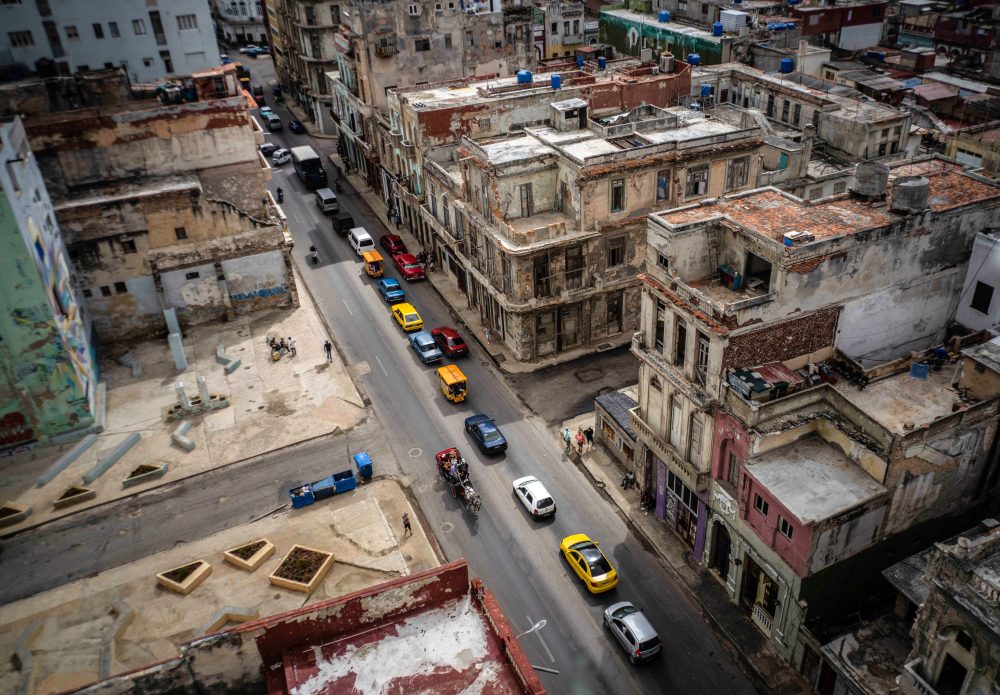

HAVANA (AP) — Cuban authorities have introduced the capital city’s initial pair of modular housing units constructed from converted shipping containers, marking a significant development in a metropolis where formerly grand buildings are falling apart.
This weekend, government leaders including President Miguel Díaz-Canel assembled to present the residences to two single mothers: one woman had resided in a shelter for over a decade, while the other was living in just one room with her two teenage children, state media reported.
According to media accounts, construction teams completed the dwellings within a month using leftover materials from tourism development projects, technology created by Cuba’s Revolutionary Armed Forces, and containers that had previously transported solar panel components from China.
On Saturday, authorities announced that Cuba faces a shortage of more than 800,000 housing units, with Havana experiencing the most urgent crisis.
Twenty-nine-year-old beautician Yurieska Artunet Martí, who resides in Havana’s historic district, was compelled to relocate from her previous apartment when it deteriorated completely. She continues to occupy the same building and floor, but now lives in the rear section that remains upright — at least temporarily.
“Everybody here in Havana lives in fear,” she said as she looked up at her rotting ceiling and disintegrating walls. They shelter Artunet Martí, who is four-months pregnant, and her three children, ages 7 months, 1 and 5.
Wall plaster drops onto their sleeping area during the night, she explained.
Artunet Martí lacks the financial means to relocate. Two months prior, she was compelled to shut down the beauty salon she operated from her residence, where customers had to navigate deteriorating stairs, avoid broken wood, and step around a large opening where an elevator previously functioned.
“People stopped coming because of the building’s condition,” she said.
The celebrated residences in Old Havana, featuring architectural styles from Spanish Colonial to Cuban Baroque, are notorious for collapsing, particularly following heavy rainfall, occasionally resulting in fatalities among residents.
Statistics from the government in 2020 revealed that the island nation of approximately 10 million inhabitants possessed 3.9 million residences, with almost 40% rated as fair or poor quality. Insufficient upkeep, severe economic difficulties, and harsh weather conditions are responsible.
The upper levels of Artunet Martí’s building remain vacant; all residents were relocated to shelters for their protection.
“What are we going to do?” she said. “We know we’re in danger, but we have to accept reality.”
In a different section of historic Havana, 60-year-old Carlos Sablón described how part of his building’s third level caved in during nighttime hours. Sablón was viewing television when it occurred but recognized what had transpired.
“It’s quite damaged by time,” he said of the building’s infrastructure as he looked out his second-story window and onto a tiny, crumbling courtyard.
The third floor was unoccupied during the collapse, but emergency responders evacuated all other tenants. Without means to afford alternative housing, Sablón, an engineer, returned to his unit. Since it remained undamaged, he restored electricity and water service for himself and several other residents who remained.
“You’re always going to be afraid,” he said as he lamented that no one ensures the safety of homes in Havana.
“This is the one I fear the most,” Sablón said of his apartment building, which he believes will keep collapsing. “I hope it’s not when someone is walking by.”
A few blocks from Sablón’s location lives 63-year-old Magalys Caro. She remains restricted to one room, an improvised kitchen area, and a bathroom in her building’s front portion. She previously inhabited a company building that allowed her to move in after her adjacent home was destroyed during a hurricane.
However, her current residence also presents dangers.
“The back there has collapsed,” Caro said as she pointed to a spacious, open-air area behind her.
“I’ve been living here in these poor conditions for about 10 years,” Caro said. “Nothing gets resolved. The Housing Department does nothing.”
During Saturday’s ceremony revealing Havana’s initial two modular residences, Cuban Prime Minister Manuel Marrero Cruz recognized that the shipping container conversion program could be accelerated.
“It is not moving at the desired pace,” he said, adding that the work is underway.
Delilah Díaz Fernández, housing director general at Cuba’s Ministry of Construction, announced that over 2,000 containers designated for residential conversion have received approval, with approximately 700 currently undergoing transformation.
“The program … holds immense potential and is here to stay,” she said, adding that as new containers arrive, they will be considered for eventual housing.
According to Díaz Fernández, the program will primarily benefit individuals who lost their residences due to severe weather or structural failures.