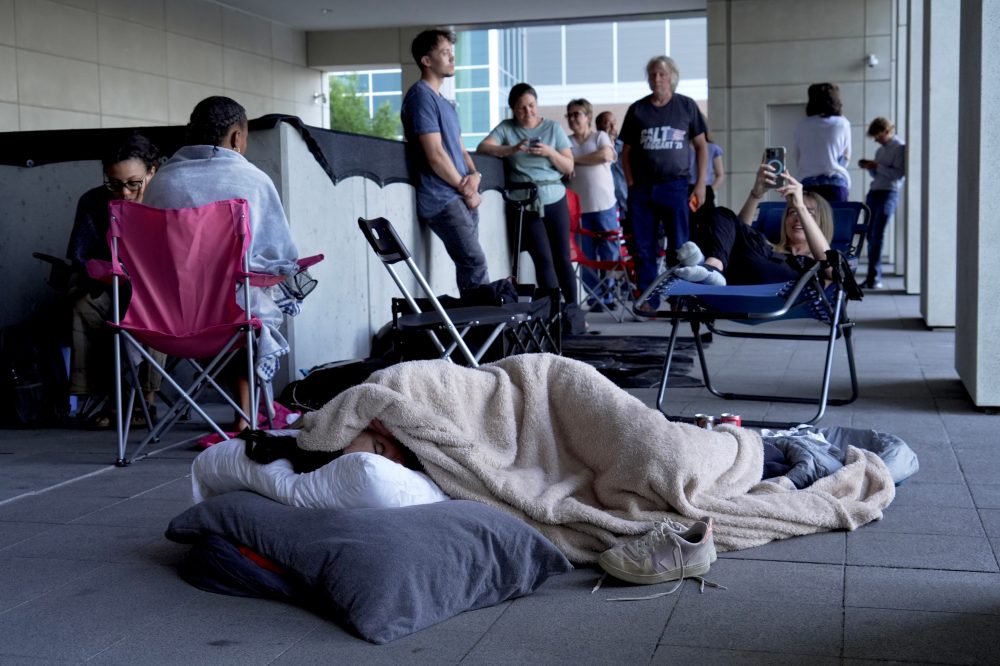

PROVO, Utah — Folding chairs, sleeping pads, and blankets have become a familiar sight outside a Utah courthouse each morning, as people line up — sometimes through the night — hoping to secure one of just 14 public seats inside a courtroom where a preliminary hearing is underway for the man accused of killing conservative activist Charlie Kirk.
The hearing for defendant Tyler Robinson has drawn intense national attention and even significant interest from abroad. Continuous livestreams and round-the-clock media coverage have stoked public curiosity, driving spectators to compete fiercely for the limited courtroom access available on a first-come, first-served basis.
The proceeding is expected to conclude Friday. At that point, State District Judge Tony Graf will determine whether prosecutors have presented sufficient evidence to send Robinson to trial on a charge of aggravated murder.
On Thursday morning, Chris Palmer, the court’s director of security, announced that people would no longer be permitted to bring tents or camping gear to the courthouse steps. He also made clear that cutting in line or holding spots for others would not be allowed.
Rules inside the courtroom go beyond basic decorum. Palmer addressed those waiting outside, saying the people attending the hearing deserve to feel comfortable. “These people come here to get justice,” he said. “They don’t need to feel like they’re under a microscope when somebody’s sitting behind them or ahead of them.”
Each morning, sheriff’s deputies and court staff distribute wristbands amid what can only be described as organized disorder. Reporters and bloggers position themselves near the entrances, phones ready, hoping to capture the arrival of Kirk’s family, Robinson’s family, or notable figures such as Donald Trump Jr.
Earlier in the week, court officials announced that wristbands for public seating would be individually labeled after security found that some individuals had purchased matching colored wristbands in an attempt to sneak inside.
Joshua Carr, a local man who described himself as an independent journalist, was first in line Thursday. A friend had arrived at 9 p.m. the previous evening to hold his place until Carr showed up at 2:30 a.m. Carr said he has been following the case and the conspiracy theories surrounding it for several months.
“Being in the courtroom is a different thing because you’re able to actually feel the emotions, see the expressions on people’s faces that aren’t shown in the public feed,” Carr said.
Billie Webb traveled from Salt Lake City to attend. She has followed the investigation since Kirk was shot on September 10 and has been present at earlier hearings on motions filed by both prosecutors and defense attorneys. Webb arrived at 5 a.m. Wednesday and found herself eighth in line, but the afternoon start time meant she still made it inside. On Thursday, despite arriving at 3 a.m., she missed the cutoff — but said she was “absolutely determined” to get in on Friday.
Among the things drawing Webb’s interest was a recorded law enforcement interview with Robinson’s roommate and romantic partner, Lance Twiggs. Attorneys spent much of Wednesday debating whether that recording should be made public.
Webb said she also intends to be present if the case advances to trial. “If I have to camp for 24 hours, I will,” she said.
Massive public and media interest in high-profile court cases is not a new phenomenon. It is typically driven by celebrity, politics, race, or the sensational nature of the crime itself.
One early example dates back to 1935, when a New Jersey trial for the man charged with kidnapping and killing the infant child of legendary aviator Charles Lindbergh drew enormous crowds and press coverage. Decades later, the O.J. Simpson double murder trial in the 1990s became so widely followed it was dubbed the “Trial of the Century.”
More recently, large public gatherings and media attention surrounded the 2021 trial of Derek Chauvin, the former police officer convicted and sentenced to more than 20 years in prison for the death of George Floyd in Minneapolis. That same year, lines formed outside a Manhattan federal courthouse for the trial of British socialite Ghislaine Maxwell, who was ultimately convicted of recruiting teenage girls to be sexually abused by American millionaire Jeffrey Epstein.