
SAN DIEGO — A putrid odor resembling rotten eggs fills Steve Egger’s Southern California residence, particularly during nighttime hours when the contaminated Tijuana River churns with Mexican sewage before flowing into the Pacific.
The 72-year-old resident reports that he and his spouse experience recurring headaches and wake up with congestion while coughing up mucus. Their residence features medical-grade air filtration that refreshes the atmosphere every quarter hour.
Even with these precautions, “most nights we breathe in a horrible stench,” he explained. “It’s awful.”
According to the International Boundary and Water Commission, over 100 billion gallons of untreated waste containing industrial toxins and debris have flowed through the Tijuana River since 2018. This waterway crosses territory where three generations of Egger’s family previously operated a dairy farm. Last year, both nations reached an accord to address this persistent issue by modernizing sewage treatment facilities to handle Tijuana’s expanding population and factory discharge from numerous American-owned manufacturing plants.
Meanwhile, tens of thousands of residents face exposure to this contamination. During a February trip to San Diego, Environmental Protection Agency Administrator Lee Zeldin stated that resolving this severe and prolonged environmental disaster affecting a predominantly low-income Latino community will require approximately two years.
Untreated waste creates more than just offensive odors. It releases hydrogen sulfide, a dangerous gas capable of damaging nasal neurons and triggering asthma episodes. According to the Centers for Disease Control and Prevention, it can produce headaches, nausea, confusion, trembling, coughing, breathing difficulties, skin and eye inflammation, and potentially death. Scientists are just beginning to comprehend its lasting health consequences.
No federal safety guidelines exist for hydrogen sulfide exposure except for employees at high-risk locations like sewage facilities or livestock waste areas. Several states established standards years ago, but these regulations are obsolete. A California legislative proposal would update the state’s 56-year-old guidelines to address current health concerns. Texas legislators are similarly considering revising their regulations.
“I think when you look back when the standard was first established and then it was reviewed, it was all about nuisance — basically it was all about odor,” explained Democratic Sen. Steve Padilla, who represents the Tijuana River Valley and authored the California legislation. “I don’t think we had the understanding scientifically of what the health impacts were here, and now we do.”
Should the legislation succeed, new standards would likely not take effect until 2030.
Egger’s property displays a “Stop the Stink” placard, part of Citizens for Coastal Conservancy’s initiative demanding officials address the international sewage problem.
The 120-mile waterway originates in Tijuana, Mexico, enters California, and flows into the ocean. Nearby San Diego County shorelines have remained closed for years, and Navy SEALs conducting training exercises in these waters have become ill.
Since January alone, the Tijuana River has transported 10 billion gallons of primarily raw waste and industrial pollutants into the United States, according to International Water and Boundary Commission records. For perspective, a major pipeline break in January released 244 million gallons of untreated sewage into the Potomac River, impacting wealthy, predominantly white neighborhoods. Federal authorities responded to that incident within weeks.
A 2024 study conducted by San Diego County and the CDC covering approximately 40,000 households near the Tijuana River revealed that 71% could detect sewage odors inside their homes, while 69% had at least one family member become ill from exposure.
Even at minimal concentrations, “you’re going to feel like it’s in your sinuses. You can’t get rid of the smell. It’s going to be a constant irritation,” stated Ryan Sinclair, an associate professor of environmental microbiology at Loma Linda University School of Public Health.
The EPA reports it is collaborating with local and state authorities to identify odor reduction methods.
San Diego County distributed more than 10,000 air purifiers to residences this year. However, atmospheric contamination persists. The river’s foam has become visible from satellite imagery.
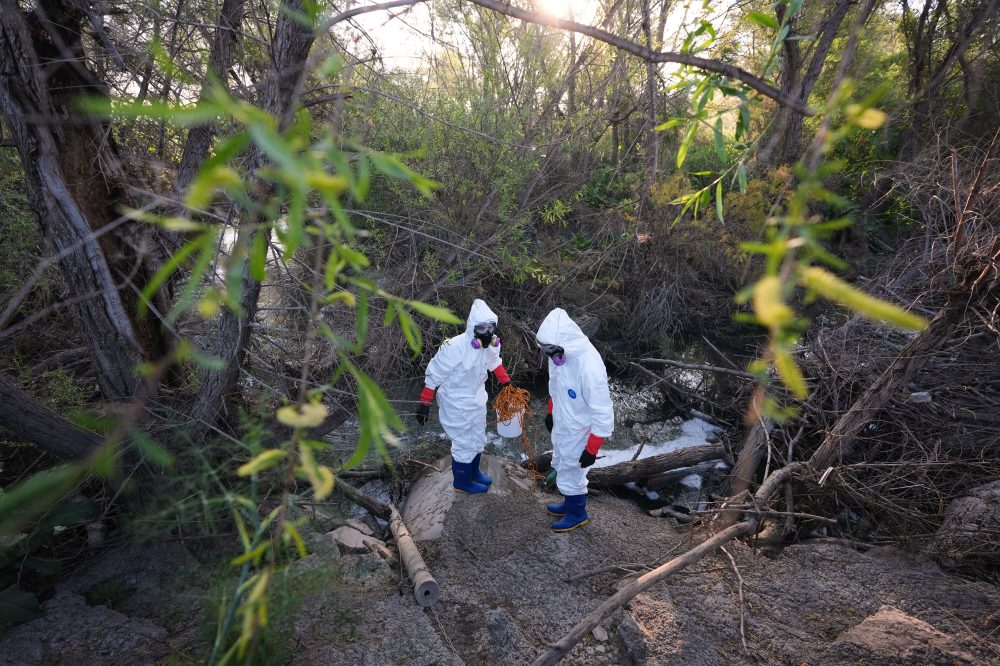
In September 2024, University of California, San Diego chemistry professor Kimberly Prather and her research team installed atmospheric monitoring equipment in Egger’s neighborhood.
Their discoveries were shocking: Hydrogen sulfide levels reached 4,500 times normal urban concentrations and 150 times California’s air quality standards during peak nighttime river flows.
Numerous residents, including Egger, felt their concerns were finally validated.
“They’d been being more or less gaslit and told, ‘There’s gas. It’s a nuisance. It smells, but it’s not bad,’” Prather explained.
Her research team has since identified thousands of additional gases emanating from the river that are odorless “and many of them are more toxic.”
Egger reports that physicians have recommended relocation, though they haven’t provided written confirmation of hydrogen sulfide poisoning.
However, his family’s connection to the area runs deep. His spouse was raised in Tijuana. His brother and deceased brother’s family occupy adjacent properties on the former Egger Dairy grounds. The deteriorating milk barn and corroded farm machinery remain nearby.
“This is where I’ve lived all my life, with my family, my parents, my grandparents,” he stated. “This is home.”
During Egger’s childhood, he swam in the river that only flowed during rainy periods. Now primarily filled with sewage and industrial contamination, it runs continuously. He advocates restoring the river to its original path, which would place it closer to the border and farther from residential areas and schools. He believes this would prevent pooling that creates hydrogen sulfide concentration zones.
Less than half a mile from Egger’s residence, the odor becomes overwhelming where the river emerges from underground pipes near Saturn Boulevard.
Researchers refer to this location as “the Saturn hot spot.” The stench penetrates closed vehicles and remains inside for days.
Dr. Matthew Dickson and his wife, Dr. Kimberly Dickson, operate a medical practice approximately one mile from this contamination zone. Many patients experience migraines, nausea, wheezing, eye infections, and mental confusion. Asthma sufferers report increased inhaler usage when outdoor air quality deteriorates.
“They’d say, ‘You know, I feel better when it doesn’t smell outside,’” Dr. Kimberly Dickson noted.
Following a tropical storm in August 2023 that caused river overflow onto roadways, the physicians’ patient loads increased threefold within days.
Digital medical records validated the doctors’ suspicions. When river flow volumes spike, respiratory illness cases increase by 130%, they reported.
“Every day that this isn’t fixed,” Dr. Matthew Dickson emphasized, “more people are getting sick.”