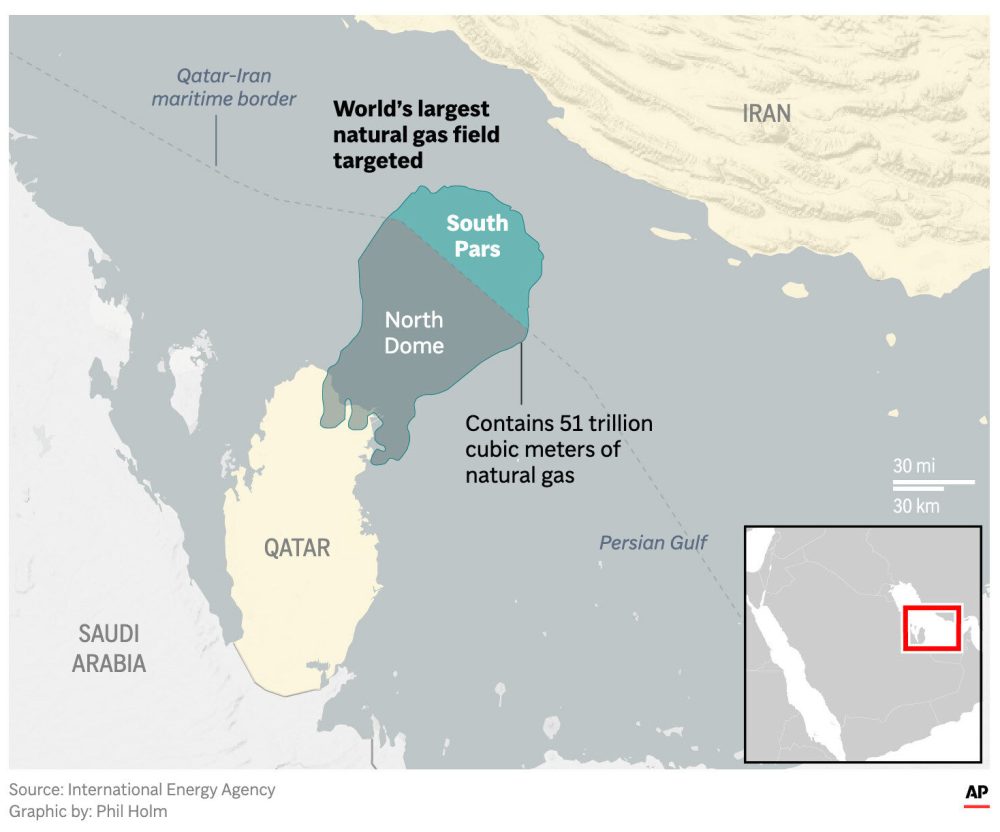

FRANKFURT, Germany — A crucial Iranian natural gas facility that suffered an attack earlier this week serves as a vital energy source for the nation and represents part of the globe’s most extensive gas field complex.
Following Israel’s strike on the South Pars facility, Iran launched counter-attacks against energy installations throughout the Middle East, creating fresh turbulence across the region and international markets.
The ongoing Iranian conflict has delivered severe energy disruptions to worldwide markets by blocking most crude oil and liquefied natural gas shipments through the Strait of Hormuz. Tehran has also launched strikes against vessels and critical export terminals belonging to Persian Gulf neighbors, driving energy costs higher despite these nations — including Saudi Arabia, Qatar, Oman, Iraq and the United Arab Emirates — remaining uninvolved in U.S.-Israeli operations against Iran.
Following Wednesday’s assault, President Donald Trump announced Israel would refrain from future South Pars attacks, while cautioning through social media that continued Iranian strikes on Qatar’s energy systems would prompt U.S. retaliation to “massively blow up the entirety” of the field.
Regarding South Pars specifically, the focus centers not on Iranian exports but rather the nation’s primary domestic energy supply in a country that frequently faces electricity generation challenges.
This Persian Gulf gas field — the planet’s largest — spans both Iranian and Qatari territories. Iranians call their portion South Pars while Qataris refer to their section as the North Field.
Key details about the South Pars installation:
Tehran depends extensively on natural gas for electricity generation and residential heating. Despite having a significantly smaller economy, Iran ranks as the world’s fourth-largest natural gas consumer, trailing only the United States, China and Russia, according to Columbia University’s Center on Global Energy Policy.
Unlike neighboring Middle Eastern nations, Iran utilizes gas for heating purposes due to colder weather conditions, with much consumption receiving government subsidies that discourage conservation efforts. South Pars provides the primary supply.
While South Pars primarily serves Iranian domestic requirements, global oil costs increased and European gas prices surged following news of the attack — largely due to concerns about Iranian counter-strikes on Gulf energy infrastructure. The assault represented “a serious escalation” given potential Iranian retaliation threats, stated Andres Cala, a geopolitical analyst with energy intelligence company Montel News.
Iran has experienced electrical shortages from gas supply disruptions despite possessing substantial energy reserves on paper. During July, government buildings closed when extreme heat overwhelmed the power system.
However, both nations have utilized the shared underground reserves quite differently.
Qatar, with its much smaller population, has invested billions developing the field for liquefied natural gas production, which it exported from the Ras Laffan facility before the conflict began. At that location, gas undergoes cooling to liquid form before loading onto tankers bound for Asian customers who convert it back to gas. This profitable operation has established Qatar as supplier of approximately one-fifth of global LNG.
Ras Laffan ceased operations March 2 following an Iranian attack and sustained another strike Thursday. Damage extent remains uncertain, but the closure and assault have driven up natural gas prices across Asia and Europe.
Thursday’s strikes represented part of “a dangerous escalation” in the conflict and “a grim warning” for LNG markets, according to data and analytics company Energy Intelligence.
Iran presents a different situation. Sanctions and insufficient investment mean Iran channels its gas through domestic pipeline networks for cooking, home heating, electricity production, and industrial raw materials. Iranian exports remain relatively modest at approximately 9 billion cubic meters compared to Qatar’s exceeding 120 billion cubic meters. Iran’s export destinations include Turkey and Armenia, both capable of securing alternative supplies.
Iran previously planned three LNG export facilities along its Persian Gulf coast, including partnerships with Total Energies and Shell. However, nuclear program sanctions have blocked these projects by preventing necessary technology imports and investment. A third facility at Asulayeh — located near the attack site — reportedly nears completion after beginning construction nearly two decades ago.