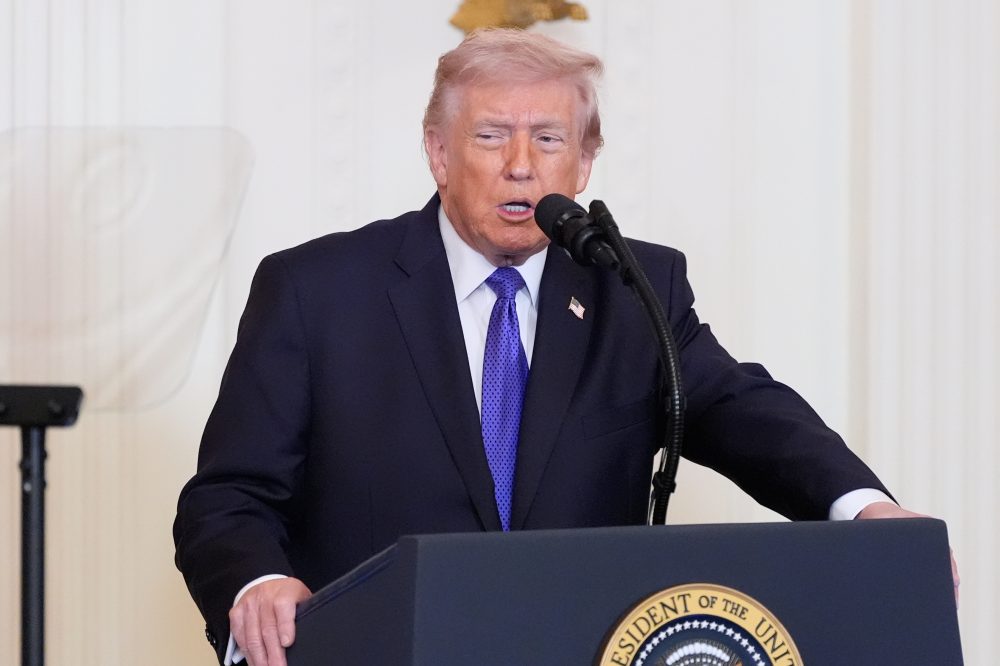

Throughout Donald Trump’s second term in office, lawmakers have repeatedly challenged his military decision-making authority, beginning with actions in Latin America and now extending to Middle Eastern operations.
The Republican-led House will face another critical vote on Thursday following the Senate’s rejection of a Democratic proposal aimed at constraining Trump’s authority in the ongoing U.S.-Israeli conflict with Iran.
Similar to many of his predecessors, Trump asserts extensive, nearly unrestricted command over American military forces. His administration has sanctioned naval strikes in Venezuelan waters, implemented maritime blockades, and greenlit military missions targeting Venezuelan leader Nicolás Maduro’s removal from power — actions that could constitute acts of war under international standards. Before launching extensive bombing operations in Iran, he also suggested potential military involvement in Greenland and other Latin American regions.
While the Constitution designates the president as military commander, it also establishes congressional oversight responsibilities. Trump has declared he will not approve any legislation that restricts his military options — evidence that some scholars believe demonstrates how civilian military control has shifted from its constitutional foundation.
Military historian Peter Mansoor, a retired U.S. Army colonel and Ohio State University professor, explained the constitutional framework: “The Constitution gives war powers to two different branches of government.” He expressed concern that “the pendulum has swung towards the executive,” noting that “the framers meant for Congress to be the most powerful branch.”
Constitutional provisions regarding military authority are clearly outlined in two key articles. Article I grants Congress the power “to declare war,” while Article II designates the president as “commander in chief of the Army and Navy.” Additionally, Congress maintains control over military funding.
Since World War II, Congress has not issued any formal war declarations. However, American military personnel have engaged in major combat operations in Korea, Vietnam, Iraq, and Afghanistan, among other locations, resulting in casualties and deaths since 1945.
During the Venezuelan operation, an Army pilot sustained injuries, prompting Trump to present him with the Medal of Honor — an award legally reserved for combat actions against foreign adversaries. As of Wednesday, the Iranian conflict has claimed six American service members’ lives.
During last month’s Senate discussions about Venezuela, Senator Rand Paul of Kentucky criticized what he called an “elaborate song and dance” and declared it “an absurdity” to suggest Trump’s military actions constituted anything less than warfare.
Virginia Democrat Senator Tim Kaine, who introduced both Venezuelan and Iranian war powers measures, described his latest proposal — which was defeated 47-53 — as preventing presidential attempts to circumvent constitutional requirements.
Throughout American history, Congress has formally declared war against 11 nations across five separate conflicts. The 19th century saw three declarations, World War I prompted two, and World War II generated six. In each instance, presidents formally requested congressional action, typically following direct attacks on American interests or territory.
Even President James K. Polk sought congressional approval for the Mexican War, despite its primary purpose being territorial expansion.
During this same historical period, Congress frequently authorized military force without formal war declarations. Early authorizations typically covered specific naval operations protecting American commercial activities. This approach, first used in 1798, became the standard framework for post-World War II military engagements.
President Harry Truman inherited World War II victory under declarations issued during Franklin Roosevelt’s administration. In 1950, when the newly formed United Nations called for intervention in Korea and requested member nation assistance, Truman deployed American forces in what he termed a “police action” without seeking congressional permission. Congress subsequently approved the Defense Production Act that year to support war mobilization efforts, essentially endorsing Truman’s decision retroactively. This legislation remains available for Pentagon use today.
The conflict known historically as the “Vietnam War” — though often labeled “the Vietnam conflict” by administrations expanding Southeast Asian operations — spanned presidencies from Dwight Eisenhower through Gerald Ford.
Lyndon Johnson convinced Congress to approve the Gulf of Tonkin Resolution in 1964, using this authorization to escalate American involvement significantly.
Despite growing casualties and declining public support, Johnson and successor Richard Nixon maintained broad congressional authority. The 1964 resolution stated: “Congress approves and supports the determination of the President, as Commander-in-Chief, to repel any armed attack against the forces of the United States and to prevent further aggression.”
Although Congress revoked this measure in 1971, Nixon continued military operations without withdrawal.
According to Mansoor, formal war declarations serve purposes beyond initiating conflicts. They also establish official endings — requiring Senate ratification of peace treaties. Avoiding these legal parameters, he explained, creates conditions for “forever wars.”
As America struggled toward its Vietnam exit in 1973, Congress enacted the War Powers Resolution, designed to establish presidential constraints by mandating communication with lawmakers and enabling congressional votes on military action parameters. This legislation provided the framework for this year’s unsuccessful Venezuelan resolutions and Iranian measures.
In 2020, the Democratic-controlled House narrowly passed legislation intended to limit Trump’s Iranian military authority at that time. However, the War Powers Resolution has proven ineffective as a practical check on executive power.
Ronald Reagan deployed troops to Lebanon in 1982 as part of an international peacekeeping mission. He did not reference the War Powers Resolution when informing Congress and delayed seeking congressional authorization until 1983 — after military casualties had already occurred.
In 1990, George H.W. Bush informed Congress under War Powers Resolution provisions that he had sent troops to the Middle East following Iraq’s Kuwait invasion. Bush requested congressional “support” rather than “authorization” only after securing United Nations approval for international coalition action led by American forces. Congress authorized military force in January 1991.
Bill Clinton deployed American troops repeatedly — to Somalia, Haiti, Rwanda, Bosnia and Herzegovina, Kosovo, and Iraq. He sought congressional funding but not explicit authorizations. When lawmakers pressured Clinton to seek approval for 1998 Iraqi strikes, he asserted presidential authority interpretations similar to Trump’s current arguments.
George W. Bush rapidly mobilized military forces following the September 11, 2001 terrorist attacks. After quick congressional consultation, lawmakers passed a joint resolution authorizing comprehensive action. This unique measure targeted no specific country initially and focused on al-Qaida. Congress supported the measure almost unanimously while requesting reports every 60 days.
Military historian Mansoor observed that Bush used this authorization to conduct anti-terrorism operations globally. Bush returned to Congress in 2002, requesting authorization for Iraqi action.
The congressional authorization Bush received contained no expiration date. His successor, Barack Obama, inherited Iraqi troops and initially maintained their presence. Afghan operations continued through Obama’s two terms, Trump’s first presidency, and into Joe Biden’s administration.
Biden ultimately withdrew American forces from Afghanistan, ending what had become the nation’s longest undeclared war in American history.