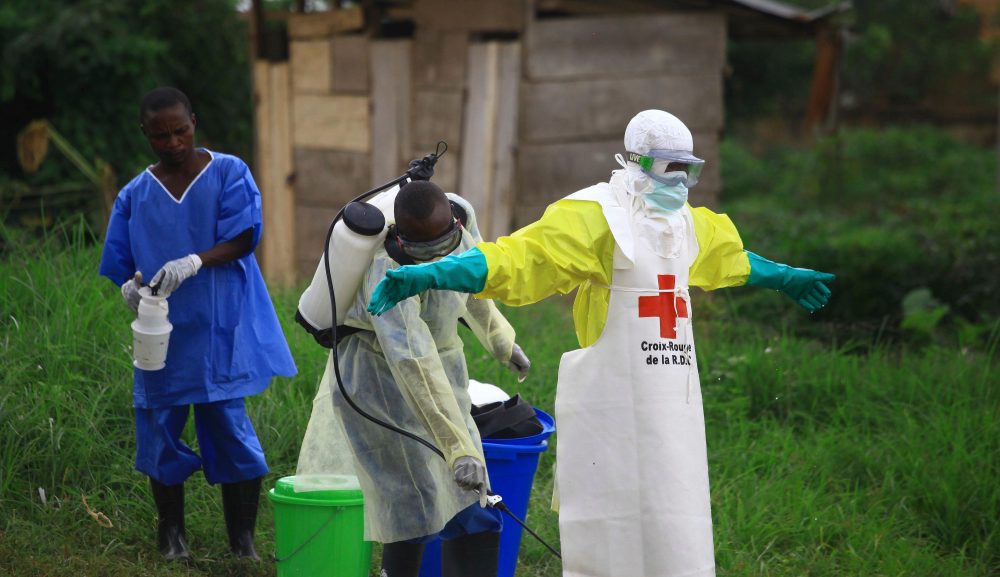

Continental health authorities have verified a fresh Ebola outbreak in the Ituri province of Congo.
The Africa Centres for Disease Control and Prevention announced Friday that 246 suspected cases and 65 fatalities have been documented in this latest outbreak.
The majority of suspected Ebola cases have been identified in Ituri’s Mongwalu and Rwampara health zones. Additional suspected cases have emerged in Bunia, which serves as Ituri province’s capital.
While only four deaths have received laboratory confirmation, health officials declared the new outbreak following numerous suspected cases.
Ituri sits in Congo’s remote eastern region with inadequate road infrastructure, positioned over 1,000 kilometers (620 miles) from Kinshasa, the country’s capital.
The Africa CDC highlighted a significant worry regarding the closeness of impacted regions to Uganda and South Sudan. Bunia, Ituri’s primary urban center, sits close to Uganda’s border.
The organization noted additional spread risks from heavy population movement, mining-related travel, and ongoing security problems in affected regions. Armed group attacks have resulted in dozens of deaths and displaced thousands throughout portions of Ituri province over the past year.
Contact tracing efforts face significant gaps, according to the Africa CDC, as regional officials work urgently to locate individuals potentially exposed to the virus.
The Africa CDC announced it has begun collaborating with national officials and partners to facilitate a “rapid, coordinated response.”
The agency organized an emergency high-level coordination meeting Friday involving health officials from Congo, Uganda and South Sudan, along with essential partners including U.N. agencies and other nations.
The gathering will address immediate response priorities, cross-border coordination, surveillance, safe and dignified burials and resource mobilization, among other critical areas, according to the agency.
Congo ranks as Africa’s second-largest nation by territory and frequently encounters logistical difficulties when responding to disease outbreaks due to poor roads and vast distances.
In the previous year’s outbreak, which spanned three months, the World Health Organization initially encountered substantial obstacles delivering vaccines, requiring a full week following outbreak confirmation.
Financial support has presented ongoing challenges. Health officials expressed concerns about recent U.S. funding reductions during last year’s outbreak.
The U.S. previously backed Congo’s Ebola outbreak responses, including 2021 when the U.S. Agency for International Development allocated up to $11.5 million supporting continental efforts.
This represents Congo’s 17th outbreak since the disease initially appeared in the nation in 1976.
The current outbreak emerges approximately five months after Congo’s previous Ebola outbreak concluded in December following 43 deaths. The prior outbreak in northeastern Equateur province during 2022 resulted in six fatalities.
An Ebola outbreak spanning 2018 to 2020 in eastern Congo claimed over 1,000 lives, representing the highest death toll following the 2014-2016 outbreak across West African nations Guinea, Sierra Leone and Liberia that killed more than 11,000 people.
The Ebola virus spreads easily and can transmit from wild animals to humans. Human-to-human transmission occurs through contact with bodily fluids including vomit, blood or semen, and contaminated surfaces and materials such as bedding and clothing.
The resulting disease presents as rare but serious — and frequently deadly — illness in humans. Symptoms encompass fever, vomiting, diarrhea, muscle pain and sometimes internal and external bleeding.
Scientists first identified the virus in 1976, close to the Ebola lake in present-day Congo. Initial outbreaks developed in isolated Central African villages near tropical rainforests.