
Colorado voters head to the polls Tuesday for a state primary that carries significant consequences — not just for the governor’s race, but potentially for the balance of power in the U.S. Senate.
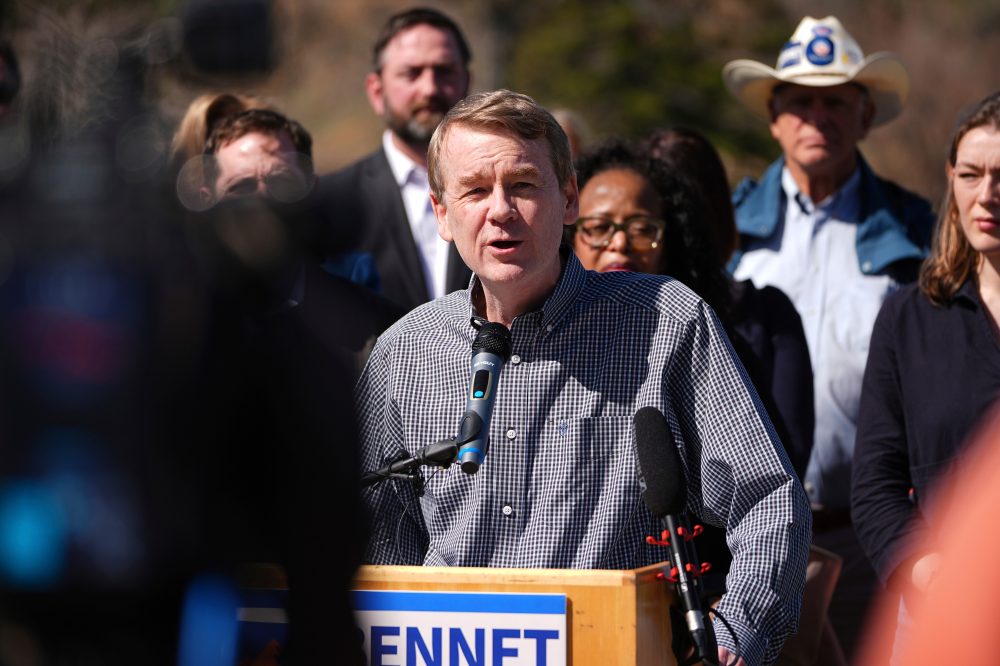
On the Democratic side, U.S. Sen. Michael Bennet and state Attorney General Phil Weiser are squaring off for the party’s gubernatorial nomination. The winner would seek to succeed term-limited Democratic Gov. Jared Polis. Weiser has described the current political climate as a “revenge campaign” by President Donald Trump against Colorado and its outgoing governor.
The race carries an added layer of political intrigue: if Bennet wins the nomination and the general election, he would have to give up his U.S. Senate seat. Under that scenario, the sitting governor would appoint a replacement to serve until the next general election in 2028. Bennet has stated he intends to hold onto his seat until taking office as governor, at which point he would name his own successor rather than leaving that choice to Polis.
During a June 4 debate, Bennet said any replacement he appoints would be under 50 years old. Three of the four Democrats currently in Colorado’s congressional delegation meet that threshold: Jason Crow, Joe Neguse, and Brittany Pettersen — all of whom have endorsed Bennet.
Bennet has also made clear that Polis would not be under consideration, citing the governor’s decision to commute the sentence of Tina Peters — a former Mesa County Clerk who was convicted in connection with a security breach of county election equipment following the 2020 election. Peters became a prominent figure in election conspiracy circles supported by Trump and his allies.
If Weiser prevails, Bennet would remain in the Senate for the two years left on his term. Some Weiser backers have leaned into that outcome, sporting bumper stickers reading “Weiser for governor! Bennet for Senate.”
This marks the second time Bennet has pursued another office while serving in the Senate. He briefly sought the Democratic presidential nomination in 2019. He is currently one of four sitting U.S. senators running for governor this cycle — the most in recent memory.
On the Republican side, the Democratic nominee will face one of three candidates: state Rep. Scott Bottoms, state Sen. Barb Kirkmeyer, or pastor and Marine Corps veteran Victor Marx. Marx leads the GOP field in fundraising, having brought in roughly $2.8 million in contributions with about $200,000 remaining on hand heading into the final 20 days of the campaign. His totals more than doubled the combined figures for both Kirkmeyer and Bottoms.
Colorado Secretary of State records show that outside groups have directed more than $400,000 in television and digital advertising toward supporting Marx. He has also been the target of a several-hundred-thousand-dollar ad effort opposing him and backing Kirkmeyer. A separate group has spent a smaller amount on social media and email ads opposing Marx while supporting Bottoms.
In the Democratic race, Weiser has raised approximately $6.5 million compared to Bennet’s $4.8 million. Both campaigns have also benefited from outside group spending in the millions — both in support of their own candidate and against the other.
Democrats have dominated Colorado’s gubernatorial contests in recent years, winning nine of the last 11 races and holding the office continuously since 2007.
At the top of the ballot, first-term Democratic U.S. Sen. John Hickenlooper is facing a primary challenge from state Sen. Julie Gonzales. The winner will go on to face Republican state Sen. Mark Baisley, who is running unopposed in his primary.
A closely watched U.S. House contest is shaping up in the 8th Congressional District in the northern Denver suburbs, where Republican U.S. Rep. Gabe Evans is seeking a second term. His Democratic challenger will be either former state Rep. Shannon Bird or state Rep. Manny Rutinel. Control of the House could hinge on that seat come November.
The state’s most populous jurisdictions include El Paso County and the city and county of Denver. The counties of Arapahoe, Jefferson, Adams, and Douglas — which ring Denver — also have large voter populations, as do Larimer, Weld, Boulder, Pueblo, and Mesa counties.
Together, those 11 counties account for roughly 87% of Colorado’s total registered voters and will be the primary sources of primary votes for both parties. Republican-leaning El Paso and Douglas counties tend to carry more weight in GOP primaries, while heavily Democratic Denver and Boulder counties play a larger role on the Democratic side.
Polls close at 7 p.m. Mountain Time, which is 9 p.m. Eastern Time.
As of June 1, Colorado had approximately 4.4 million registered voters — including about 1.1 million registered Democrats, roughly 997,000 registered Republicans, and approximately 2.3 million voters with no party affiliation. Unaffiliated voters may participate in the Democratic, Republican, or Unity Party primaries, though registered party members may only vote in their own party’s contest.
By Thursday, roughly 327,000 Democratic primary ballots and about 228,000 Republican primary ballots had already been submitted, reflecting Colorado’s predominantly mail-based election system.
In the 2022 state primary, results first came in at 9:04 p.m. ET — four minutes after polls closed. By midnight ET, about 79% of votes had been tallied, with the final update of the night arriving at 4:05 a.m. ET when roughly 90% of ballots had been counted.
Under Colorado law, an automatic recount is triggered if the margin between the top two finishers is 0.5% or less of the leading candidate’s vote total. As of Tuesday, 126 days remain until the 2026 midterm elections.