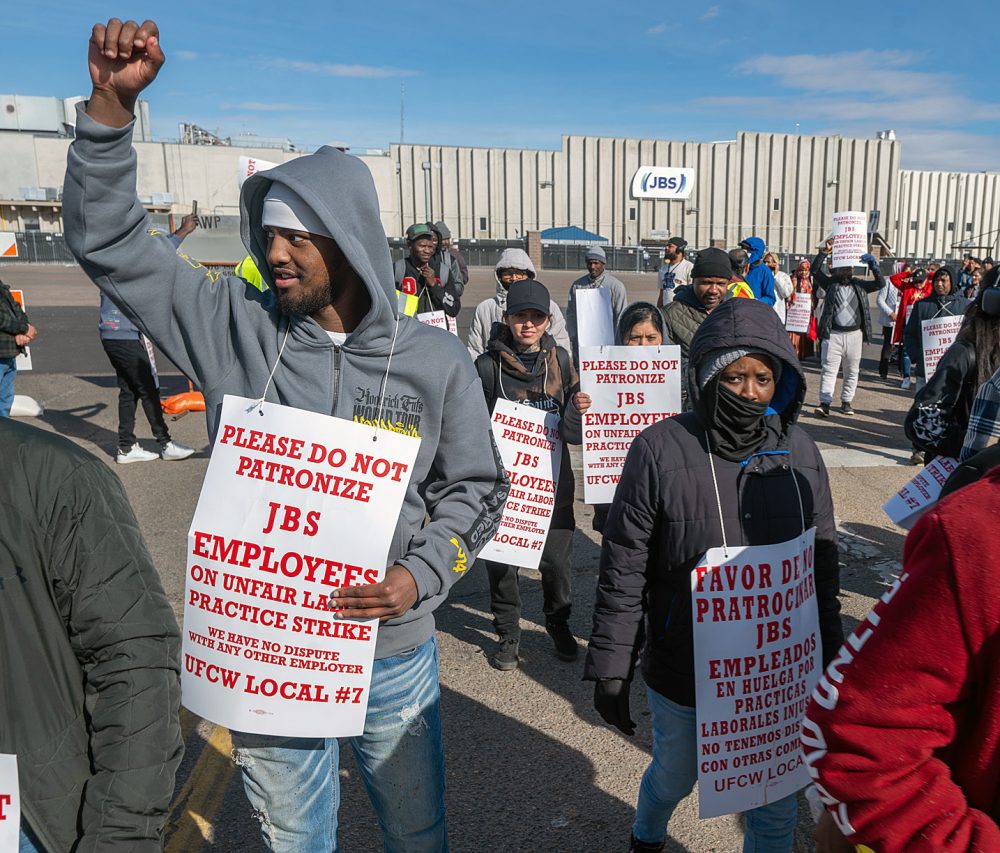

Thousands of employees at a massive Colorado beef processing facility have decided to end their three-week walkout and head back to work after the company agreed to restart contract talks, union officials said Saturday.
The labor action at the Swift Beef Co. facility in Greeley, Colorado, started on March 16 when United Food and Commercial Workers Local 7 members walked off the job seeking improved wages and healthcare benefits.
This work stoppage occurred during a time when the nation’s cattle population has dropped to its lowest point in 75 years, caused partly by drought conditions and poor pricing for ranchers. At the same time, consumer beef costs have reached unprecedented heights, contributing to broader economic concerns across the country.
Union representatives stated that employees will clock back in on Tuesday morning following JBS USA’s commitment to restart discussions later this week.
“Workers remain united and will continue to fight,” said local union president Kim Cordova in a statement.
Company spokesperson Nikki Richardson confirmed that JBS USA is “preparing to resume and ramp up operations at the Greeley plant next week.”
“Our Last, Best and Final offer remains on the table,” Richardson said in an email that did not include terms. “We hope employees will have the opportunity to review and vote on it soon.”
This Greeley walkout marks the first time U.S. slaughterhouse workers have gone on strike since employees at a Hormel facility in Minnesota left their posts in 1985. That previous strike extended beyond a year and featured violent clashes between law enforcement and demonstrators.
JBS operates as the globe’s biggest meat processing corporation with a $17 billion market value. The company serves as Greeley’s largest employer in this city of roughly 114,000 residents located 50 miles northeast of Denver.
Union leaders launched the Greeley strike citing allegations that Swift Beef Co. management took retaliatory actions against employees and engaged in other unfair labor practices.
The union reported that the company proposed annual wage increases of less than 2%, falling short of Colorado’s inflation rate. JBS USA has rejected claims of labor law violations and maintained that its contract proposal was reasonable.
Industry analyst Abby Greiman from Ever.Ag noted that the Greeley facility handles approximately 6% of the nation’s total beef slaughterhouse capacity.
A prolonged work stoppage could have disrupted the entire industry and potentially pushed consumer prices even higher, according to Jennifer Martin from Colorado State University’s animal sciences department.
Federal statistics show that ground chuck beef prices have more than doubled in the past twenty years, jumping from $2.55 to $6.07 per pound.
The Colorado labor dispute followed January’s closure of a Tyson Foods processing plant in Lexington, Nebraska, which was anticipated to impact the local economy significantly. Tyson Foods blamed the shutdown on reduced cattle herds and projected losses in the millions this year.
JBS received approval for New York Stock Exchange trading last May despite environmental protests and a federal investigation that resulted in the company’s October guilty plea for bribing Brazilian officials to secure financing for U.S. expansion.
At the Greeley location, union officials accused the company of attempting to pressure workers into leaving the union through individual meetings, according to union general counsel Matt Shechter.