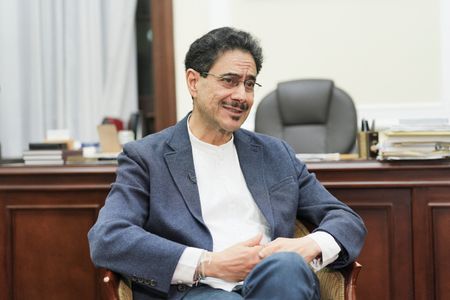

BOGOTA — Colombian senator Ivan Cepeda, a 63-year-old leftist activist whose early life was defined by political exile and the murder of his father, is making a bid for the country’s presidency, pledging to build on and expand the progressive reforms of his predecessor.
Cepeda held the lead in surveys heading into the first-round vote in late May, but ultimately came in second place behind right-wing candidate Abelardo De La Espriella, who is now considered the frontrunner heading into Sunday’s deciding vote.
The two candidates offer dramatically different paths for Colombia. Cepeda has pledged to continue and intensify the economic and social agenda of President Gustavo Petro — the nation’s first leftist president and a former guerrilla. De La Espriella, meanwhile, has promised a tougher stance on crime and fewer restrictions on business and industry.
Investors, conservative voters, and the business sector have largely aligned with De La Espriella. Cepeda has drawn support from coastal and Amazonian regions, the traditional political left, and voters in Bogota. He argues that the country’s entrenched inequality demands what he describes as “social capitalism” — a framework centered on poverty reduction.
Among his policy proposals: higher taxes on Colombia’s wealthiest citizens, opening state contracts to community organizations, distributing 1 million hectares of land to victims of the country’s armed conflict, and expanding financial support for low-income individuals and the elderly.
“It is a program that proposes social reforms that I want not only to be deepened and consolidated, but also to be radicalized in some cases,” Cepeda told Reuters in an interview last week.
Cepeda served as a facilitator in negotiations that produced a 2016 peace deal between the Colombian government and the former FARC guerrilla organization. He has vowed to press forward with Petro’s contentious efforts to broker peace with other illegal armed groups that have been in conflict with the state for decades.
Following the first round, Cepeda has moderated certain positions, expressing a desire for broader political consensus on reforms and stepping back from earlier plans to pursue a new national constitution.
“I am a democrat, I am going to run a government strictly adhering to the Constitution and the law,” he said.
Cepeda’s academic background spans philosophy, law, and political science, studied across Bulgaria, France, and Colombia. He rose to greater national prominence after former President Alvaro Uribe was sentenced to 12 years of house arrest on fraud and bribery charges — a case in which Cepeda was recognized as one of several victims.
Cepeda has been connected to left-wing politics since childhood. Both of his parents were communist leaders, and the family endured two separate periods of political exile — first in Havana and later in the former Czechoslovakia.
His father, Manuel Cepeda, was shot and killed in 1994 while traveling by car in Bogota. The younger Cepeda has recounted that he was riding a bus to university when he spotted his father’s body at what he initially assumed was a traffic accident. In 2010, the Inter-American Court of Human Rights ruled that the Colombian state bore responsibility for Manuel Cepeda’s killing, which was carried out by military and paramilitary forces.
Cepeda is married to Pilar Rueda, who recently stepped down from her role as an advisor to the special tribunal established to investigate and prosecute human rights abuses connected to Colombia’s ongoing internal conflict.
His political opponents have alleged that he maintains close connections to former FARC leadership — accusations he has firmly denied.
The most recent polling shows Cepeda trailing with 44.8% support compared to De La Espriella’s 52.6% ahead of Sunday’s runoff.