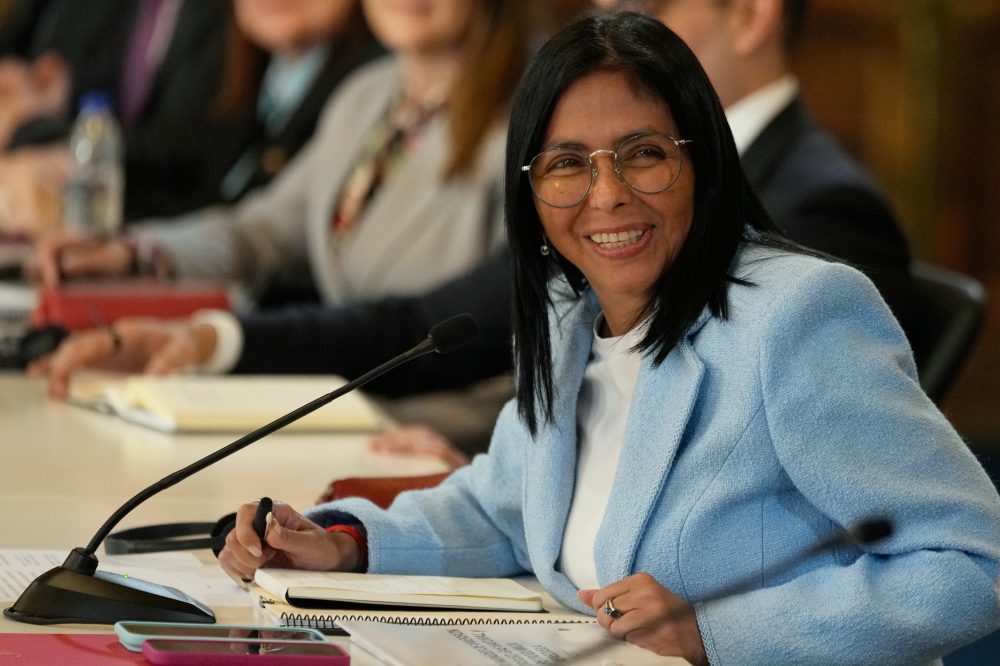

CARACAS, Venezuela — Colombian President Gustavo Petro traveled to Venezuela Friday for crucial discussions with the nation’s acting president, Delcy Rodríguez, focusing on border security and trade relations. This marks their inaugural meeting, occurring several months following the U.S. military’s seizure of former Venezuelan President Nicolás Maduro and his spouse from their residence in January.
Colombia is pushing to purchase Venezuelan natural gas and recently requested relief from U.S. sanctions to invest in Venezuela’s electrical infrastructure and gas projects, potentially including the restoration of a gas pipeline connecting the two South American nations.
Petro’s government has also struck deals with Venezuela’s state oil company PDVSA to replace pipeline infrastructure on Colombia’s side of the border.
The two leaders are anticipated to address illegal armed organizations and narcotics smuggling activities along their common frontier.
“The United States has an interest in Colombia becoming the buyer of Venezuelan gas,” said Ronal Rodríguez Durán, a researcher at the Venezuela Observatory at the Universidad del Rosario.
“Colombia, by virtue of its geographical nature, would become the client that could quickly bring revenue into Venezuela under U.S. supervision,” he added.
This subject was discussed during the approximately two-hour session between Petro and U.S. President Donald Trump at the White House in February. Both characterized the discussions as cordial — a stark contrast from earlier tensions when Trump blamed Petro for flooding the U.S. with cocaine and threatened military intervention.
Petro stated they explored ways to revitalize Venezuela’s economy through Colombian support, along with America’s role, which the Colombian president said should “lift sanctions” on Venezuela.
The Trump administration seeks to restore Venezuela’s economy by attracting foreign investment to its abundant natural resources, especially oil, after years of deterioration under Maduro’s rule that devastated the country and forced at least 7.7 million people to flee.
Before Friday’s gathering, Petro revealed that his team, including senior military and police commanders, would address border security matters with Rodríguez.
Attention centers on the Catatumbo region, where competing armed factions battle for territorial dominance, and Petro emphasized the need for “close collaboration on intelligence,” cautioning that without it, “bombs land in the wrong places … and end up killing civilians.”
Colombian-Venezuelan relations have remained strained for years. Petro refused to acknowledge Maduro as Venezuela’s rightful leader after the disputed July 2024 elections that sparked protests and widespread government crackdowns. Nevertheless, he preserved diplomatic connections with Caracas.
Colombia’s administration stated that Friday’s Petro-Rodríguez meeting seeks to “contribute to a resolution of Venezuela’s political crisis.”
Yet the path to achieving this remains uncertain.
University researcher Rodríguez Durán noted that Petro’s influence in potential mediation efforts is constrained since his presidency concludes in August. Future Venezuelan relations will probably depend on Colombia’s next leader.
Petro and Rodríguez had planned to meet last month at their shared border, but both governments suddenly postponed the gathering, citing “force majeure” without providing details, stating only that it would occur later.
Prior to that cancelled meeting, multiple Venezuelan civil society groups sent an open letter to Petro, requesting Colombia’s help in “promotion of democratic principles and human rights,” including freeing “all political prisoners” and stopping “persecution.”