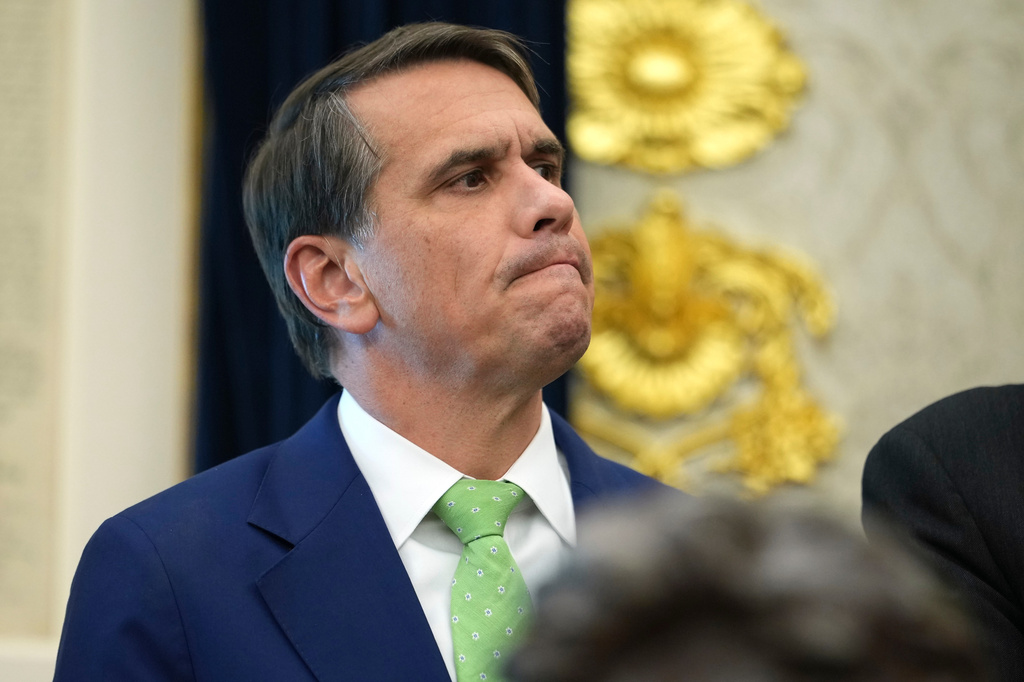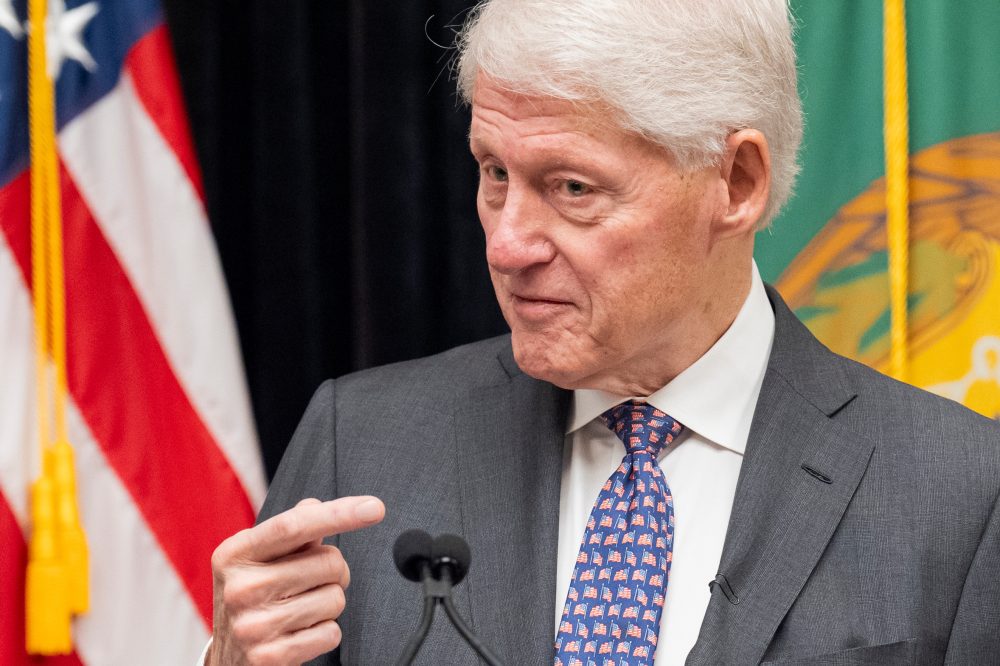

Former President Bill Clinton appeared before congressional investigators Friday to address his past associations with convicted sex trafficker Jeffrey Epstein, creating a historic moment as the first ex-president ever required to provide testimony to Congress.
The private questioning session took place in Chappaqua, New York, one day following Hillary Clinton’s own testimony before lawmakers examining the disgraced financier’s criminal activities spanning over twenty years.
On the same day, President Donald Trump made his way to Texas to discuss energy initiatives and economic strategies during a heated Republican Senate primary campaign. All three GOP contenders are scheduled to appear alongside him just days ahead of the election.
Recent polling data reveals approximately 60% of American adults support creating an independent Palestinian state in the West Bank and Gaza Strip regions. This level of backing remains consistent with trends observed since 2020, when at least half of Americans began endorsing Palestinian statehood.
However, Democratic and independent voters have shown increased enthusiasm for the two-state approach. Roughly three-quarters of Democrats and about 60% of independents now back Palestinian independence.
Contrasting sharply with American sentiment, separate Gallup surveys indicate only around 30% of Israelis and Palestinians living in affected territories actually support a two-state arrangement.
The shifting American perspective stems largely from Democratic voters, who now express significantly greater sympathy for Palestinians compared to Israelis. Gallup findings show approximately two-thirds of Democrats align more closely with Palestinian concerns, while only about 20% favor Israeli positions.
Democratic sympathy toward Palestinians grew stronger as the Gaza conflict continued, with independent voters’ perspectives also evolving. For the first time in Gallup’s tracking, independents now show more Palestinian sympathy than Israeli support, with 40% favoring Palestinians versus 30% supporting Israelis.
Artificial intelligence company Anthropic faced mounting pressure Thursday when CEO Dario Amodei declared the firm “cannot in good conscience accede” to Pentagon requirements for unrestricted technology access. This escalated tensions with the Trump administration, which threatened contract termination and additional measures by Friday.
The Claude chatbot creator stated it wouldn’t abandon negotiations but criticized new Defense Department contract terms for making “virtually no progress on preventing Claude’s use for mass surveillance of Americans or in fully autonomous weapons.”
Pentagon spokesman Sean Parnell responded on social media that the military “has no interest in using AI to conduct mass surveillance of Americans (which is illegal) nor do we want to use AI to develop autonomous weapons that operate without human involvement.”
Anthropic remains the sole holdout among major AI companies, as the Pentagon maintains contracts with Google, OpenAI, and Elon Musk’s xAI for a new military internal network.
A tragic case in Buffalo has sparked outrage after a nearly blind Myanmar refugee died following his abandonment at a donut shop by Border Patrol agents. Nurul Amin Shah Alam, 56, was detained February 19th after his jail release but was freed the same day when authorities determined he couldn’t be deported.
Agents transported him to a Tim Hortons restaurant north of downtown Buffalo and left him there, according to officials and advocacy groups. His family, expecting him to leave jail directly, wasn’t notified of his release. Shah Alam’s attorney reported him missing February 22nd after learning immigration detention facilities didn’t have him.
Shah Alam was discovered dead Tuesday evening, though the exact time of death remains unknown. Family friend and spokesperson Khaleda Shah said relatives are demanding justice.
Iran and the United States conducted lengthy indirect negotiations Thursday concerning Tehran’s nuclear program but failed to reach agreement, maintaining the threat of Middle Eastern warfare as the U.S. has assembled substantial military forces in the region.
Omani Foreign Minister Badr al-Busaidi, who facilitated the Geneva discussions, reported “significant progress in the negotiation” without providing specifics.
Before talks concluded, Iranian state television announced Tehran’s determination to continue uranium enrichment, rejection of proposals to transfer materials abroad, and demands for international sanctions removal, suggesting unwillingness to meet Trump’s requirements.
Al-Busaidi indicated technical discussions involving lower-level officials would resume next week in Vienna, headquarters of the International Atomic Energy Agency, which would likely play a crucial role in any agreement.
American Middle East sympathies have dramatically shifted toward Palestinians, according to fresh Gallup polling, following decades of overwhelming Israeli support. This transformation accelerated during the Gaza war.
Three years ago, 54% of Americans sympathized more with Israelis compared to 31% for Palestinians. Currently, support stands nearly balanced, with 41% expressing greater Palestinian sympathy and only 36% favoring Israelis.
These figures reflect how Israeli support has become deeply divisive in America, carrying profound implications for domestic politics and foreign policy. The sentiment change has been primarily driven by Democrats, who now show much stronger Palestinian sympathy.
Gallup data suggests this shift began before Hamas’s October 7, 2023 attack on Israel, then intensified during Israel’s subsequent Gaza military operations. The polling carries a margin of error of plus or minus 4 percentage points, indicating roughly equal sentiment toward both sides.
Federal immigration officials arrested a Columbia University student early Thursday, sparking campus demonstrations and accusations that agents entered university housing by impersonating police officers searching for a missing child.
Hours after detaining student Ellie Aghayeva, federal authorities suddenly reversed course, allowing her freedom following apparent intervention by President Donald Trump.
In a Thursday afternoon social media post, Mayor Zohran Mamdani said he raised arrest concerns during an unrelated Trump meeting, after which the president agreed to her immediate release.
“I am safe and okay,” Aghayeva posted on Instagram minutes after Mamdani’s announcement, adding she felt “complete shock” from the experience.
This whirlwind sequence highlighted the unusual relationship between the Republican president and Mamdani, a democratic socialist whom Trump previously threatened with deportation.
Trump appears unable to select a favorite in the Texas Senate Republican primary, so when he visits the state Friday, all three candidates from the competitive race will join him just days before primary voting.
Senator John Cornyn seeks his fifth term while facing challenges from state Attorney General Ken Paxton and Representative Wesley Hunt in an increasingly bitter personal battle. All three men, lacking Trump’s coveted endorsement, have emphasized their connections to him while intensifying campaigning before Tuesday’s vote.
Trump will attempt to build on his Tuesday State of the Union address message, declaring economic prosperity and enhanced American security as central Republican arguments for maintaining congressional majorities.
Trump’s endorsement hesitation reflects the race’s complex dynamics.
Former Secretary of State Hillary Clinton informed congressional members Thursday she possessed no knowledge of Jeffrey Epstein’s or Ghislaine Maxwell’s crimes, beginning two days of depositions that will include former President Bill Clinton.
The depositions in the Clintons’ Chappaqua hometown follow months of tense exchanges between the former Democratic power couple and the Republican-controlled House Oversight Committee investigating Epstein. This marks the first instance of a former president being compelled to testify before Congress.
The push for Epstein abuse accountability has become nearly unstoppable on Capitol Hill and beyond.
Trump, who has expressed regret about the Clintons’ forced testimony, yielded to pressure last year to release Epstein case files. The Clintons agreed to testify after the Oversight panel and Chairman Rep. James Comer, R-Ky., rejected their sworn statement offers and threatened criminal contempt charges.