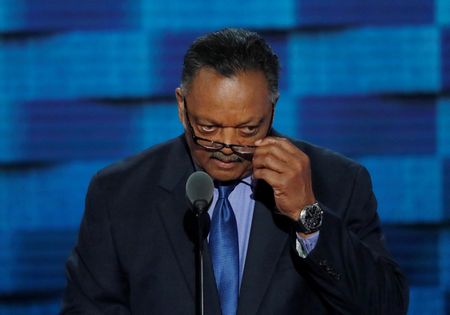

Civil rights activists across the nation are mourning the loss of Jesse Jackson while vowing to carry forward his decades-long mission for racial equality following his death Tuesday at 84.
Jackson emerged as a pivotal figure in America’s civil rights movement following Martin Luther King Jr.’s assassination in 1968, dedicating over fifty years to breaking down segregation barriers and expanding political involvement for Black Americans and other underrepresented groups.
However, civil rights and diversity programs nationwide now face mounting challenges under the current Trump administration’s policies.
The federal government has rolled back diversity initiatives and targeted educational materials about slavery that officials label “anti-American.” The administration has also backed efforts to restore Confederate monuments honoring Civil War leaders who defended slavery. Civil rights advocates express concern that these actions threaten to reverse decades of advancement.
Through a series of interviews with civil rights leaders and experts, many expressed alarm that Jackson’s dream of a unified, multiracial American democracy faces serious threats in today’s polarized political environment.
National Urban League President and CEO Marc Morial warned: “We’re in a moment where the fabric and the social compact of America, which included rights, could be unraveled and we could be on the brink of a long period of division and hate in America.”
“The last 60 to 70 years have been about building this multicultural, multiracial democracy in America and we’re in a period of danger,” Morial added.
President Trump offered his condolences on Truth Social, sharing multiple photographs with Jackson and calling him “a good man, with lots of personality, grit, and ‘street smarts’” while describing the civil rights leader as “a force of nature.”
When contacted about Jackson’s passing, the White House directed inquiries to Trump’s social media statement. Officials did not immediately respond to questions regarding the elimination of diversity programs.
CARRYING FORWARD JACKSON’S MISSION
Jackson, who launched two campaigns for the Democratic presidential nomination, became renowned for his magnetic ability to channel grassroots energy into electoral power — registering millions of new voters through his National Rainbow Coalition while remaining at the forefront of racial justice activism.
Civil rights leaders emphasized that such political engagement remains crucial today.
Civil rights lawyer and Democratic analyst Areva Martin stressed the importance of preserving Jackson’s legacy through continued organizing and advocacy for civil and voting rights, especially as the Trump administration dismantles diversity programs, intensifies immigration enforcement, and challenges foundational civil rights laws like the 1965 Voting Rights Act that prohibited nationwide voting discrimination.
“We need to pick up the mantle,” Martin declared. “If Jesse Jackson were able-bodied he would have been out across the country organizing voters and building coalitions. He would know that’s the only way to fight to win back Congress and reverse the damage done by this administration.”
Community organizers have raised concerns about aggressive immigration enforcement operations and raids in Democratic strongholds, disproportionately affecting Black and Latino neighborhoods in what advocates describe as efforts to diminish immigrant communities’ voting influence.
NAACP President Derrick Johnson announced that his organization will intensify outreach initiatives leading up to November’s midterm elections in Jackson’s honor, highlighting multiple legal challenges addressing alleged voter suppression and registration efforts.
“Jesse Jackson is American history,” Johnson stated. “His legacy demonstrates how one can use their voice and a platform to advance interest in causes that are pro-democracy, pro-America and pro-bringing people together.”
The Movement for Black Lives, which energized the 2020 racial justice demonstrations, committed to continuing Jackson’s tradition of electoral participation.
The group is establishing nationwide rapid-response “community care networks,” already activated to distribute food and essential supplies in at least seven cities during ongoing federal immigration operations.
“He had the audacity — from his presidential run, being that Black left voice and being unapologetic about the need for us to form coalitions and engage with systems,” explained Dr. Amara Enyia, the movement’s co-executive director.
Jackson established the Chicago-headquartered civil rights organizations Operation PUSH and the National Rainbow Coalition, later merged into the Rainbow PUSH Coalition.
Ziff Sistrunk, a 70-year-old Chicago local, regularly participates in complimentary Saturday morning community breakfasts at the organization’s offices that combine social connection with civic participation.
“Jackson showed us how to resist, he showed us how to protest and how to be a statesman,” Sistrunk reflected. “All we have to do for the next generation who want to make changes is use his life as an example.”