
A Chinese robotics company that specializes in creating advanced robotic hands for humanoid robots is planning to seek a $6 billion valuation in its upcoming funding round, representing twice its current worth, according to company officials.
Linkerbot, headquartered in Beijing, just finished what it described as a “series B+” funding round last week that placed the company’s value at $3 billion. Company representatives did not specify when the next investment round would begin or clarify whether the $6 billion target would come through private investment or a public stock offering.
The two-year-old startup has attracted backing from major investors including Alibaba’s Ant Group and Sequoia spin-off HongShan Group. The most recent funding round included participation from government-supported Zhongguancun Science Park Fund, Bank of China Asset Management, and Fosun Capital, according to a company announcement released Thursday.
The company currently commands more than 80% of the worldwide market for high-degree-of-freedom robotic hands and intends to increase manufacturing capacity “soon” to 10,000 units monthly from its current production of nearly 5,000, CEO Alex Zhou explained in an interview with Reuters.
Financial backing for China’s humanoid robotics sector has increased dramatically this year following impressive demonstrations by industry leaders like Unitree, whose products showcased remarkable technological progress during a televised performance and Beijing’s humanoid robot half-marathon event last month. Unitree submitted paperwork for a Shanghai stock exchange listing in March, pursuing a valuation as high as $7 billion.
While rival humanoid manufacturers such as X Square Robot concentrate on developing robotic hands for domestic tasks, Linkerbot focuses on replicating high-skill human craftsmanship.
“We aren’t just making hands. Our goal is to replicate the entire library of human dexterous skills within our hardware,” Zhou explained, discussing the company’s LinkerSkillNet platform, which he describes as the world’s most comprehensive real-world dexterous manipulation database.
The platform functions as a multimodal data collection system that transforms human abilities into standardized, transferable capabilities for robotic hands, currently housing more than 500 different skills.
“The hand is the most complex part of the whole humanoid robot. Elon Musk described on several occasions that the part was taking more than half of their whole engineering effort for Tesla’s Optimus,” noted Georg Stieler, who leads robotics and automation at technology consulting firm Stieler.
Musk has promised that Tesla’s newest Optimus version, scheduled for release this spring, will possess “the manual dexterity of a human.”
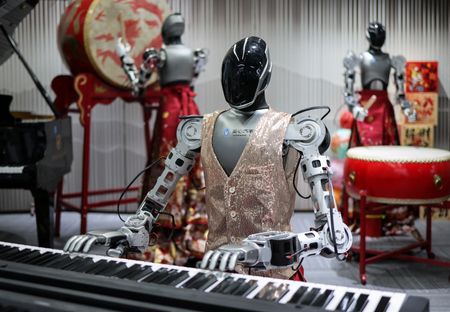
Drawing inspiration from his childhood appreciation for Doraemon, the Japanese animated robotic cat character who carries countless gadgets in his pocket, CEO Zhou imagines his robots performing piano music, providing massage therapy, or even conducting dental procedures – capabilities he describes as offering “value-add that is at least triple that of basic labour.”
Linkerbot’s robotic hands can already quickly turn screws, handle flexible soft materials, thread needles, and perform high-precision manufacturing tasks. The company provides products to several of China’s top humanoid robot manufacturers as well as international industrial corporations, though specific client names remain confidential due to non-disclosure agreements.
The company’s basic O6 lightweight model can handle a 50-kilogram load while weighing just 370 grams, performance Zhou identified as a crucial benefit for industrial uses requiring both compact size and strength.
Linkerbot produces essential components including joint modules, motors, and reducers internally, utilizing specialized polymers that provide self-lubrication and resist corrosion, Zhou noted.
Beyond industrial applications, research institutions and prominent international universities use Linkerbot’s robotic hands. The company employs more than 400 people across five manufacturing facilities in Beijing and Shenzhen, and is creating automated production lines where robotic hands assemble other robotic hands.
A significant barrier to widespread industrial adoption of humanoid robots remains their expense, with leading industrial models from Unitree, AgiBot, and UBTech costing between $100,000 and $150,000 per unit, according to industry analysts. However, Linkerbot claims its hands offer easier implementation.
“Chinese factory owners are extremely pragmatic. They’ve realised that for most factory work, two arms and a pair of dexterous hands are enough,” Zhou said.
“Currently, many of our customers simply mount our hands onto existing robotic arms rather than buying a full humanoid,” he explained.