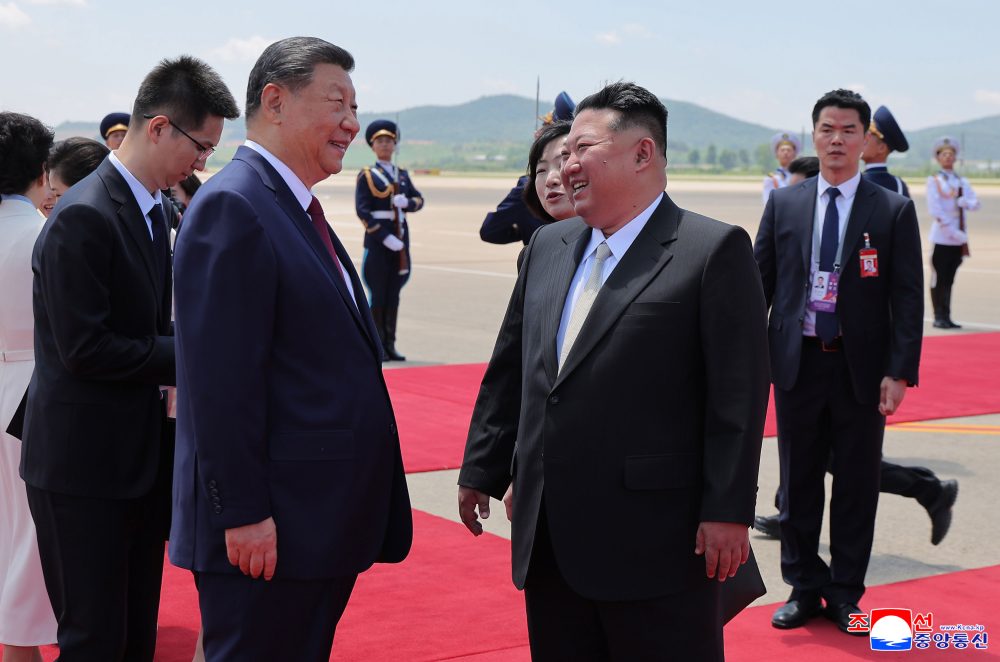

SEOUL, South Korea (AP) — Chinese President Xi Jinping concluded his journey back to China on Tuesday after completing a significant diplomatic visit to North Korea that featured high-level discussions and public events with leader Kim Jong Un, highlighting both nations’ efforts to strengthen their partnership.
The Chinese leader arrived in the capital Pyongyang on Monday for his first visit to the country in seven years. During their high-level discussions that day, Xi indicated China’s readiness to broaden collaboration across multiple sectors such as trade, agriculture, construction and technology, while Kim described maintaining their nations’ friendship as “the most important top-priority strategic work,” based on reports from Chinese and North Korean state media.
On Tuesday, Xi and Kim made a visit to a North Korea-China friendship tower that pays tribute to Chinese soldiers who served alongside North Korea during the 1950-53 Korean War. The leaders emphasized the significance of continuing their nations’ longstanding friendship and spirit of opposition to the United States, according to Chinese state media coverage.
The two leaders, whose previous meeting took place in Beijing in September, also visited a ruling Workers’ Party training school and planted a fir tree as a symbol of their bilateral relationship. Xi subsequently participated in a luncheon and farewell ceremony before departing for Beijing, Chinese state media reported.
Analysts believe Xi probably sought to rebuild his nation’s unique influence over North Korea, which has recently prioritized its foreign policy relationship with Russia. They evaluate that Kim requires certain economic and political advantages in exchange.
Coverage from both nations’ state media organizations regarding Monday’s summit highlighted Xi and Kim’s dedication to expanding cooperation and featured Kim’s continued backing of China’s “one-China” policy concerning the Taiwan matter.
However, the coverage failed to indicate whether the leaders addressed North Korea’s nuclear program, a delicate security matter in the region. During his 2019 visit to Pyongyang, Xi stated Beijing was prepared to play a constructive role in the denuclearization of the Korean Peninsula.
This situation could represent a diplomatic victory for Kim, who seeks international acknowledgment as a nuclear weapons state, a position that analysts say he would leverage to demand the removal of international economic sanctions.
By avoiding mention of the denuclearization matter, China creates space for the understanding that it seems to acknowledge North Korea’s potential nuclear state status, going beyond simply ignoring it, according to analysis by Ban Kil Joo, assistant professor at the Korea National Diplomatic Academy in Seoul.
In a strategic exchange, North Korea confirmed its backing of China regarding the Taiwan matter, Ban noted.
Kim Gyubeom, an analyst at the Institute for National Security Strategy in Seoul, indicated China seems to be following a “managerial approach” that neither completely endorses nor heavily pressures Pyongyang, while keeping strategic dialogue with North Korea and emphasizing regional stability.
Rebuilding unique influence over North Korea would provide Xi with advantages in negotiations with U.S. President Donald Trump, who has consistently voiced his interest in resuming diplomacy with Kim.
Concerns have emerged about China’s influence over North Korea in recent years, as the North has concentrated on supporting Russia’s war efforts through troop and weapon deployments in return for economic and other aid.