
NEW YORK (AP) — The destruction of Manhattan’s original Pennsylvania Station in 1963 represented a tragic loss for American architecture, eliminating a magnificent Beaux Arts railway terminal that featured Roman-inspired columns and an expansive central hall that was the city’s largest enclosed space at that time.
Madison Square Garden was built where the station once stood — now housing the NBA’s New York Knicks and NHL’s New York Rangers — while rail passengers were relegated to dark, cramped underground passages created by a far more practical redesign finished in 1968.
“Through Pennsylvania Station one entered the city like a god,” architectural historian Vincent Scully famously observed. “One scuttles in now like a rat.”
However, an ambitious new plan for the Western Hemisphere’s busiest transportation center aims to restore the terminal’s former magnificence. The station first opened in 1910 and today handles Amtrak service, as the national railroad company owns the facility, plus suburban commuter trains and connections to the city’s extensive subway network.
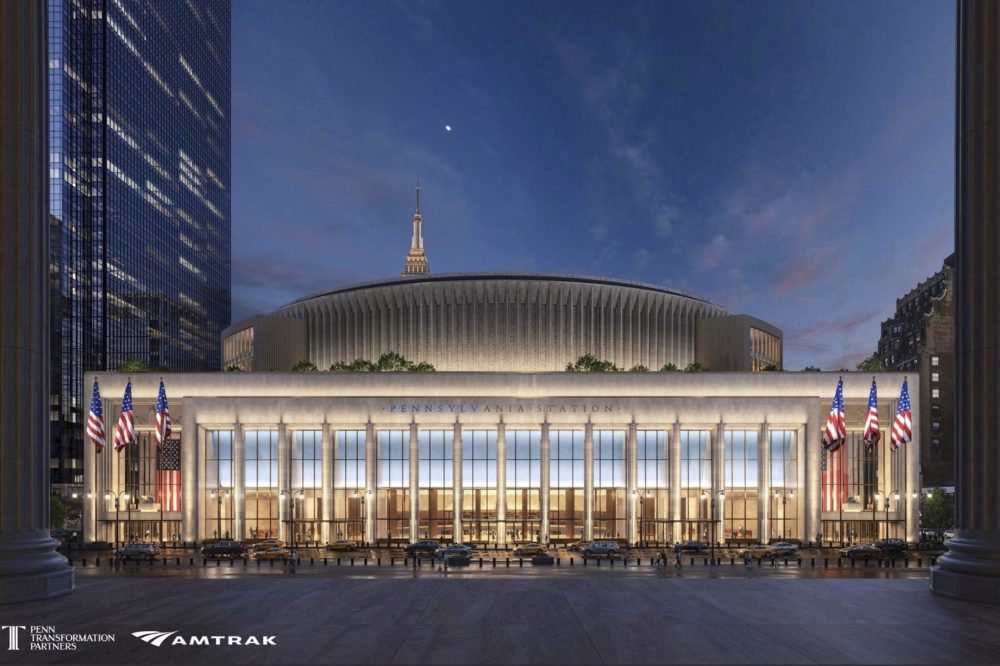
Design images unveiled Monday by Amtrak and Penn Transformation Partners, the planning and construction group selected for the work, show a rectangular stone exterior featuring impressive columns along a majestic entrance.
Travelers would enter a light-filled main hall with towering ceilings reaching over 50 feet in some areas. The design incorporates bronze elements and decorative features, including a relief sculpture of the city’s iconic skyline and a large traditional station timepiece, also crafted in bronze.
A wall near an entrance displays the seal of President Donald Trump, who directed Amtrak to take charge of the project last year following decades of bureaucratic delays and political disputes between transit authorities and competing stakeholders, including James Dolan, the billionaire owner of MSG, the Knicks and the Rangers, who has firmly resisted relocating the venue.
Trump has discussed renaming his native city’s station after himself as part of his efforts to establish his legacy through infrastructure projects, ranging from an expansive new ballroom at the White House to a ceremonial arch at the entrance to the nation’s capital.
Currently, however, the name carved in large letters across the planned main entrance would continue to say “Pennsylvania Station,” according to Monday’s design releases.
“I’m not focused on names at all,” said Andy Byford, whom Amtrak appointed as a special adviser to supervise the reconstruction, when questioned about a possible name change.
“This building has a name, and the name is there,” added Peter Cipriano, one of the lead developers.
The planned design takes inspiration from the elaborate, Beaux-Arts style of Grand Central Terminal, the city’s other primary rail center, plus Art Deco structures like the Empire State Building and Rockefeller Center, according to Vishaan Chakrabarti, one of the project team leaders.
Planners also studied the imposing, federal architectural style of Washington, D.C. government buildings and those constructed by the Works Progress Administration during the Great Depression.
The goal, he explained, is to reestablish Penn Station’s status among the city’s most celebrated landmarks and restore a “sense of public ambition” to one of the country’s essential civic facilities.
“There was this fearless embrace of ornament and decoration that in some ways we’ve lost,” Chakrabarti said. “We want to bring some of that sense of craftsmanship back.”
The reconstruction is expected to require approximately $7 billion to $8 billion, with construction scheduled to start before 2027 ends, officials announced Monday. Penn Station would continue operating during the work as the project moves forward in stages across roughly six years.
Over 600,000 travelers pass through the rail center on typical weekdays, exceeding the combined traffic of the three major international airports serving the greater New York area — John F. Kennedy, LaGuardia and Newark Liberty.
Previous proposals have suggested moving MSG, but Monday’s revealed plans would keep the “World’s Most Famous Arena” in its current location.
An MSG-owned theater constructed directly over the railway tracks would need to be demolished to accommodate the new exterior and main hall.
The development team and MSG owner James Dolan have established a “memorandum of agreement” for this essential component, which influenced the rail company’s decision to select this proposal over three competing bids, Byford noted. Specific contract terms, including compensation, remain undetermined.
“You’ll understand why we wouldn’t want to negotiate that in public,” said Byford.
The project’s next steps involve refining the initial designs and completing the comprehensive federal environmental assessment process, which will help produce more precise cost estimates, Byford explained.
He emphasized that there are no intentions for the government to acquire nearby properties to enlarge the station, as some worried residents have speculated. The project also will not burden commuters financially.
“There will be no fare hike to pay for this project,” Byford said. “It’s not going to happen.”