
A critical material shortage is threatening the expansion of artificial intelligence data centers globally, as China tightens export controls on indium phosphide, a compound essential for manufacturing high-speed optical components.
The situation became urgent enough that Coherent’s CEO Jim Anderson joined a U.S. business delegation accompanying President Donald Trump to China, partly to address delays in Chinese export licensing for the strategic material, according to three sources with knowledge of the matter.
Trade representatives from both nations also discussed the export control issues during meetings in Seoul before Trump’s May 14-15 summit with China’s President Xi Jinping, two U.S. government officials and a person briefed on the discussions confirmed.
The compound, known as InP, has become what experts describe as a powerful trade tool for Beijing that could significantly slow AI data center construction worldwide.
“InP is one of several supply chain bottlenecks collectively gating AI data centre buildouts,” explained Konrad Wang, a research analyst at SemiAnalysis.
As artificial intelligence demands grow rapidly, indium phosphide has become increasingly valuable because it’s an irreplaceable component in new photonic technology that uses light through optical fibers rather than electrical signals through copper wiring for data centers.
Major technology investments reflect this shift, with Nvidia announcing $2 billion investments in both Coherent and Lumentum in March. Custom-chip manufacturer Marvell Technology also acquired semiconductor startup Celestial AI last year to access its photonics expertise.
However, China’s export limitations on InP that started in February 2025 have created significant obstacles for companies racing to develop the fastest and most energy-efficient AI data center components.
China’s commerce ministry did not respond to requests for comment.
Beijing’s control over this material demonstrates its willingness to expand beyond its established rare earth export restrictions, which have already disrupted global automotive, semiconductor and aviation supply chains amid ongoing trade tensions with Washington.
“Beijing is developing a more granular ‘materials chokepoint’ toolkit,” noted Paul Triolo, a partner at consulting firm Albright Stonebridge Group.
“Rather than blocking finished photonics products outright, it can slow or condition the export of the upstream compounds, substrates, metals … that determine whether the optical-module ecosystem can scale quickly enough to meet hyperscaler demand.”
China dominates indium production globally, accounting for 70% of worldwide output as of 2024, according to U.S. Geological Survey data.
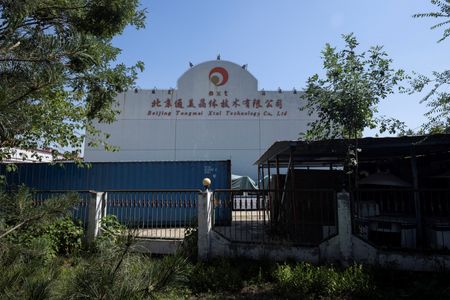
The impact is spreading throughout the industry. AXT, the world’s second-largest InP substrate producer and a key Coherent supplier, stated in May that “InP export permits represent the most significant challenge we currently face.”
The company, which produces most of its InP substrates in China, reported that its Chinese subsidiary only obtained its first export permits last June and faces a substantial order backlog.
Wang from SemiAnalysis said “the restrictions ripple through the entire optical supply chain,” affecting companies beyond AXT and Coherent.
Lumentum has sold out its production through 2028 despite increasing output fourfold, while Taiwanese optical manufacturers VPEC and LandMark Optoelectronics have experienced InP substrate supply disruptions due to AXT permit delays, according to Wang.
Since China implemented the InP export restrictions, the average cost for a 6-inch InP wafer has jumped 250% to $5,000.
Facing increased costs and extended supply disruptions, at least two major U.S. photonics chipmakers have contacted industry organizations seeking assistance with export licenses, a source familiar with the situation reported.
American photonics companies are attempting to develop their own InP substrate production and find alternative suppliers like Japan’s Sumitomo Electric Industries. However, capacity expansion is limited and slow, as new manufacturing facilities typically require two to three years to become operational, analysts explained.
Coherent announced in May it would double its InP wafer capacity at its Texas facility this year and plans to more than double that capacity again by the end of 2027.
AXT, Coherent, Lumentum, VPEC and LandMark did not respond to requests for comment. LandMark signed a long-term InP supply agreement with Sumitomo in April.
Sumitomo told reporters it had not experienced any production impact from China’s InP export controls thus far.
However, a person familiar with China’s photonic chip industry noted that Sumitomo uses much of its InP substrate production internally, leaving the broader global market undersupplied.
Market leaders AXT and Sumitomo together control nearly 80% of global InP substrate manufacturing, while JX Advanced Metals holds approximately 10% of the market.
China’s export restrictions have opened opportunities for domestic InP substrate manufacturers, with Yunnan Germanium, Guangdong Xiandao and Zhuhai Dingtai Xinyuan leading the local market.
Many Chinese companies are rapidly expanding production capabilities. Yunnan Germanium announced a 189 million yuan ($28 million) investment in April to increase production capacity to 450,000 individual InP wafers annually. The company’s 2025 annual report showed InP wafer shipments increased by 74%.
Guangdong Xiandao also initiated a new investment project this year through its subsidiary Guangdong Xianrui, targeting annual production of 40 tons of InP crystals, the raw material for substrates.
Both Yunnan Germanium and Guangdong Xiandao are negotiating with Chinese officials for export approvals, but their international shipments, if authorized, will likely remain limited, according to a source at a major Chinese InP manufacturer.
The source indicated his company was concentrating on domestic markets in the near term, as there was no indication the Chinese government would favor domestic companies over firms like AXT seeking to export InP substrates from China.
Additionally, companies such as Coherent, primarily supplied by AXT, and Lumentum, mainly supplied by Sumitomo and JX Advanced Metals, are unlikely to change suppliers easily, as transitioning to new suppliers requires extensive qualification processes, the person explained.
Neither Yunnan Germanium nor Guangdong Xiandao responded to requests for comment.