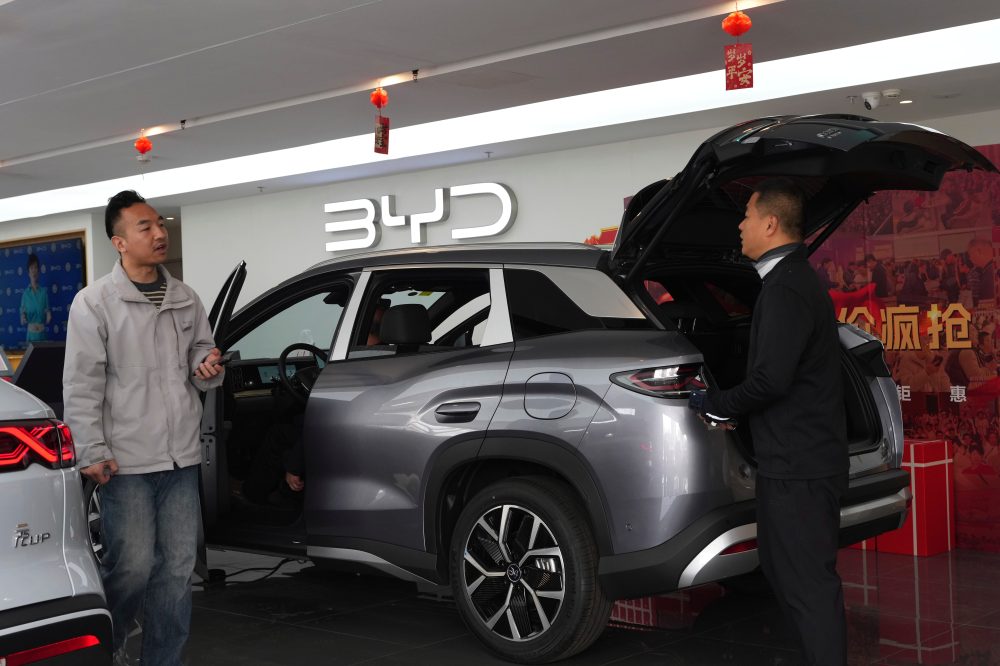

Chinese electric vehicle manufacturer BYD announced Friday that it achieved record annual revenue of $116 billion, surpassing Tesla’s figures, though the company experienced its first earnings decline since 2021 amid intense market competition.
The Shenzhen-based automaker has claimed the title of world’s largest electric vehicle producer, delivering 2.26 million electric cars in 2025 – a 28% increase from the previous year. This milestone allowed BYD to overtake Tesla, which reported deliveries of 1.64 million vehicles, representing a 9% decrease.
BYD’s revenue climbed 3.5% to reach 804 billion yuan ($116 billion) in 2025, setting another company record and exceeding Tesla’s annual revenue of $94.8 billion. However, the company’s annual earnings dropped 19% to 32.6 billion yuan ($4.7 billion), marking the first profit decrease since 2021.
The electric vehicle manufacturer has been pursuing international expansion into markets across Latin America and Europe, where automotive industry experts indicate profit margins typically exceed those found in China. The company has also invested in advanced technology improvements, recently unveiling an innovative fast-charging battery system just before releasing its financial results.
Industry analysts predict challenging conditions ahead this year due to extremely competitive circumstances within China. However, rising oil and gasoline costs related to the Iran conflict may revive consumer interest in renewable energy alternatives, potentially benefiting electric vehicle companies.
BYD has reported declining domestic sales for six consecutive months, with total sales dropping 36% year-over-year to 400,241 units during January and February, as increased international sales failed to compensate for ongoing domestic market weakness.
“They cannot rely on mass market EVs to help them keep the same volume that they were selling,” stated Chris Liu, a senior analyst at Shanghai-based advisory firm Omdia.
An aggressive pricing battle in China, the globe’s largest automotive market, has damaged BYD’s profit margins, while competitors like Geely Auto have been capturing market share in early 2026.
Company chairman Wang Chuan-fu acknowledged in Friday’s earnings statement: “We also recognize that competition in the NEV (new energy vehicle) industry has reached a fever pitch, and is undergoing a brutal ‘knockout stage.’”
Extensive government incentives designed to encourage Chinese consumers to adopt electric vehicles have been renewed but reduced this year, creating additional pressure on manufacturers. Market expectations suggest the Iran conflict and resulting global energy crisis could drive more consumers toward electric vehicles, potentially benefiting companies like BYD domestically and internationally.
BYD’s Hong Kong-traded shares have declined more than 20% over the past year, though they have shown improvement during March trading.
Significant technological advances may prove crucial for market recovery, according to industry experts. In early March, BYD introduced an updated version of its powerful “blade” electric vehicle battery capable of reaching nearly full charge within nine minutes.
The company also unveiled new vehicle models including the redesigned Datang SUV equipped with cutting-edge technology, which HSBC automotive analysts noted in a research report could “help BYD to regain domestic market share through technology leadership.”
Internationally, BYD intends to continue expanding its global market presence to improve profitability. The company has established operations in the United Kingdom, Brazil, and Argentina, targeting sales of approximately 1.3 million vehicles overseas in 2026, up from roughly 1.05 million last year. According to S&P Global Ratings analyst Claire Yuan, BYD’s approach of constructing and expanding manufacturing facilities abroad will support its international market development.