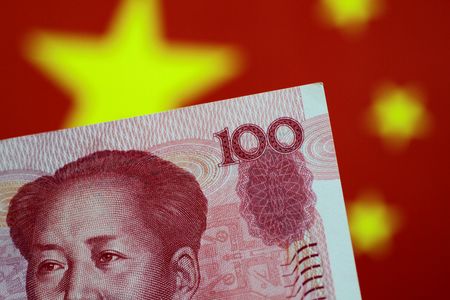

SHANGHAI/HONG KONG – Chinese businesses are flocking to financial protection strategies to shield themselves from currency risks as a strengthening yuan has damaged exporter profits for months, with recent Middle Eastern conflicts adding to market instability.
This movement has reached unprecedented levels and sources indicate government officials are actively supporting the shift. Currently, short-term caution is pushing investors and companies toward the dollar, temporarily halting an 11-month yuan surge.
However, long-term hedging activities will strengthen the market, and the rush toward protection indicates a significant transformation as exporters reduce dollar holdings, potentially driving the yuan even higher as export activity flourishes.
Through forward contracts, which allow companies to lock in exchange rates ahead of time, businesses sold a record $39 billion worth of foreign currencies in January.
This came after record dollar sales to Chinese banks totaling $100 billion in December and $80 billion in January.
The pattern will likely persist as China’s exports jumped 22% during January and February, positioning the economy to exceed last year’s record $1.2 trillion trade surplus.
Chinese exporters, who earn dollars from overseas sales, traditionally retained most proceeds as investments, converting only necessary amounts to yuan for domestic expenses.
A climbing yuan creates difficulties: Their dollar reserves lose value. Consequently, they’ve been dumping dollars and increasing protection measures, which further pressures the yuan upward, encouraging additional dollar selling.
“We have seen a stark transformation in market participants’ view on the yuan over the past year,” said Lynn Song, chief economist for Greater China at ING in Hong Kong.
“Where overwhelmingly we had a strong yuan depreciation bias in the markets, (we now have) almost a consensus yuan appreciation bias,” he explained, noting this shift encourages hedging that strengthens yuan performance in immediate trading.
This creates a sensitive scenario for regulators trying to prevent one-sided markets, with two sources confirming authorities have urged both importers and exporters to reduce exposure through hedging.
Recently, trading activity has spiked with short-term options favoring the dollar. However, company interviews and public statements reveal increasing efforts to guard against yuan strength.
During recent months, foreign exchange regulators and the central bank have directed certain Chinese banks to promote hedging instruments and boost corporate hedging percentages, which would become part of regulatory assessments for lenders, according to two informed sources not authorized for public comment.
These unofficial directives, called window guidance, instructed some coastal province banks to raise client hedging ratios to approximately 40%, one source revealed. The national average stands at 30%, increasing eight percentage points since 2020, Li Bin, deputy head of the State Administration of Foreign Exchange (SAFE), announced at a January media briefing.
“We will continue to strengthen exchange-rate risk management services … supporting businesses in better focusing on their core operations and mitigating risks,” he stated.
People’s Bank of China Governor Pan Gongsheng informed reporters at the National People’s Congress last week that combined with 30% yuan usage in cross-border commerce, roughly 60% of trade “is relatively less affected by exchange-rate fluctuations.”
“This ratio is projected to increase further this year,” he noted. The PBOC declined comment when Reuters inquired, and SAFE didn’t immediately respond.
Financial losses provide strong motivation for companies caught holding dollars as the currency surrendered nearly 6% of its yuan value over 11 months.
Huizhou Sanchuang Technology, a Chinese cooling equipment manufacturer, has dramatically altered its approach from a year ago, deputy financial officer Michael Don explained. Previously, the company maintained cash reserves in Hong Kong investment products, earning returns as the dollar strengthened.
“Now, we settle the dollar receipts as soon as we get them,” he said.
Beijing Ultrapower Software blamed yuan strength for contributing to a 28% drop in its 2025 profits, according to company documents.
Suzhou Junchuang Auto Technologies attributed a 31% decline in annual earnings to the rising yuan; other companies reporting foreign exchange losses include robot manufacturer Ninebot, Shenzhen Hello Tech Energy, and Shenzhen Hui Chuang Da Technology.
In response, numerous firms have adopted forwards, options and swaps, explained Liu Wencai, founder of risk-management consultancy D-Union.
D-Union discovered that a record 1,409 publicly traded Chinese companies reported currency-risk hedging activities in 2025, up 13.5% from the previous year. Additionally, roughly 300 companies have already announced forex hedging strategies this year.
Foreign exchange risk hedging “would greatly improve corporate value and is more significant at a time when Chinese companies are ramping up overseas expansion,” Liu stated.
Certainly, Middle Eastern warfare has disrupted many projections. PBOC adjustments to forward reserve requirements have made dollar selling in forward markets slightly costlier, with both factors combining to stop yuan advances.
However, companies have accumulated approximately $1 trillion in domestic dollar deposits plus another $2 trillion in foreign dollar holdings, Soochow Securities estimates suggest. If even a small portion were hedged or brought home due to uncertainty, it would significantly alter China’s forex market flows.