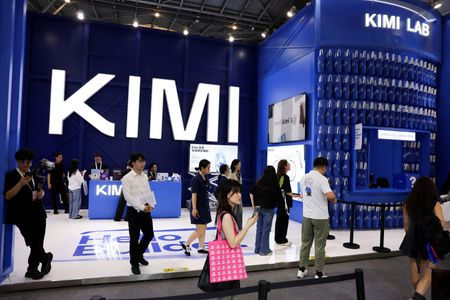

A Chinese artificial intelligence startup called Moonshot AI has put the brakes on new subscriptions after the debut of its latest model, Kimi K3, generated more user interest than its systems could handle — a development that coincides with the company’s efforts to raise new capital and potentially go public.
According to two sources familiar with the situation, Moonshot is restructuring its offshore corporate setup in preparation for a possible initial public offering on the Hong Kong stock exchange. The company has brought in financial advisers, including Goldman Sachs and China International Capital Corp, to help map out the IPO, though the timing has not been finalized, according to one of those sources and a third person with knowledge of the plans. All sources spoke anonymously because the details are confidential.
Goldman Sachs and Moonshot both declined to comment on the matter. China International Capital Corp did not respond to a request for comment.
Moonshot was founded in 2023 by Yang Zhilin, an AI researcher who studied for his doctorate at Carnegie Mellon University in Pittsburgh. The company has become one of the most closely followed AI startups in China.
In May, the company raised more than $2 billion from investors including Meituan, China Mobile, and CPE, according to a fundraising document reviewed by Reuters. That brought Moonshot’s total fundraising history to more than $5.5 billion. The company has since been seeking up to an additional $2 billion in new investment, with its valuation climbing to $30 billion as of June.
The surging appetite for powerful AI models is drawing significant investor attention to China’s top AI companies, but it is also driving up the need for expensive computing infrastructure.
Moonshot’s rivals, including DeepSeek, have also been seeking outside investment to expand their computing capabilities as Chinese AI companies race to close the gap with their American counterparts. U.S. export restrictions on advanced Nvidia chips have made access to computing power a major obstacle for these firms.
On Sunday, Moonshot announced that since Kimi K3’s release, the model has attracted enormous user interest, creating what the company described as “unprecedented compute challenges.” User requests over the previous 48 hours had far exceeded projections and were pushing the limits of existing server clusters, the company said.
In response, Moonshot said it would immediately pause new consumer subscriptions and redirect available computing resources to existing paid users, who would not be impacted by the crunch. The company also announced plans to divide future membership options into two tiers, including one dedicated specifically to coding tasks, in an effort to better align computing supply with the types of work users are doing.
The capacity strain follows a strong debut for Kimi K3, which Moonshot unveiled on Friday. The company described it as a 2.8 trillion-parameter model — which it says makes it the largest open-weight AI system in the world. Open-weight models allow users to download and customize the underlying technology, though analysts note that few users would realistically host a model of Kimi K3’s scale on their own due to the hardware costs involved.
“Kimi K3 has received far more love than we expected, and our GPUs are feeling it,” Moonshot wrote on X, noting that new subscription slots would be reopened gradually as additional capacity comes online.
The model’s size and its focus on coding and agent-style tasks make it particularly resource-intensive to operate at scale, since those types of workflows typically require the model to run repeatedly and demand heavy processing capacity.
Moonshot said Kimi K3 performs competitively with leading American models on certain technical benchmarks, a claim that has also been supported by independent evaluations.
The launch is part of a broader wave of activity among Chinese AI developers. Companies such as Z.ai and MiniMax have also recently introduced more capable models at lower costs, calling into question the assumption that China’s AI sector trails U.S. developers by months. Separately, Alibaba — which is an investor in Moonshot — announced Sunday that its own 2.4-trillion-parameter model, Qwen3.8-Max-Preview, had gone live on its AI platforms ahead of a planned open-weight release.