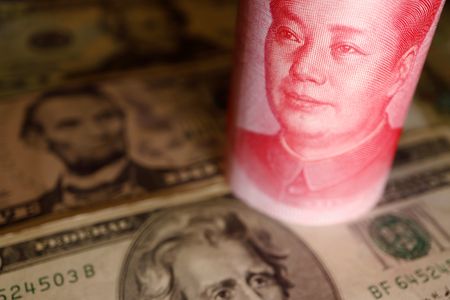

China’s central bank is working to put the brakes on its rapidly strengthening currency as the yuan continues climbing against the U.S. dollar, driven by strong export performance and declining American interest rates.
The Chinese yuan posted a 4.4% increase last year, marking its largest annual rise since 2020, and has already gained approximately 2% in 2026, reaching levels not seen in three years.
On Friday, the People’s Bank of China (PBOC) took action to moderate the yuan’s appreciation by eliminating reserve requirements for foreign exchange forward contracts, a decision designed to make dollar purchases more attractive.
Financial experts believe China’s monetary authorities may implement further strategies to keep the yuan from strengthening too rapidly.
The central bank announced it would remove the 20% reserve requirement for forex forward contracts beginning March 2nd. This action will make buying dollars less expensive and reverses a policy from September 2022 that had raised these requirements to combat the yuan’s sharp decline and prevent capital from leaving the country.
“It sends a clear policy signal that regulators want to prevent excessive yuan appreciation, which will help stabilize market expectations,” said Wang Qing, chief macroeconomic analyst at Orient Golden Credit Rating.
The PBOC could also increase the foreign exchange reserves that banks must maintain, currently set at 4% after being lowered from 6% in 2023. Such a move would require more dollar purchasing and reduce available dollar liquidity domestically.
Since December, China’s central bank has been establishing daily yuan reference rates that are weaker than what market conditions suggest, demonstrating its desire to slow currency gains. This gap has expanded to record levels this week, showing the bank’s increasing concern about the yuan’s strength.
Major Chinese state-owned banks have been purchasing dollars in domestic markets and holding them as part of an unusual strategy to control yuan strength, according to December reports. These institutions appeared to avoid recycling the dollars back into swap markets, likely trying to reduce dollar availability and increase costs for those betting on yuan gains.
Currency expert Brad Setser from the Council on Foreign Relations suggested in a recent analysis that while the central bank wasn’t directly visible in markets, state banks may have been operating on its behalf.
“All the activity is with the state banks,” he noted, describing what he called a “nearly unprecedented” level of indirect intervention in December.
Chinese monetary officials regularly make public comments reinforcing their goal to keep the yuan “basically stable” and caution against currency overshooting. The central bank has also consistently encouraged market participants to use financial instruments to protect against currency fluctuations instead of making one-directional yuan bets.
In severe situations, the PBOC can directly trade foreign currencies to affect exchange rates. During China’s 2015-16 market crisis, the central bank sold dollars to support a declining yuan. However, in recent years, Chinese authorities have avoided direct market intervention, as shown by their relatively unchanged foreign currency reserves.