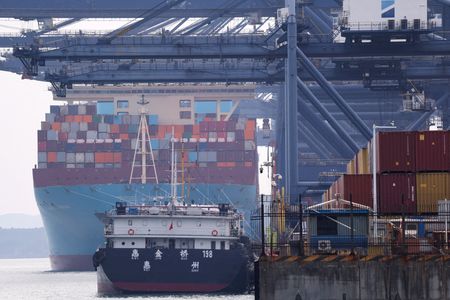

BEIJING, Feb 27 – Nearly twelve months have passed since China strengthened its rare-earth export restrictions, supposedly to block foreign military use, yet exporters continue grappling with fundamental uncertainties: at what point does a tiny magnet transform an ordinary item into a regulated product?
Companies manufacturing everything from medicine containers, advertising displays, engine parts and specialized glass have joined a growing list of businesses seeking guidance from the commerce ministry about licensing requirements.
China is building up its export enforcement workforce and implementing compliance measures across the nation, despite increasing expenses for local companies and creating shipping complications.
An examination by Reuters of more than 200 public export-control compliance questions submitted to China’s commerce ministry from 2019 through early this month revealed a dramatic increase following last April’s rare-earth control tightening.
Meanwhile, Washington has relaxed certain export limitations on items like sophisticated artificial-intelligence processors during President Donald Trump’s second administration, following China’s restrictions on rare-earth exports that threatened to disrupt global supply networks across automotive, technology, energy, aerospace, and defense industries.
Both nations’ export restrictions are anticipated to receive significant attention when Trump and Chinese President Xi Jinping convene in Beijing during late March for their second face-to-face meeting since Trump’s return to the presidency, creating a crucial test of whether the delicate trade agreement between the world’s two biggest economies can survive.
“What we are seeing in China is … the rapid construction of a comprehensive export-control apparatus designed to weaponize chokepoints across strategic and non-strategic sectors,” said Alfredo Montufar-Helu, a Beijing-based managing director at Ankura Consulting. “That the U.S. is reining in some of its controls is a direct acknowledgement of China’s growing leverage.”
China’s commerce ministry did not respond to a request for comment.
EXPORT COMPLIANCE QUERIES JUMP
Companies have overwhelmed the Chinese commerce ministry’s website with pressing compliance inquiries: do magnetic materials exceed rare-earth limits; are gallium nitride semiconductors prohibited; does ultraviolet medical machinery qualify as regulated technology.
Between 2019 and 2024, only 43 export-control compliance inquiries appeared publicly. During 2025 alone, that figure soared to 135, with approximately 16% consisting of grievances about problems like shipping delays and heightened regulatory obstacles. The complaint rate nearly doubled during early 2026.
The true volume of exporter inquiries likely exceeds these numbers by substantial margins since companies can utilize multiple private channels, including reaching out to provincial and municipal commerce offices, many lacking public inquiry systems like the central government’s commerce ministry.
Official replies to Chinese exporter questions have remained unclear and standardized, avoiding confirmation of whether specific products, from rare-earth magnets to medical supplies, needed licensing.
The enforcement campaign encompasses legal and administrative elements. Since China implemented its Export Control Law in October 2020, it has introduced or expanded export control policies 29 times, versus only six instances between 2015-2020.
Employment documents indicate 45 commerce ministry positions available in this year’s national civil-service exam could involve export-control-related duties, compared with 11 such openings in both 2022 and 2023.
Numerous provincial and municipal administrations have organized compliance workshops and policy briefings during the past year, while Beijing has hosted national export-control working conferences bringing officials from throughout the country to the capital.
Beijing’s October 2025 modification to its rare-earth export-control system incorporated lessons from the U.S. Foreign Direct Product Rule, which permits Washington to claim authority over certain foreign-manufactured goods created using American technology.
“China’s use of rare earths as leverage is completely learned from the West – especially the U.S.,” said Li Xing, professor at the Guangdong Institute for International Strategies, a think tank in Guangzhou.
China controls rare-earth processing, transforming ore into refined oxides and metals utilized in electric vehicles, wind turbines and defense systems, representing a supply chain bottleneck more significant than mining operations.
Its new licensing framework extends into processing and downstream integration.
“This is not just a supply chain shortage. This is economic warfare,” said Nick Myers, chief executive of U.S. rare-earth startup Phoenix Tailings.
PACE OF U.S. EXPORT CONTROLS SLOWS
Throughout Trump’s initial presidency and under President Joe Biden, the United States quickly broadened export controls focused on China.
Yearly China-related additions to the Entity List, requiring U.S. exporters to secure licenses often reviewed with denial presumption, jumped from 47 in 2018 to 227 in 2020, hitting a peak of 257 in 2024, according to Reuters analysis.
Since Trump’s presidential return, this pattern has shifted. China-related Entity List additions dropped to 131 in 2025, approximately half the prior year’s rate.
Earlier this month, the Pentagon temporarily released, then retracted, a revised Military End User list that would have included Chinese technology companies Alibaba and Baidu while removing several memory chip manufacturers.
The White House and the U.S. Commerce Department’s Bureau of Industry and Security did not respond to requests for comment. A Pentagon official said the list was withdrawn as it may require modifications based on new information and that a revised list would be published, without providing additional details.
This moderation has attracted criticism from bipartisan U.S. legislators, who have criticized the administration for approving specific Nvidia AI chip exports and reducing BIS funding.
A Nvidia spokesperson said in a statement that criticism of the current administration’s decision to greenlight these semiconductor shipments to China was unintentionally promoting the interests of foreign competitors.
“America should always want its industry to compete for vetted and approved commercial businesses, and thereby protecting national security, creating American jobs, and keeping America’s lead in AI,” the spokesperson said.
Nvidia CEO Jensen Huang, who criticized Biden-era controls, said last year that “export control was a failure” and that Trump “realises it’s exactly the wrong goal.”