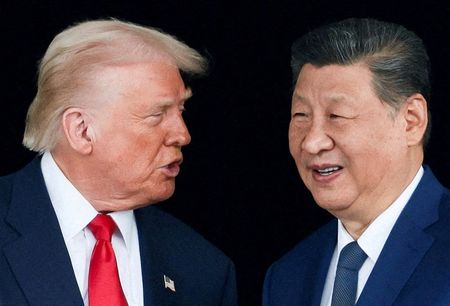

BEIJING — While President Donald Trump implements tariffs against various nations, China is seizing the opportunity to restructure international commerce in ways that could shield its $19 trillion economy from American influence for decades to come.
According to a Reuters investigation, Beijing is taking advantage of the disruption caused by Trump’s policies to integrate China’s massive manufacturing sector into major economic partnerships worldwide, including deals with the European Union, Gulf nations, and trans-Pacific trading groups. This strategy involves fast-tracking approximately 20 trade agreements that have been under development for years, despite global concerns about China’s excess production capacity, limited market openness, and weak domestic consumer spending.
An analysis of 100 Chinese-language publications by government-supported trade experts since 2017 shows a coordinated effort by China’s policy consultants to counter U.S. trade strategies and undermine Washington’s efforts to limit Chinese economic influence.
China is now implementing this strategy. The agreement signed with Canada during Prime Minister Mark Carney’s January trip to Beijing — reducing tariffs on Chinese electric vehicles — represents the first of multiple deals designed to diminish U.S. economic leverage, according to conversations with 10 sources including Chinese government representatives and trade officials.
“Don’t interrupt your opponent when he is making a mistake,” commented one Chinese official regarding Trump’s disruptive trade policies.
The analysis, based on more than 2,000 trade strategy documents endorsed by the Chinese Academy of Social Sciences and Peking University, which provide guidance to senior leadership, demonstrates that policy experts widely believe that difficult structural adjustments are worthwhile for China’s long-term control of international trade. These document contents are being disclosed publicly for the first time.
If Beijing succeeds, it could overturn more than ten years of American trade policy by positioning itself as the center of a new, Chinese-influenced multilateral system, according to two Western diplomatic sources.
“The Chinese have a golden opportunity now,” stated Alicia Garcia Herrero, senior fellow at the Bruegel think tank.
China’s commerce ministry did not respond to requests for comment regarding Beijing’s approach.
When asked about China’s strategy, a U.S. official told Reuters it was predictable that nations with significant trade surpluses would try to preserve globalization.
“President Trump is fixing the problems globalization caused for the United States while other countries are trying to double down on globalization as free market access to the United States goes away,” the official stated.
BUILDING PARTNERSHIPS
The change in China’s messaging reflects its strategic thinking. Twelve months ago, Beijing was using military-style rhetoric, referencing Mao Zedong and China’s resistance against Western forces during the Korean War.
Currently, as China prepares for Trump’s April visit, its diplomats are traveling globally, encouraging trade partners to join in protecting multilateral cooperation and open commerce.
In January, China sent its senior diplomat to small nation Lesotho — initially targeted by Trump with a 50% tariff — to promise development assistance. On Saturday, state media announced China would eliminate tariffs on imports from 53 African nations. Meanwhile, China is promoting AI-enhanced customs technology to neighboring countries and working to modernize digital infrastructure supporting international trade.
These actions highlight an objective outlined in policy documents: to integrate China so thoroughly into global trade networks that partners cannot afford to disconnect under U.S. pressure.
“In countering U.S. strategic competition with China, ‘anti-decoupling’ should become China’s primary focus,” wrote Ni Feng, fellow at CASS’s Institute of American Studies, in 2024.
Chinese representatives are now working to expedite delayed trade negotiations. Since 2017, China has been in discussions with nations including Honduras, Panama, Peru, South Korea and Switzerland.
“We are willing to negotiate bilateral and regional trade and investment agreements with interested countries and regions,” commerce ministry spokesperson He Yongqian told Reuters during Carney’s visit, without providing details.
China’s foreign minister Wang Yi caught European negotiators off guard in November by suggesting a free-trade agreement with Brussels during discussions with his Estonian counterpart.
One month later, Wang urged the Gulf Cooperation Council to finalize ongoing free-trade negotiations. In January, British Prime Minister Keir Starmer agreed with Chinese leader Xi Jinping to begin a feasibility study for a services trade agreement that could lower barriers for British companies. German Chancellor Friedrich Merz has announced plans to pursue “strategic partnerships” with China during an upcoming trip.
China’s commerce minister Wang Wentao has made membership in the Comprehensive and Progressive Agreement for Trans-Pacific Partnership (CPTPP) a top priority. This agreement originated from the U.S.-supported Trans-Pacific Partnership, created partly to counter China before Washington withdrew in 2017.
However, China’s massive trade surplus complicates these efforts. Some member nations worry Chinese manufacturers might use improved market access to export excess low-cost products while China’s domestic consumption remains weak.
Wendy Cutler, chief negotiator during the Obama administration for the Trans-Pacific Partnership, recognized Beijing’s opportunity to promote trade and multilateralism but emphasized China needed to move beyond rhetoric.
“And with its huge trade imbalances, as well as some of the coercive measures it’s now taking against countries like Japan, it’s hard to see how they’re walking the walk,” Cutler told Reuters.
A senior European trade diplomat characterized Beijing’s proposals as “pure Chinese propaganda,” stating Brussels had no intentions for a trade agreement.
Chinese advisers remain determined. Speaking to Reuters, one referenced the EU and China’s landmark 2020 investment agreement negotiated during Trump’s first presidency. However, the deal was suspended in 2021 before implementation due to disputes over human-rights sanctions.
STRATEGIC INSIGHTS
Some Chinese advisers argue in the documents that Beijing should examine how Washington has “weaponized” international organizations to contain China, and take advantage of opportunities created by Trump’s willingness to abandon or marginalize multilateral institutions like the World Trade Organization.
Others suggest Beijing should concentrate on shaping global standards in areas such as intellectual property through programs like Xi’s Belt and Road initiative and China’s participation in the Regional Comprehensive Economic Partnership, covering approximately 30% of worldwide GDP.
China is now implementing these strategies.
Its recently enhanced agreement with Southeast Asian nations, for instance, emphasizes AI-driven and digital commerce, where China aims to establish early dominance.
China’s customs processing vision is demonstrated at its “Friendship Port” on the Vietnamese border, where state media reports domestically-developed AI technology has reduced waiting times by 20%, enabling faster deliveries. Reuters could not independently confirm this claim.
MASSIVE TRADE SURPLUS
The challenges that China’s $1.2 trillion trade surplus creates for trading partners’ manufacturing industries are difficult to ignore.
Pascal Lamy, former WTO director-general and EU trade commissioner, said Chinese companies are exporting more goods to Europe than the region can handle.
“It’s a mystery how, given the nature of the regime, given the sort of collective cleverness, how is it that they have not succeeded in rebalancing their economic model?” he stated.
Not everyone views closer Chinese relationships as the best method to reduce U.S. dependence.
Stephen Nagy, China project lead at the Macdonald-Laurier Institute in Ottawa, said Carney’s tariff-reduction agreement with Xi appears intended to create negotiating power before discussions over the U.S.-Mexico-Canada (USMCA) trade agreement.
“I think his bet is wrong,” he added, predicting Trump would not be influenced.
Carney has stated Canada honors its USMCA commitment to avoid free-trade agreements with non-market economies. His office did not respond to comment requests.
Mexico, meanwhile, is cautious about risking U.S. market access by developing closer Chinese ties.
“We see no need for a free-trade agreement with China right now,” said a Mexican trade official. “We are already in the CPTPP and have 60% of world GDP covered.”
Beijing’s trade partners genuinely need China to boost its consumer spending, said Fred Neumann, chief economist for Asia Pacific at HSBC.
Wang, China’s commerce minister, has stated that increasing imports is a priority as Beijing prepares to unveil its next five-year plan in March, consistent with commitments to raise consumption’s portion of GDP.
But economic rebalancing is a long-term undertaking. Trump has three years remaining in office, and the following administration could return to building coalitions to contain China.
China must “study in depth the logic of U.S. actions within international institutions and the possible next steps it may take to better respond to increasingly fierce strategic offensives in the future,” Zhao Pu, then at Renmin University and now a researcher at CASS’s Institute of American Studies, wrote in 2023.