
Chinese government officials have begun preliminary discussions with solar equipment manufacturers about potentially restricting exports of cutting-edge technology to the United States, according to five individuals familiar with these early-stage conversations.
The potential restrictions could jeopardize American company investments and slow progress in space-based computing initiatives, given that China produces over 80% of global solar panel components and houses the world’s top 10 solar cell equipment suppliers.
Sources indicate that no final decisions have been made, and the discussions haven’t progressed to seeking formal industry input from a sector already struggling with significant overcapacity following years of rapid growth.
China’s commerce ministry and state council did not provide immediate responses to Reuters’ requests for comment.
POTENTIAL IMPACT ON US MANUFACTURING EXPANSION
Should these measures be implemented, they could disrupt expansion plans for American companies like Tesla, which aims to construct new facilities or enhance existing operations to increase domestic production capacity.
This would represent another expansion of export restrictions in a technology sector where China maintains dominance, following Beijing’s decision to regulate rare earth exports last year in response to US tariffs.
The timing coincides with escalating US-China competition in developing space-based computing systems powered by solar technology, an area of particular interest to Tesla CEO Elon Musk.
Major US technology corporations including Google and Amazon are investing heavily in terrestrial solar and energy storage infrastructure while also relying on similar orbital data centers to meet artificial intelligence’s increasing power requirements.
Industry analysts and executives have anticipated potential export controls, partly due to growing concerns about efforts by Musk and others to increase American solar panel manufacturing and reduce dependence on China.
INDUSTRY CONCERNS ABOUT US COMPETITION
Xu Xiaohua, chairman of Anhui Huasun Energy, told Caijing business magazine earlier this year that Musk is attempting to capitalize on China’s solar industry downturn to obtain equipment and expertise.
Xu emphasized the need for Chinese companies to strengthen their efforts to maintain technological leadership.
Huasun did not respond immediately to requests for comment.
These potential restrictions come as leaders Xi Jinping and Donald Trump prepare for a summit in Beijing next month, which both nations see as an opportunity to establish more stable trade relations.
Reuters previously reported that Tesla was negotiating to purchase $2.9 billion worth of solar panel manufacturing equipment from Chinese suppliers, including Suzhou Maxwell Technologies, which was awaiting export approval from the commerce ministry.
Musk has stated that solar power could meet all of America’s electricity needs, and Tesla has set an ambitious target of establishing 100 gigawatts of solar manufacturing capacity on American soil by 2028.
CONCERNS ABOUT TESLA’S INDEPENDENCE GOALS
“Tesla succeeding in its solar self-sufficiency push could prove a nightmare for China’s world-leading solar manufacturers,” stated research firm Trivium China, which specializes in Chinese government policy analysis, in a recent report.
The firm noted that Chinese manufacturers would not only lose a significant potential customer but could face competition from a powerful new rival during a period of existing financial strain.
“Beijing won’t sit idly by as its industrial champions inadvertently aid the industrial policies of rival countries.”
Three sources, who requested anonymity due to the confidential nature of regulatory discussions, reported that Suzhou Maxwell Technologies received official visits after Reuters published details about Tesla’s negotiations with Chinese suppliers.
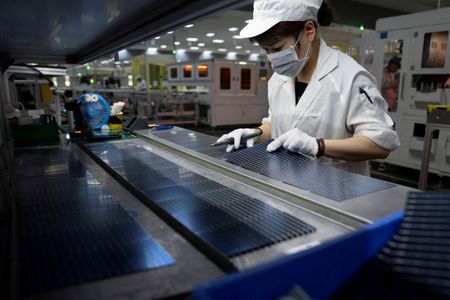
Discussions between regulators and Suzhou Maxwell Technologies centered on possible limitations for US shipments, including sophisticated equipment required for producing high-efficiency panels using HJT technology, according to two sources.
Neither Suzhou Maxwell nor Tesla provided immediate responses to comment requests.
SCOPE AND TIMING REMAIN UNCLEAR
Reuters could not establish the potential breadth of restrictions regarding other export destinations, implementation timelines for licensing requirements, or specific product coverage.
In 2025, China announced licensing requirements for exports of related technology, including advanced batteries and materials for energy storage systems used in large-scale solar installations, but delayed implementation until November this year.
Other Chinese solar manufacturers have continued negotiations and shipments of solar manufacturing equipment to the United States, including additional companies competing for Tesla’s business, according to two sources.
HJT, or heterojunction solar technology, enhances power generation by utilizing crystalline silicon wafers surrounded by ultra-thin silicon layers within the cell, enabling greater capture of sunlight-generated electrons as electrical energy.