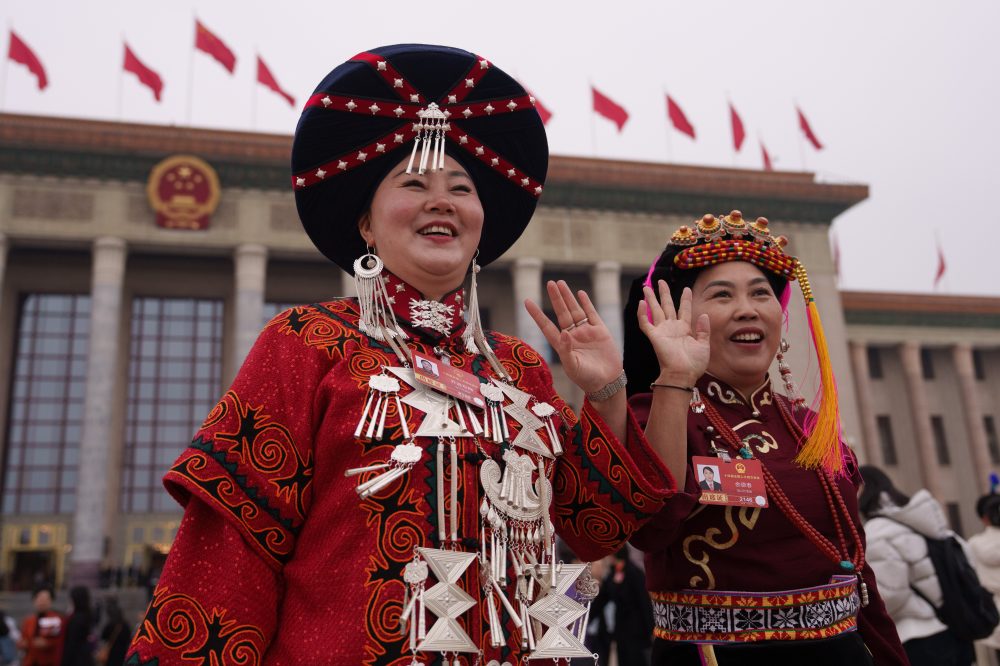

BEIJING — Chinese lawmakers are preparing to pass comprehensive legislation promoting what officials describe as ethnic unity, though human rights advocates warn the measure will strip away protections for minority communities and accelerate forced cultural integration.
The National People’s Congress is anticipated to ratify the legislation Thursday, with the goal of building “a stronger sense of community among all ethnic groups in the Chinese nation,” according to Lou Qinjian, the congressional delegate who presented the bill to lawmakers.
The legislation requires all levels of government and private businesses to actively promote ethnic cohesion, extending to local administrations and state-connected organizations such as the All-China Women’s Federation.
“The people of each ethnic group, all organizations and groups of the country, armed forces, every Party and social organization, every company, must forge a common consciousness of the Chinese nation according to law and the constitution, and take the responsibility of building this consciousness,” the proposed law states.
Researchers and policy experts view this new legislation as damaging to minority group identities, particularly because it requires Mandarin Chinese instruction throughout mandatory schooling, along with other assimilation measures.
Han Chinese constitute the vast majority of China’s population, with Mandarin serving as the nation’s official language. The remaining 55 ethnic minorities are distributed nationwide and represent 8.9% of the total population.
China’s constitution guarantees that “each ethnicity has the right to use and develop their own language” and “have the right to self-rule,” while the Law on Regional Ethnic Autonomy provides limited self-governance to these communities, including flexibility in economic development strategies.
Policy analysts believe the new legislation will override these existing protections in actual implementation.
“It puts a death nail in the party’s original promise of meaningful autonomy,” stated James Leibold, a professor at Australia’s LaTrobe University specializing in China’s evolving minority policies. Leibold described the law as the culmination of Chinese President Xi Jinping’s “major rethink” of ethnic policies.
China’s United Front, the agency responsible for minority affairs, declined to provide comment when contacted.
The law’s Article 15 requires Mandarin Chinese education for all children from pre-kindergarten through the completion of high school.
While Mandarin already serves as the main instructional language in Inner Mongolia, Tibet and Xinjiang — regions with substantial minority populations — this new law effectively prohibits minority languages from serving as primary educational languages anywhere in the country.
Previously, ethnic minorities maintained some control over educational language choices in their schools.
Students in Inner Mongolia, the autonomous region adjacent to Mongolia, formerly could complete most of their education using Mongolian language materials.
This practice ended in 2020 when incoming students discovered their Mongolian textbooks were banned and replaced with Chinese materials. The policy shift triggered widespread demonstrations and immediate government suppression, followed by re-education programs, according to research co-authored by Leibold and a former Mongolian journalist.
Currently, students in the region can only take Mongolian as a foreign language course, limited to one hour daily.
Academic experts also highlight the law’s emphasis on creating “mutually embedded community environments,” which they believe could lead to the dissolution of minority-concentrated neighborhoods.
“The intention is to encourage Han and other minorities to migrate into each other’s communities,” explained Minglang Zhou, a University of Maryland professor who researches China’s bilingual education policies.
While numerous nations, including the United States, implement comparable assimilation strategies, China frames its approach as bringing development to minority regions. However, Maya Wang, deputy Asia director at Human Rights Watch, argues the law doesn’t genuinely promote equality.
“The question was never so much about ensuring their participation in the economy in an equitable manner, more inclusive manner,” Wang said, noting the policies are imposed on Tibetans. “And a truly inclusive model does not preclude the ability of children to speak two languages.”
The legislation also establishes legal grounds for Chinese authorities to pursue individuals or organizations outside China if their activities are deemed harmful to ethnic unity progress.
These international prosecution provisions mirror language in the National Security Law that China implemented in Hong Kong during 2020, enabling authorities to charge people living abroad for actions Beijing considers seditious or separatist. Hong Kong officials subsequently placed bounties on 34 overseas activists suspected of security law violations.
Rayhan Asat, a legal researcher at Harvard University, said “the law serves as a strategic tool and gives the pretext to government to commit all sorts of human rights violations.”
Asat’s younger brother, Ekpar Asat, is currently serving a 15-year prison term in Xinjiang for allegedly promoting ethnic discrimination and hatred. Asat said her family never received official notification of his arrest or trial proceedings.
Her brother operated as an entrepreneur who developed a social media platform for Uyghurs. She said authorities detained him shortly after his 2016 visit to the United States through the State Department’s International Visitor Leadership Program.
The Uyghur Muslim minority has faced an extensive campaign of detention and imprisonment by Chinese authorities. Although short-term internment facilities were reportedly closed in 2019, thousands were subsequently transferred to prisons, where analysts say they were prosecuted for their ethnic identity rather than actual criminal conduct.
Asat expressed hope that President Donald Trump will discuss her brother’s case during his planned meeting with Xi.
She voiced concerns about how future generations will understand Uyghur identity.
“I think preserving any sort of Uyghur identity would be impossible,” she said.