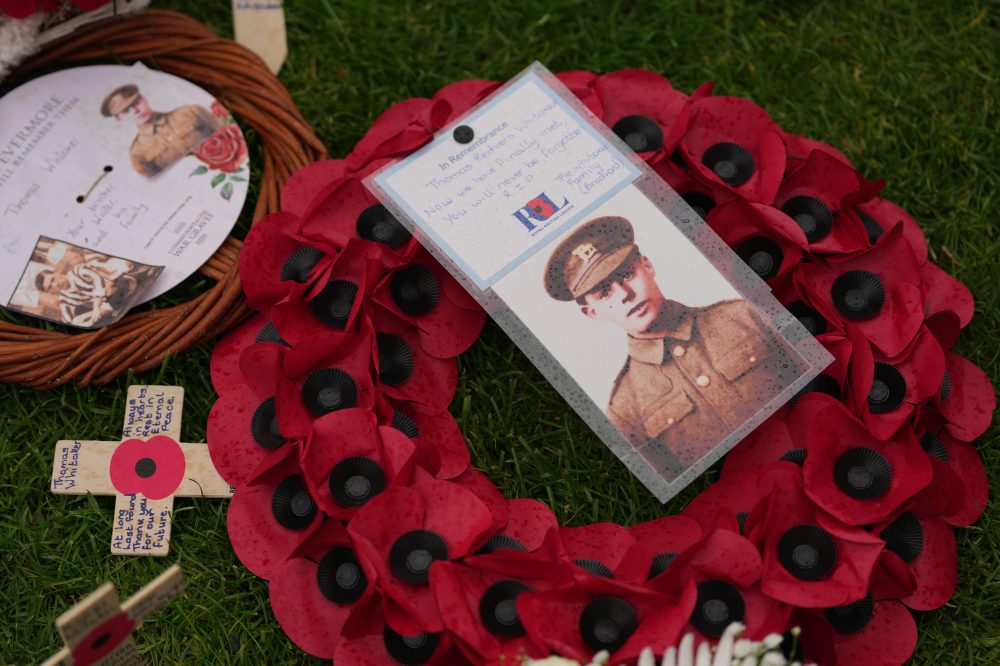

ZONNEBEKE, Belgium (AP) — A personal postcard carried by a World War I soldier has led to the identification of his remains and brought together separated family branches more than a century after he perished on the Western Front.
Memorial services took place Wednesday in western Belgium where dozens gathered to honor six British soldiers whose identities were recently confirmed using archival records and DNA testing. The ceremony featured the dedication of six fresh white marble headstones.
Among those laid to rest at Tyne Cot Cemetery was Pvt. Thomas Whitaker, who had been carrying a postcard from Bradford in northeast England when he died in the trenches. Family members from that same area attended the service.
Three Whitaker relatives participated in the ceremony. As sunlight broke through overcast skies, 22-year-old Joe Whitaker recited a poem he composed for his great-great-uncle: “At peace in foreign hills, he finally drifts away to sleep, his mind on Bradford mills.”
The postcard Thomas carried became vital evidence for British government investigators working to confirm his identity and eventually connected Joe’s family with a previously unknown branch of the Whitaker lineage.
“The thought that (Thomas) might have been thinking of home, comforted by this postcard that he kept on him from Bradford — we were all quite taken aback by that,” Joe said.
He explained that composing the poem “felt like the right thing to do.”
Alexia Clark, who works commemorations cases for the U.K. Ministry of Defence’s Joint Casualty and Compassionate Centre (JCCC), explained that the six soldiers were discovered during excavation work in western Belgium. The postcard found with one soldier provided an important clue.
“And then actually when we looked at the missing list and went, ‘Oh we have got one from Bradford! Great, there’s a strong chance that he is going to be one of them,’” she said.
The JCCC team, nicknamed “the war detectives,” combined the postcard with other recovered items like a Lewis Gun and military uniforms to narrow down possibilities from the more than half million British soldiers still unaccounted for from World War I.
Investigators reached out to possible family members for DNA samples, which confirmed the identities of Thomas Whitaker along with privates Horace Frederick Cook, Frederick Martin, Charles Richard Russels, Courtney Darvill Hart and Joseph Turnley — all serving with the 2/4 Battalion Queen’s Royal West Surrey Regiment.
Paul Turnley received a ceremonially folded British flag presented by military officials in recognition of his relative Pvt. Joseph Turnley’s sacrifice.
“Just a privileged to be laying a relative of ours to rest, to watch, to be present and then to be passed the flag… it was the greatest treasure actually,” Paul said, honoring his grandfather’s cousin.
The ceremony took place as local residents, cyclists, and students observed from a nearby farm road. A military musician performed a solemn melody on cornet while Rev. Adéle Rees offered prayers.
Pvt. Jone Wainile from the Princess of Wales’s Royal Regiment honor guard then recited the moving Kohima Epitaph: “When you go home tell them of us and say, ‘For your tomorrow, we gave our today.’”
Paul Whitaker reflected: “My children, my grandchildren, anyone, can come and know where Thomas is, and that is a lovely thing to have. It’s just a real privilege to have Thomas be one of the ones that has been found.”