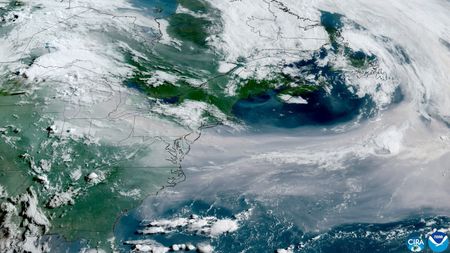

Canadian military forces were gearing up Saturday to airlift residents out of a remote northwestern Ontario community as massive forest fires continued to push dangerous smoke across a wide stretch of the United States — including right here in Delaware.
Federal Emergencies Minister Eleanor Olszewski announced late Friday that armed forces aircraft would be used to evacuate the roughly 600 people living in Fort Hope, located in a sparsely populated region of northwestern Ontario where some of the most severe fires are raging. The area has limited road access and depends largely on air transportation. Thousands of others from fire-affected zones have already been moved to communities farther south in Ontario.
Canada’s federal natural resources ministry reported Saturday that 69 new fires broke out overnight, pushing the total number of active fires to 955 across the country. The total land burned so far has reached nearly 11,000 square miles — or about 28,500 square kilometers — which remains well below the five-year average. However, wind patterns have driven the smoke across the U.S. border, leading officials to issue air quality alerts and health advisories across multiple states.
As of 8 a.m. Eastern Time Saturday, the U.S. Environmental Protection Agency’s AirNow monitoring site listed air quality as “unhealthy” across a broad region that included southern Ontario, eastern Ohio and West Virginia, most of Pennsylvania and New Jersey, much of Virginia, and all of Maryland, Delaware, and Washington, D.C.
Conditions were even worse in parts of western Pennsylvania, including the Pittsburgh area, where air quality was rated “very unhealthy.” AirNow projected that those areas would see gradual improvement as the day went on.
The smoke is also expected to have minimal effect on Sunday’s soccer World Cup final at New York New Jersey Stadium, according to forecaster AccuWeather, which made that assessment on Friday.
President Donald Trump weighed in on Friday, blaming what he described as poor Canadian forest management practices for the smoke situation. He stated he would factor in the “incalculable cost” of addressing the pollution when determining tariffs on Canadian goods.
Following the president’s remarks, Minister Olszewski pushed back, noting that Canada has put C$12 billion — roughly $8.56 billion U.S. — into forest sustainability and fire prevention efforts since 2020 as the nation faces increasingly dry and warm weather conditions.
Climate experts have long pointed to rising temperatures as a driver of drier forest conditions and greater wildfire risk. Large-scale forest fires have now become a near-annual event across Canada, which is home to some of the largest forested landscapes on the planet.