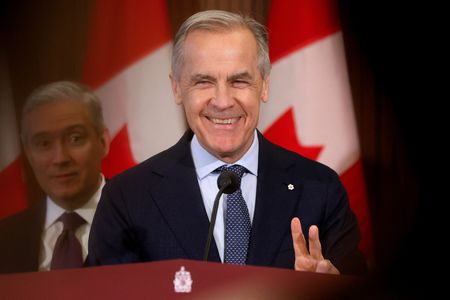

OTTAWA – Canadian Prime Minister Mark Carney is positioning himself for crucial trade negotiations with the United States following his party’s decisive victory in last week’s special elections, which secured him a parliamentary majority.
The Canadian leader now confronts a critical July 1 deadline where Canada, the U.S., and Mexico must decide whether to maintain their current trade arrangement, renegotiate terms, or implement yearly reviews leading up to the agreement’s 2036 expiration date. Under mounting pressure from Washington for trade concessions, Carney plans to pursue a restructured agreement this year targeting tariffs on Canadian steel, aluminum, and automotive products.
Prior to the Liberal Party’s electoral sweep, Carney argued that securing a parliamentary majority was essential for effectively managing Trump’s trade policies. Political experts and former government officials now say the Prime Minister must fulfill his campaign promises to revitalize Canada’s economy and successfully navigate negotiations with the Trump administration.
“Dealing with Trump and negotiating a trade deal with the U.S. is what Canadians hired Mark Carney to do,” stated Dan Arnold, who previously served as a senior aide in former Prime Minister Justin Trudeau’s administration. “He now has to rise to the moment and show us the fruits of these deals he’s been signing.”
Recent polling conducted by Nanos Research revealed that Canadians prioritize economic issues and inflation concerns, with the nation’s relationship with the United States ranking as their second-highest worry.
While Trump has repeatedly made provocative statements about making Canada the 51st U.S. state, Carney has committed to expanding Canadian exports to alternative markets by 100% over the next ten years. His government has finalized over 20 economic and security partnerships in the past year, including agreements with China, and is currently working toward a deal with India. Despite these efforts, nearly 70% of Canada’s exports still flow to the United States.
During a Sunday video address, Carney characterized Canada’s heavy dependence on U.S. trade as “weaknesses that we must correct.” He encouraged Canadians to draw inspiration from historical leaders like Chief Tecumseh, who organized Indigenous communities around the Great Lakes to oppose American territorial expansion during the War of 1812.
“I will never sugarcoat our challenges,” Carney declared, noting that the United States has dramatically shifted its trade policies and imposed tariff levels not witnessed since the Great Depression era.
While U.S. trade officials conducted meetings in Mexico City this week, formal discussions between Washington and Ottawa regarding the North American trade pact renewal have yet to commence.
Fen Hampson, an international affairs professor at Carleton University in Ottawa, believes the time has come for decisive action. “It’s time for the prime minister to take the gloves off and start negotiating in the trenches,” he said. Hampson suggested that Carney’s majority government provides the political flexibility to make potentially unpopular compromises, such as opening Canada’s protected dairy sector to U.S. competition or persuading provincial governments to increase American alcohol imports.
“If he had a minority, the prime minister might not be able to absorb these concessions,” Hampson explained. “But he has the political capital to do it and he can also use his influence to address provincial premiers who have been obstacles.”
Dominic LeBlanc, the minister overseeing U.S. trade relations, informed a parliamentary committee that Canada aims to secure both sector-specific tariff agreements and a comprehensive North American trade deal. Representatives from Carney’s office and LeBlanc’s department did not respond to requests for comment, though the government has previously stated that Canada’s dairy supply management system remains non-negotiable. The White House also declined to comment.
Diamond Isinger, who handled Canada-U.S. relations during the Trudeau government, believes Carney’s majority provides stability through the uncertainty surrounding November’s U.S. midterm elections, with no Canadian federal election anticipated until 2029.
“The prime minister now has time to get to a better CUSMA deal without the fear of a snap election,” she said, referencing the Canadian name for the trade agreement.
Conservative opposition leader Pierre Poilievre, who lags behind Carney by more than 20 points in leadership preference polls, criticized the Prime Minister on Tuesday, claiming he “refuses to stand up against these wrong-headed American tariffs.” Poilievre noted that formal bilateral discussions have not occurred in five months.
Asa McKercher, who teaches public policy at St. Francis Xavier University in Nova Scotia, argues that Carney must concentrate on domestic priorities, including the pending decision on Canada’s next fighter jet fleet and infrastructure investment projects announced last year.
“He’s done the world circuit and made some great speeches, but now he has to actually focus on being a domestic politician,” McKercher observed.
Drew Fagan, a visiting professor at Yale University, emphasized the need to address rising living costs. Government statistics show that among Group of Seven developed nations, Canada maintains the second-highest unemployment rate and leads in food price inflation.
“This is a country that’s fundamentally getting poorer for many people,” Fagan noted. “Given what’s happened in the world in the last 18 months, Carney is not being blamed for the price of cheese and juice. Canadians have put up with a lot but at some point, they will hold somebody accountable.”