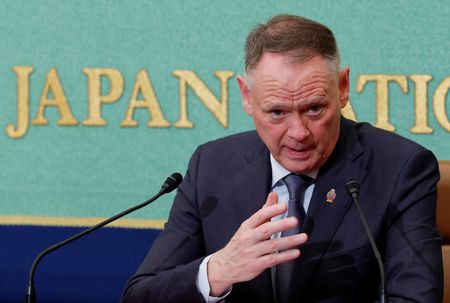

TOKYO — Canadian Defence Minister David McGuinty confirmed Thursday that he sat down with Japan’s defence minister to discuss a cutting-edge military aircraft program that the two countries’ governments are jointly pursuing alongside Britain and Italy.
The program in question is the Global Combat Air Programme, known as GCAP, which was launched in 2022 with the goal of producing a next-generation stealth fighter jet by 2035. The effort is being led by three major defense contractors: Britain’s BAE Systems, Japan’s Mitsubishi Heavy Industries, and Italy’s Leonardo.
McGuinty met with Japanese Defence Minister Shinjiro Koizumi in Tokyo on Wednesday. Speaking to Reuters afterward, McGuinty described GCAP as a “promising initiative” and said Canada wants to learn more before making any decisions. “We are interested in learning more about it. I’ll take it back to my team and see what it looks like,” he said.
Canada’s curiosity about the program is drawing attention at a time when GCAP is gaining interest from potential new partners. If Canada were to formally join, it would become the first nation outside the program’s three founding members to participate. Italian Defence Minister Guido Crosetto said this month that he would welcome additional countries willing to share in the development costs.
Officials in Rome and executives at Leonardo have floated Canada, Saudi Arabia, and Germany as countries that could potentially join as partners or observers. However, any expansion of GCAP would need to be approved by all three founding nations.
GCAP is considered one of two major Western sixth-generation fighter jet initiatives. The other is the U.S. Air Force’s Next Generation Air Dominance program, known as NGAD.
A competing European project called the Future Combat Air System, or FCAS, which had been developed by France, Germany, and Spain, has fallen apart due to a dispute between aerospace companies Airbus and Dassault Aviation.