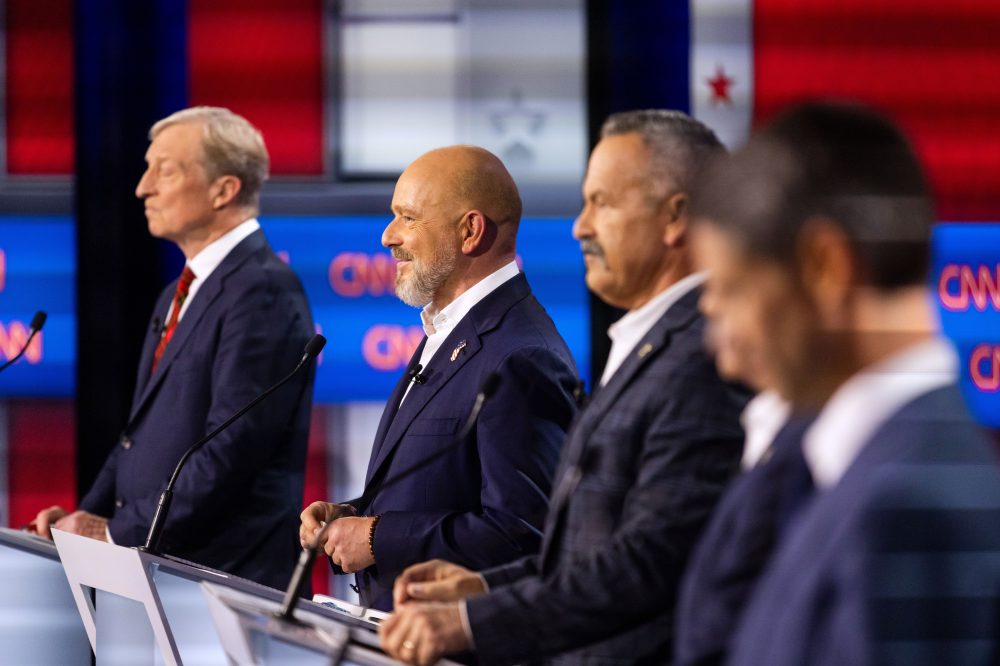

SACRAMENTO, Calif. — Seven contenders seeking California’s top executive office engaged in a spirited televised debate Tuesday evening, sparring over contentious issues including a proposed wealth tax and government healthcare for undocumented residents.
The CNN-broadcast forum represented one of the final opportunities for candidates to make their case to voters before the June 2nd primary to replace term-limited Democratic Governor Gavin Newsom. With mail-in ballots already circulating, the top two vote-getters will move forward to November’s general election regardless of political affiliation.
While no Republican has occupied the governor’s mansion for over ten years, the crowded field suggests uncertainty with less than four weeks remaining until election day.
Tuesday’s debate featured Democrats Xavier Becerra, former Biden administration health secretary; Katie Porter, ex-congresswoman; billionaire environmental advocate Tom Steyer; San Jose Mayor Matt Mahan; and former Los Angeles Mayor Antonio Villaraigosa. Republicans Steve Hilton, a conservative media personality, and Riverside County Sheriff Chad Bianco also participated.
Healthcare policy sparked intense exchanges among the candidates.
The contenders battled over eliminating private insurance for a government-controlled system, a concept that has repeatedly stalled in the state legislature.
Porter, an advocate for government-managed healthcare, challenged Becerra directly about his shifting position on the matter.
“Do you support CalCare — California having its own state-run, single-payer system, yes or no?” Porter asked.
Becerra provided an ambiguous response.
“The most important thing about having a Medicare for All plan is that it includes everyone,” he said. “What we have to do is get to the point where we are covering everyone with something like Medicare for All.”
Mahan, opposing a state-controlled system, later interjected that Becerra “was unable to clearly answer the most important question on healthcare.”
Becerra pushed back: “I did answer that question.”
Steyer aligned with Porter in supporting the proposal, while Bianco, Hilton, and Villaraigosa dismissed it as impractical or financially unrealistic.
Immigration discussions revealed stark partisan divisions.
Steyer, Porter and Becerra endorsed state-funded medical coverage for low-income undocumented immigrants, a program Newsom initially expanded but later reduced. Bianco labeled the approach “ridiculous.”
Democratic candidates strongly criticized Trump administration immigration enforcement operations.
Steyer argued the state should pursue legal action against federal agents and immigration officials who engage in racial profiling or violence against Californians. Mahan noted that San Jose business owners have seen customers disappear because many immigrants fear leaving their homes.
Bianco defended Immigration and Customs Enforcement activities, stating agents were upholding federal law and working to remove individuals he described as “criminals” without legal status.
Hilton, who emigrated from England, emphasized he was the debate’s only immigrant participant. He cautioned against mixing legal and unauthorized immigration issues.
“Although it is the federal government’s responsibility to determine and implement immigration policy, I think it’s important that all the laws are peacefully enforced,” Hilton said. “As governor, I would make sure that we work with the federal government to enforce our laws.”
Democratic candidates repeatedly stressed their opposition to Trump’s immigration agenda.
Neither Hilton, who has Trump’s backing, nor Bianco frequently mentioned the former president, except to argue that Democrats wrongly hold him responsible for state problems.
Becerra referenced Trump most frequently, highlighting his numerous lawsuits against the administration during his tenure as state attorney general from 2017 to 2021, before Biden appointed him health secretary.
“I’m going to repeat Donald Trump as often as I have because he’s the menace,” Becerra declared.
When Villaraigosa pressed Hilton to confirm Trump’s 2020 election defeat, Hilton declined to respond.
“Endlessly going on about Donald Trump doesn’t serve the needs of the struggling families and small businesses,” Hilton said.
Mahan attempted to stake out centrist ground. He criticized Becerra for attributing high fuel costs entirely to Trump, while noting San Jose has challenged the Trump administration’s immigration policies in court. He called Republican support for Trump’s “cruel and ineffective policies” disqualifying.
Porter offered a blunt assessment: “Donald Trump sucks.”
Tax policy discussions centered on wealth inequality measures.
Steyer stood alone in endorsing a proposed billionaire tax likely appearing on November ballots. The one-time levy would restore funding eliminated by Trump-era cuts that reduced healthcare access for low-income residents.
Porter supports higher taxes on California’s wealthiest residents but characterized the proposed tax as a short-term solution to systemic problems.
Mahan proposed suspending gasoline taxes to ease burdens on working families.
Hilton suggested eliminating income taxes on the first $100,000 of earnings.
Both Mahan and Steyer advocated taxing artificial intelligence companies and directing revenue toward worker support programs, including job training initiatives.
“The answer is to tax these companies, not to regulate them to the point that they simply go to other places,” Mahan said.