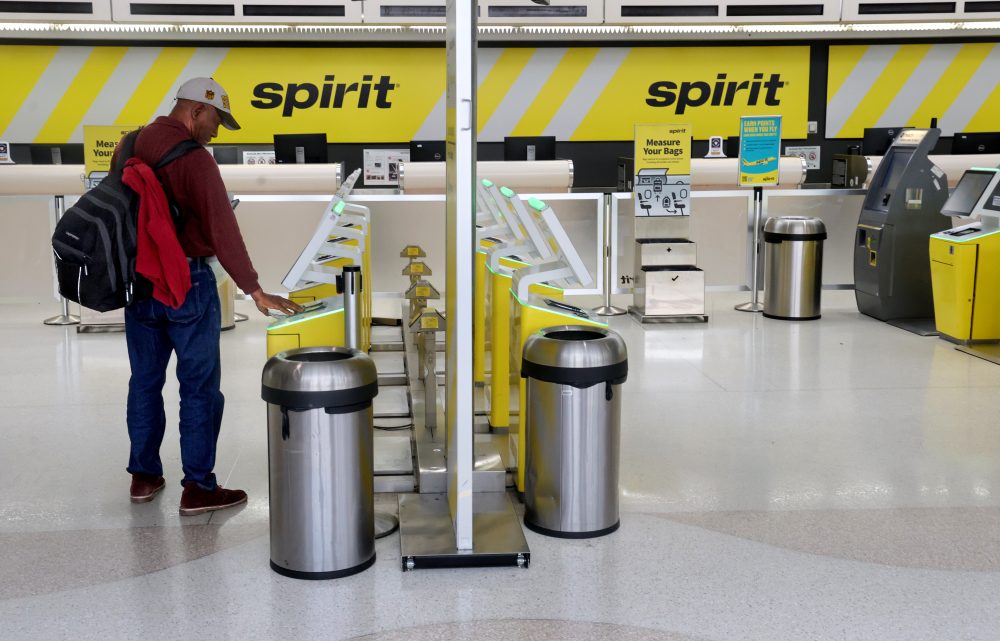

Following Spirit Airlines’ abrupt overnight closure, an attorney representing the bankrupt budget airline appeared before a federal judge to express regret to cost-conscious travelers who may now find it difficult to locate reasonably priced flights.
“We apologize most specifically for those Americans who may now be priced entirely out,” Spirit lawyer Marshall Huebner said in court, thanking all the passengers who relied on the airline during its 34-year run, many of whom, he said, “could not otherwise have afforded air travel.”
The May 3 collapse of Spirit isn’t the only challenge facing vacation planners just one week before Memorial Day traditionally kicks off the busy summer travel period. Escalating jet fuel expenses linked to the Iran conflict have driven up ticket prices and related charges throughout the commercial aviation sector. Two remaining budget carriers in the United States have just completed a merger.
The uncertain future for affordable air travel demonstrates how challenging it has become for budget, bare-bones airlines to survive while facing volatile fuel expenses, inflation and intensifying competition. While low-cost airlines attract customers focused solely on ticket prices, established carriers can more readily generate income to counter fuel expenses through first-class cabins, loyalty programs, business travel contracts, extra fees and sophisticated pricing systems.
“Dynamic pricing has taken away one of the last structural advantages that low-cost carriers had,” said Shye Gilad, a former airline captain who now teaches at Georgetown University.
For many years, budget carriers succeeded by providing fares that established airlines frequently couldn’t offer without losing profits. However, that advantage has diminished as the “big three” — American, Delta and United — became more skilled at customizing prices for different passengers, and as JetBlue, Southwest and other airlines that historically marketed themselves as cheaper options started pursuing wealthier customers.
Currently, major airlines can offer a small number of no-frills seats at Spirit-equivalent prices while continuing to charge higher amounts for regular and premium tickets throughout their aircraft. This development has made it more difficult for budget airlines to compete based purely on cost.
“They can’t just be the cheapest airline anymore,” Gilad said. “They have to be the smartest low-cost airline.”
Similar to gasoline and diesel costs, jet fuel prices have increased since the Iran war disrupted Middle East oil deliveries 11 weeks ago. This pressure led the Association of Value Airlines, a trade organization representing Allegiant Air, Avelo Air, Frontier Airlines, Spirit Airlines and Sun Country Airlines, to request $2.5 billion in emergency financial assistance from the administration in late April.
Airlines for America, the industry group for Alaska Airlines, American, Delta, JetBlue and Southwest, rejected the proposal, arguing that federal assistance would create an unfair competitive advantage for budget carriers.
“Government intervention on behalf of those airlines would punish other airlines that have engaged in self-help in order to deal with increased costs and reward airlines who haven’t made those tough decisions,” Airlines for America said in a statement. “And, in the long-term, sustaining businesses that cannot earn their cost of capital harms competition and consumers by making it more difficult for other airlines to compete.”
Transportation Secretary Sean Duffy denied the request on the same day Spirit ceased operations.
Prior to the recent fuel cost increases, industry consolidation was already occurring among budget airlines. Alaska Airlines finalized its $1 billion acquisition of Hawaiian Airlines in September 2024 after both companies agreed to preserve service levels on important routes within Hawaii and between Hawaii and the mainland United States where they faced limited competition.
Spirit had been an unsuccessful takeover target for both Frontier and JetBlue as its financial losses grew following the coronavirus pandemic.
Allegiant announced last week it had completed its approximately $1.5 billion purchase of Sun Country, a transaction initially revealed in January. The merged airline combines passenger service with Sun Country’s freight operations and charter business serving sports teams, casinos and the U.S. Department of Defense.
“Consolidation is a signal” of weakness in the industry, Gilad said. “If you can remove a competitor and improve your product offering, you might be able to eke out more profit.”
Other analysts point to the variety within the budget airline industry, a characteristic that could help some carriers better withstand rising fuel costs and market disruptions.
“Budget airlines are a pretty peculiar creature,” Vikrant Vaze, an aviation systems expert at Dartmouth College’s engineering school, said, describing a category that has encompassed struggling carriers like Spirit to giants like Southwest Airlines, which grew from a low-cost pioneer into one of the largest U.S. airlines.
“Even though they can be clubbed together as budget airlines, if you want a big umbrella term, they’re very different from each other,” Vaze said. “They have very different levels of budget-ness.”
Allegiant’s emphasis on vacation travel focuses on smaller airports with reduced direct competition. JetBlue, a hybrid low-cost carrier, relies more heavily on premium seating and loyalty perks than Spirit ever did.
Frontier most closely resembles Spirit’s approach as an ultra low-cost carrier, though industry analysts say it began this volatile period with stronger cash reserves and could gain from Spirit’s departure. The airline has already started expanding into former Spirit-dominated markets including Las Vegas, Detroit and the Florida cities of Orlando and Fort Lauderdale.
Gilad recognizes similarities to his own background working as a pilot and flight-training instructor at Independence Air, a brief low-cost airline that previously operated as a regional carrier for United and Delta. The airline, which started in mid-2004 as conflict between U.S.-led forces and insurgents in Iraq caused fuel prices to spike, closed during bankruptcy proceedings in January 2006.
“They burned through almost $200 million in 18 months,” Gilad said. “It was just that quick that they were gone.”
He noted that the same underlying pressures continue today, but fewer budget airlines remain to absorb them.