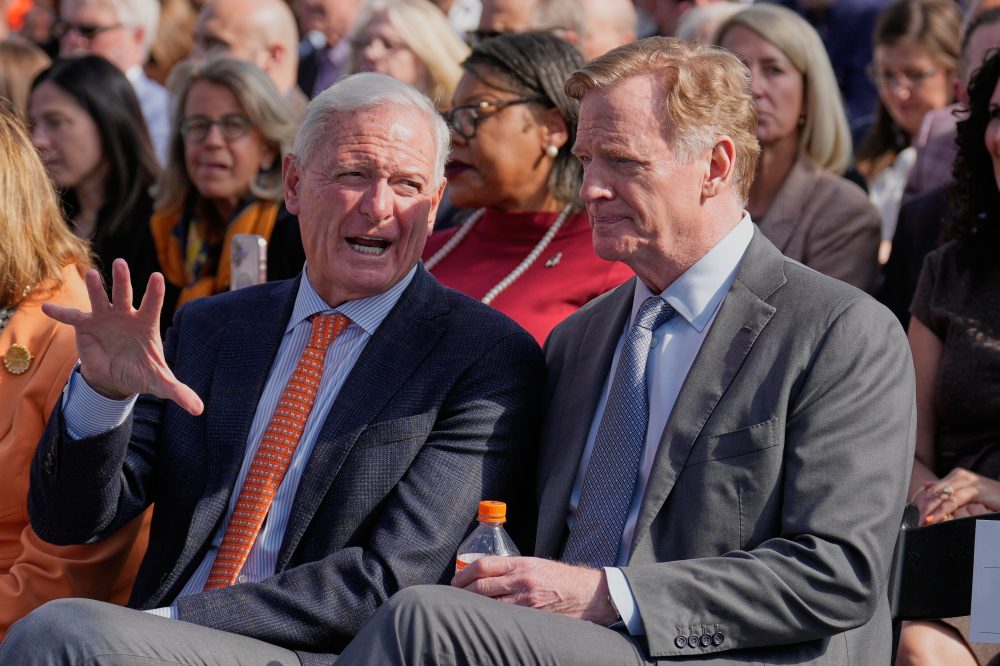

BROOK PARK, Ohio — Cleveland Browns owner Jimmy Haslam and his family celebrated a major project milestone Thursday as they officially commenced construction on their new covered stadium, which is slated to welcome fans for the 2029 football season.
However, several financial hurdles remain unresolved as work begins on the 67,500-seat venue, positioned adjacent to Cleveland Hopkins International Airport approximately 15 miles south of Cleveland’s city center.
A class-action lawsuit has frozen Ohio’s promised $600 million contribution to the project. The legal challenge contests a state budget provision that allocated $1 billion from Ohio’s Unclaimed Funds Account toward sports venue construction, claiming it violates constitutional protections against government seizure of private property.
Governor Mike DeWine expressed uncertainty about whether the legal dispute would resolve before he completes his second term in January.
“This is clearly going to go on for a while and so I’m not happy about that. There’s nothing we can do about that, but we’re going to go ahead,” he said after the ceremony. “I think that we’re going to win this case in court. It’s slow, certainly and we’re waiting, but I think eventually we win. If we do not win, if we ultimately lose, there’s another alternative. My initial proposal was to tax the sports gaming companies. I think that’s still a possibility that we could do.”
Additionally, Brook Park officials have not yet given final approval to their planned $245 million investment. The Haslam Sports Group — established by Dee and Jimmy Haslam along with their daughter and son-in-law — will shoulder the majority of expenses at $1.76 billion and assume responsibility for any budget increases.
According to Haslam, conversations about the stadium began in 2018, initially focusing on updating the Browns’ existing lakefront facility.
The current venue debuted in 1999 as Cleveland Browns Stadium, replacing Cleveland Municipal Stadium that operated from 1931 until demolition in 1996.
Plans shifted toward a new location beginning in 2021 when constructing a fresh facility became more practical than renovation.
The upcoming stadium and accompanying residential and commercial developments will occupy 178 acres where two Ford Motor Company manufacturing plants previously operated.
Cleveland officials initially contested the Browns’ decision to relocate from downtown before both parties reached an agreement. The team will finance demolition of their current home following the 2028 season, clearing space for lakefront redevelopment.
Due to its proximity to airport operations, the structure will extend 80 feet underground and rise 221 feet above ground level. The Ohio Department of Transportation granted an exception to the 150-foot height restriction above airport ground elevation after independent analysis confirmed the stadium would not interfere with aircraft routes. The facility will include Federal Aviation Administration-mandated marking and lighting systems.
“It was a bumpy road to get here, but we’re excited we’re here,” Haslam said. “I think everybody is finally beginning to sense that this is reality.”
The venue will showcase a folded plate transparent roof design, permitting natural light while protecting spectators from harsh winter conditions that characterize late-season Browns games.
The redesigned Dawg Pound represents the stadium’s most distinctive interior element. Constructed at a 34-degree angle, it will span more than 60 rows extending nearly to one of the massive video displays. The freestanding section will offer foldable seating options for fans who prefer sitting.
This area draws inspiration from European soccer venues, particularly modeling the “Yellow Wall” section at Borussia Dortmund’s stadium in Germany’s Bundesliga.
The Browns and design firm HKS report the closest seats will sit just 16 feet from the playing field, while the furthest will be only 248 feet away — closer than any other NFL facility. Approximately 80% of seating will be located in the lower level.
Officials expect the new stadium to compete for hosting the NCAA Men’s Final Four, major concerts, and other premier sporting competitions.
Regarding Super Bowl possibilities, the timeline appears more distant.
Commissioner Roger Goodell acknowledged after the groundbreaking that while the stadium will meet Super Bowl standards, Northeast Ohio faces additional obstacles, particularly insufficient hotel accommodations required for the championship game.
Goodell estimated Cleveland currently has only half the minimum room capacity needed for Super Bowl hosting. However, he indicated Cleveland remains under consideration for hosting the NFL Draft again, having done so in 2021 under COVID-19 capacity restrictions.
“I think the real challenge is going to be how transformational this is here. The airport is important for us, hotels are important for us. All of the facilities are the biggest challenge for hosting a Super Bowl,” Goodell said. “It’s great for economic impact, but it’s hard for cities to be able to meet some of those requirements on the facilities. So that’s the biggest challenge.”
The Browns join a wave of NFL stadium construction projects. Buffalo’s new facility opens this season, Tennessee’s debuts next year, and Jacksonville’s renovated stadium launches in 2028.