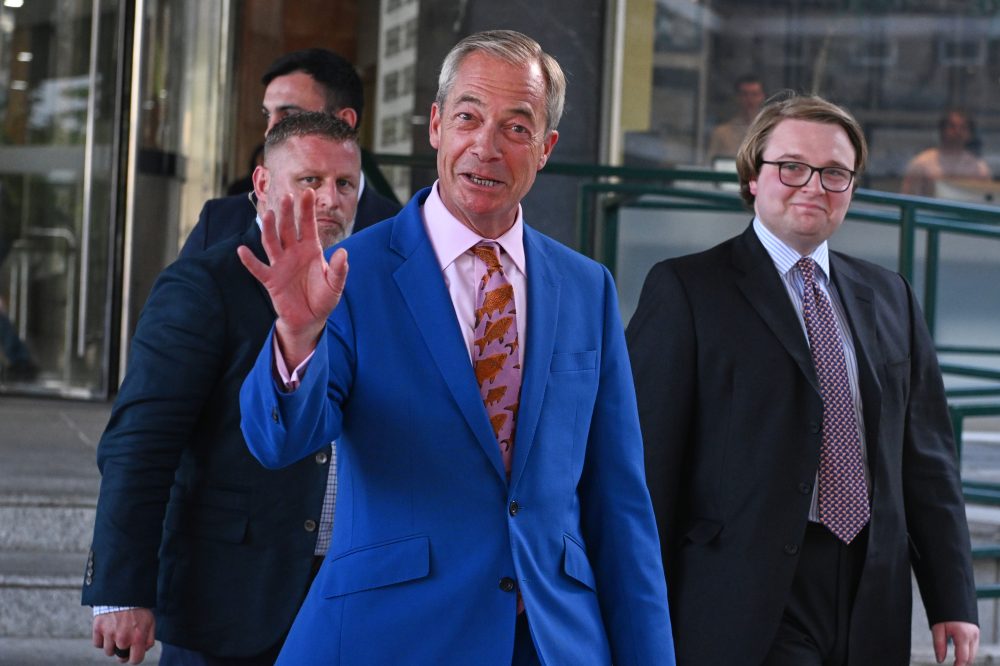

LONDON (AP) — Nigel Farage has long claimed the political establishment is working against him. His latest effort to prove that point, however, has not unfolded as he may have hoped.
Facing mounting scrutiny over his personal finances, the anti-immigration Reform UK leader made a dramatic announcement: he is stepping down from his parliamentary seat to force a special election, then immediately declared his intention to run for that same seat again. Critics wasted no time calling it a calculated maneuver to escape a parliamentary ethics investigation. Farage framed the upcoming vote as a battle of “people versus the establishment.”
His political rivals, though, have refused to cooperate with the narrative. Every major political party has announced it will not put forward a candidate to run against Farage, meaning he will face little real opposition at the ballot box.
The strategy carries significant risk. If the parliamentary standards inquiry into his finances continues after he wins — which appears likely — and concludes he broke the rules, a second special election for his seat could be required within months.
Farage only entered Parliament two years ago after seven previous failed attempts to win a seat. Despite that rocky road, he is widely considered one of the most consequential British politicians of the past several decades. His relentless push to remove the United Kingdom from the European Union helped transform Brexit from a fringe idea into reality. More recently, he has channeled public anxiety about immigration and social change in ways that mirror the approach of his ally, U.S. President Donald Trump, and various European populist figures.
Farage has made political hay — his critics say he has deliberately inflamed tensions — over migrants crossing the English Channel in small boats, referring to the phenomenon as an invasion. He has also claimed that white people face discrimination at the hands of police.
Reform UK holds just eight of the 650 seats in the House of Commons, yet the party consistently tops opinion polls and scored major victories in local and regional elections in May. Those results contributed to Prime Minister Keir Starmer being pushed out by members of his own Labour Party. If the current political trajectory continues, Farage could find himself in position to become prime minister following the next general election, which must be held by 2029.
Beyond his lawmaker’s salary, Farage draws income from a variety of sources, including selling gold bullion, hosting a television current affairs program, delivering paid public speeches, and recording personalized video messages through the Cameo platform.
Parliament’s standards watchdog is currently examining a donation of 5 million pounds — roughly $6.7 million — from Christopher Harborne, a cryptocurrency billionaire based in Thailand. Farage maintains the money was a personal gift used to cover the cost of his private security, and that it was given before he was elected to the House of Commons. Under parliamentary rules, newly elected members must disclose gifts exceeding 300 pounds (about $400) received in the prior 12 months if those gifts are connected to political activities.
Farage is also under scrutiny for his financial ties to George Cottrell, an aristocratic entrepreneur in the crypto-gambling space who previously served a U.S. prison sentence for fraud.
A finding that Farage violated parliamentary rules could result in his suspension, which would itself trigger a special election for his seat — the coastal constituency of Clacton in eastern England.
Rather than wait for the investigation to run its course, Farage chose to force that election himself.
But political observers note that if he wins — as most expect — the standards inquiry will likely pick up where it left off. A finding of wrongdoing could then set off a second Clacton election in short order.
Farage has publicly expressed frustration and exhaustion with political life, and he has a track record of walking away from parties he once led. He previously stepped down from both the UK Independence Party and its successor, the Brexit Party, over the past decade.
Tim Bale, a professor of politics at Queen Mary University of London, believes Farage will ultimately stay in the fight to lead Reform into the next general election.
“Fighting and winning a by-election is perhaps his best hope of suggesting to people that he is still very much a man alone, fighting the establishment,” Bale said.
Farage insists he has “done nothing wrong” and portrays himself as the target of dirty tricks by political enemies and “constant demonization” by media outlets. He says his need for substantial funds is partly driven by serious threats to his personal safety that require private security.
Bale acknowledged the strategy offers Farage some cover, saying it “allows him to distract from the details of that story and those allegations.” But he cautioned that Farage risks coming across “as a self-pitying, angry guy on an ego trip who is determined to distract people from some awkward facts.”
Political opponents called the resignation a stunt and a sign that Farage is struggling. Reform UK has dropped three consecutive special elections it had hoped to win, raising questions about whether the party’s support is beginning to soften. The most recent defeat came against Labour’s Andy Burnham, who is widely expected to succeed Starmer as prime minister within weeks.
With Labour, the Conservatives, the Liberal Democrats, and the Green Party all declining to run candidates against Farage, the field is essentially open to single-issue campaigners and novelty candidates — including a comedian known as Count Binface, who campaigns with a trash can over his head.
The person behind the costume is Jon Harvey, who describes himself as a 5,000-year-old intergalactic space warrior. Harvey is a recurring presence in high-profile British elections, with no serious expectation of winning. His past opponents have included former Conservative Prime Ministers Boris Johnson and Rishi Sunak, London Mayor Sadiq Khan, and most recently, Burnham.
Dressed in the style of a low-budget science fiction film, Binface mixes absurdist humor with hyper-local policy proposals, such as synchronizing traffic lights on a congested street or relocating the hand dryer in the Crown & Treaty Pub in Uxbridge “to a more sensible location.”
In his most recent race against Burnham, his top campaign promise was to “cut your taxes, and raise everyone else’s.” He also maintains a standing pledge to cap the price of croissants at 1.10 pounds, or about $1.47.
Speaking to the BBC on Wednesday, Binface said his central pitch to Clacton voters would be simple: “I’m not Nigel Farage.” He suggested that the absence of mainstream candidates said more about those parties than about him.
“Are they running scared from old Binny, or do they think that Nigel’s running a cunning stunt?” he said.