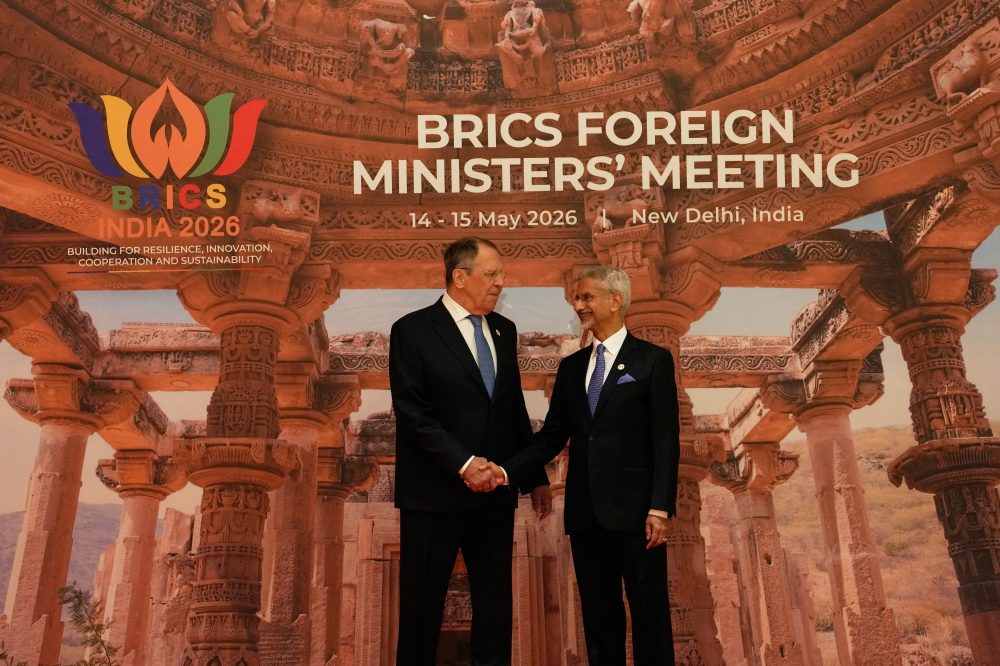

NEW DELHI (AP) — Top diplomats from BRICS member nations launched two days of discussions in New Delhi on Thursday as the growing economic alliance confronts internal disagreements regarding Middle East warfare, escalating fuel costs and mounting worldwide financial instability.
The gathering unites representatives from Brazil, Russia, India, China and South Africa alongside diplomats from recently admitted nations. The conference occurs while Iranian conflict has interrupted worldwide energy distribution and pushed up petroleum costs, happening simultaneously with U.S. President Donald Trump’s discussions with Chinese leader Xi Jinping in Beijing.
Iranian Foreign Minister Abbas Araqchi and Russia’s chief diplomat Sergey Lavrov are participating. China has sent Ambassador Xu Feihong as its representative while Foreign Minister Wang Yi stays in the Chinese capital during Trump’s diplomatic visit.
India Foreign Minister Subrahmanyam Jaishankar indicated the discussions would concentrate on worldwide and regional obstacles and methods to strengthen collaboration between member states.
During his opening statements, Jaishankar explained that BRICS could assist developing nations in better addressing health and financial difficulties they encounter along with elevated costs for energy, food and fertilizer.
“We meet at a time of considerable flux in international relations,” he said, adding that emerging and developing countries increasingly expect BRICS to play a “constructive and stabilizing role.”
Established by Brazil, Russia, India and China, BRICS developed as an alliance of significant emerging economies viewed as a balance to Western-controlled organizations like the G7. South Africa became a member in 2010 and the alliance grew additional in 2024 through the inclusion of Egypt, Ethiopia, Iran and the United Arab Emirates. Indonesia achieved full membership status in 2025.
The organization has attempted to broaden its reach by advocating for increased participation in a worldwide system historically controlled by the United States and its Western partners. It has received backing throughout portions of the Global South, where numerous nations have criticized Western-controlled financial organizations.
However, BRICS countries stay split on major matters.
India and China persist in competing for regional dominance, while member nations frequently vary in their connections with the West. Russia’s conflict in Ukraine has additionally revealed those disagreements.
The alliance’s growth has also created additional pressures. Conflicting regional priorities have heightened the challenge of displaying a coordinated stance.
Disagreements have intensified during the escalating Middle East crisis. Iran and the UAE hold BRICS membership while following conflicting regional objectives.
Iran’s deputy foreign minister stated Wednesday that internal BRICS disagreements regarding the conflict had blocked the alliance from achieving a coordinated position.
Kazem Gharibabadi informed news agency Press Trust of India that “one member country” had advocated for statements criticizing Iran, making consensus-building within the organization more difficult.
“We want India’s BRICS chairship to be successful. It is not a good approach to send a signal to the world that the BRICS is divided. One country is insisting on condemning Iran,” Gharibabadi said.