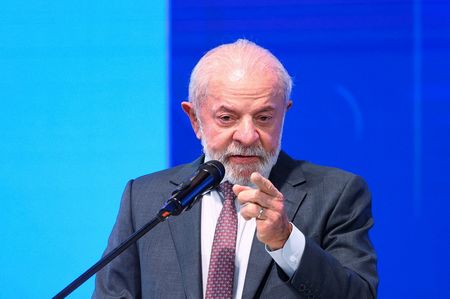

Brazilian President Luiz Inacio Lula da Silva traveled to the White House Thursday in an effort to rebuild diplomatic ties with President Donald Trump and prevent additional trade penalties on Brazilian goods, according to three sources familiar with the Brazilian leader’s plans.
The meeting aims to capitalize on what Trump previously described as their “excellent chemistry” while addressing ongoing trade disputes and exploring cooperation on critical minerals and crime fighting efforts.
“We don’t know if the visit will help,” a Brazilian official involved in organizing the meeting said. “But it’s more likely to help than doing nothing.”
Trade tensions escalated last year when Trump imposed 50% tariffs on Brazilian goods – among the steepest penalties placed on any U.S. imports. The former president accused Brazil of conducting what he called a witch-hunt against far-right ex-president Jair Bolsonaro, who was subsequently found guilty of attempting to undermine democratic institutions.
Trump later rolled back most of these trade penalties, including those affecting Brazilian beef and coffee imports, partly to help reduce rising food costs for American consumers. The U.S. Supreme Court eliminated many remaining tariffs in February by overturning global levies Trump had implemented using emergency powers.
However, Brazilian exports continue to face an additional 10% penalty set to end in July. Recent developments suggest Brazil could face new tariffs stemming from a Section 301 probe into alleged unfair trading practices.
Trade disagreements persist over digital commerce policies, with Brazil opposing a U.S.-supported World Trade Organization proposal to maintain an e-commerce tariff freeze. Brazil also maintains high import duties on certain American products, including ethanol.
The U.S. Trade Representative’s office recently claimed that nearly half of Brazil’s timber shipments originate from illegal logging operations. The Lula government disputes this allegation, pointing to record-low deforestation numbers under their administration.
Brazilian representatives grew concerned about potential new tariffs following a meeting with U.S. Commerce Department officials two weeks ago. Participants noted that American officials asked minimal questions during the discussions, suggesting the investigation was designed to justify tariffs rather than resolve trade concerns.
“What they are doing is building a case, even if unfounded, to justify the later adoption of tariffs,” one Brazilian official explained.
CRITICAL MINERALS
Relations began improving last September during the U.N. General Assembly when Trump made his “chemistry” comment, partly acknowledging Brazil’s extensive reserves of essential minerals, according to Monica de Bolle, a Brazilian economist and senior fellow at the Peterson Institute of International Economics.
The Trump administration’s goal of establishing a supply chain for rare earth elements needed in high-tech manufacturing will likely help keep Lula’s visit productive, she noted.
“On the part of the U.S., they are looking for some kind of deal – whatever that happens to be – on critical minerals and rare earths with Brazil,” de Bolle explained. “The U.S. actually needs something from Lula.”
The Lula administration doesn’t anticipate reaching a critical minerals agreement, sources close to the president indicated, as officials have struggled to reach consensus on even a basic understanding. Brazil demands that minerals undergo domestic processing, while the U.S. seeks price protection mechanisms to prevent China from using market dominance to undercut Western competitors. Negotiations remain unclear, lacking specific investment amounts, production targets, or implementation schedules.
American investments, particularly USA Rare Earth’s $2.8 billion purchase of Serra Verde’s rare earth mining assets, are moving forward without established regulatory guidelines, creating uncertainty in Brazil.
Nevertheless, both Trump and Lula benefit from demonstrating their ability to collaborate, meaning even a basic framework could be presented as successful.
“The bar is actually kind of low for both of them,” Bolle observed.
ORGANIZED CRIME
Additional tensions exist over White House efforts to classify Latin American criminal organizations as terrorist groups.
The Lula administration seeks to prevent such designation for domestic gangs PCC and Comando Vermelho, as this could authorize U.S. military intervention in Brazil or sanctions against financial institutions that inadvertently conduct business with gang members.
Such action could have “repercussions for the Brazilian economy, the productive sector, and the financial system,” Federal Police chief Andrei Rodrigues told reporters in March.
Instead, Lula plans to propose enhanced cooperation on organized crime, money laundering, and weapons trafficking.
“I don’t think we will be able to sign anything because we sent it very recently,” said one official involved in preparing the proposal.