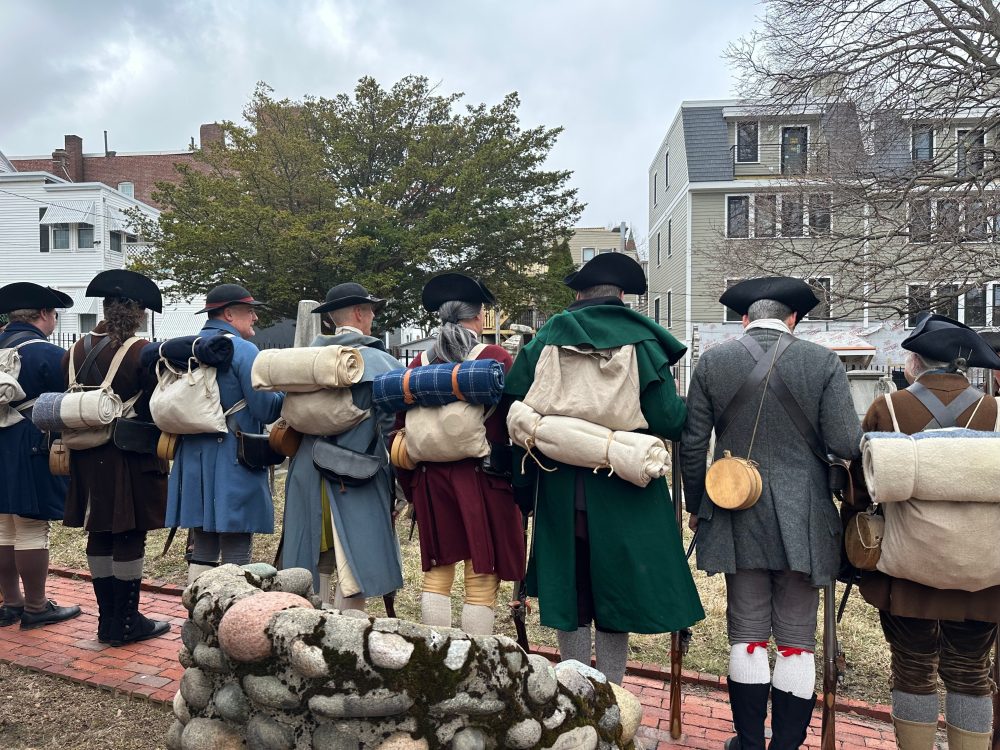

BOSTON — Historical reenactors wearing period military uniforms and three-cornered hats gathered at one of America’s most historic Catholic churches Tuesday, later discharging muskets and parading through local streets to commemorate 250 years since British forces left the city.
Participants with men on horseback and even livestock traveled across South Boston’s terrain in the morning breeze while local residents observed from their doorsteps — many still in sleepwear and covered with blankets, seemingly roused by the sounds of drumming and bagpipe music.
The observance honors Evacuation Day on March 17, 1776, when British military units departed Boston. This turning point occurred after General George Washington strengthened Dorchester Heights using cannons transported from Fort Ticonderoga by Colonel Henry Knox, forcing the British withdrawal.
This milestone represented the Continental Army’s initial significant triumph in the Revolutionary War, concluding an 11-month blockade of Boston and claiming the city for American forces.
The date traditionally coincides with St. Patrick’s Day, a combination that has influenced Boston’s festivities for generations and was celebrated again with a joint parade in South Boston over the weekend.
Tuesday’s observance started at St. Augustine Chapel and Cemetery, where attendees participated in Mass at the 1818 structure before creating a procession that traveled through South Boston toward Dorchester Heights, the elevation where colonial troops placed cannons overlooking the harbor. A memorial at that location, recently restored through a $37 million renovation, has reopened for public visits.
Ronald White from Milton, wearing colonial clothing, joined reenactors discharging replica firearms in the church cemetery after the service and explained the anniversary holds personal significance.
As a New Hampshire Sons of the American Revolution member, he connects his family history to an ancestor who served in the conflict. His eyes filled with tears Tuesday while discussing his admiration for the country’s founding fathers.
“To think that 250 years ago Henry Knox made such a courageous stand, I get choked up thinking about it,” White said. “They really were going up against a force — it was kind of a suicidal idea to stand up against Great Britain. And we did it. Here we are remembering it.”
Richard Vige, a Boston area resident, explained he visited Dorchester Heights for his first time to observe the 250th anniversary, despite maintaining a lifelong fascination with American history.
“I’ve always been interested in history, really since grade school,” he said. “I’ve visited many of the sites along the Freedom Trail, but I had never been here before. I wanted to take advantage of the 250th to see what was going on.”
He noted that participating in the commemoration provided an opportunity to consider the nation’s progress since its establishment — from a group of Atlantic coastal colonies to a country with over 340 million citizens.
Greta Gaffin, a Boston University theology student researching American religious history, found the Catholic ceremony historically contradictory.
Conducting a Catholic Mass for the anniversary represents a scenario the nation’s founders likely never envisioned. Colonial Massachusetts historically limited Catholic religious practices, and churches didn’t establish themselves in Boston until after the Revolution, as religious liberties grew and Irish immigration transformed the city.
“I’m here because I think having a Catholic Mass in honor of Evacuation Day is conceptually absurd,” she said. “They would have hated this — I had to see it.
“And I love parades,” she added.
Anti-Catholic attitudes were common in colonial New England, though this began changing during the Revolutionary War, when the American movement depended partly on Catholic France. The Quebec Act, which safeguarded Catholicism in nearby Quebec, was viewed by some colonists as dangerous and is mentioned in complaints within the Declaration of Independence.