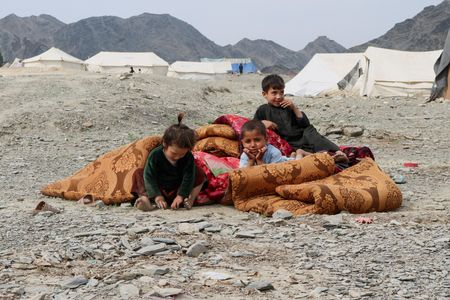

Military forces from Pakistan and Afghanistan engaged in gunfire at multiple locations along their shared border Friday, while United Nations officials reported that more than 100,000 people have been forced from their homes due to the week-long military conflict.
The two South Asian countries show no indication of resolving their most severe military confrontation in recent years, contributing to regional instability that also includes recent U.S. and Israeli military actions against Iran, which shares borders with both Afghanistan and Pakistan.
The fighting has escalated to include Pakistani airstrikes targeting Taliban government facilities, including strikes on the Bagram airfield located north of Afghanistan’s capital, Kabul.
Afghanistan’s Defense Ministry reported that Taliban military units attacked Pakistani military facilities along the 1,600-mile border, eliminating multiple outposts and bringing down an unmanned aircraft.
Pakistani military officials confirmed they conducted ground and aerial operations targeting military objectives in areas including Kandahar, the Taliban’s stronghold where senior leadership is based, and eliminated several Afghan border installations.
Demonstrators gathered in Kabul Friday to condemn Pakistan’s military actions against Afghan territory, shouting slogans opposing Pakistan, according to eyewitness accounts. The Bakhter news service reported that a substantial crowd in Laghman Province also protested Pakistan’s recent military operations.
Residents of border communities have informed Reuters that military units begin heavy artillery exchanges after dark, putting civilian homes at risk during evening hours when families gather to end their daily fast during the sacred month of Ramadan.
Multiple residents reported that family members and community members have evacuated the area.
“The situation in Afghanistan and Pakistan remains tense amid active conflict along the border,” the United Nations refugee agency stated, estimating that approximately 115,000 people in Afghanistan and 3,000 in Pakistan have abandoned their homes.
Multiple nations have volunteered to facilitate peace talks, with Turkey being the most recent, though the Iran conflict has shifted focus away from Gulf nations that had previously offered assistance.
Pakistani government representative Mosharraf Zaidi confirmed that no peace discussions were underway to resolve the conflict.
“There is nothing to talk about. There will be no dialogue and no negotiations,” he stated on state-controlled Pakistan TV. “Terrorism from Afghanistan has to end – that is Afghanistan’s problem. Pakistan’s responsibility is to protect its citizens.”
The military confrontation started last week when Pakistan launched airstrikes within Afghanistan that Islamabad claimed were aimed at militant bases. Afghanistan denounced the strikes as territorial violations and declared retaliatory military actions.
Pakistani officials have accused Kabul of sheltering militants who launch attacks on Pakistan from Afghan territory. Taliban leadership has rejected claims of supporting such organizations and maintains that Pakistan’s militant problems are domestic issues.
Friday saw the Taliban’s defense ministry claim it had also attacked a military installation in Pakistan’s southwestern Balochistan province. Reuters was unable to confirm the strike, and Pakistan’s military has not acknowledged any damage in that area.
Both nations have consistently claimed they caused significant damage to opposing forces and eliminated hundreds of enemy soldiers, without offering proof. Reuters has been unable to confirm these claims.
The U.N. mission in Afghanistan reported 56 civilian deaths and 128 injuries in the country since hostilities began. Taliban government officials have stated 110 civilians have died.
Pakistan has disputed both casualty counts, maintaining it only targets militants and supporting infrastructure.