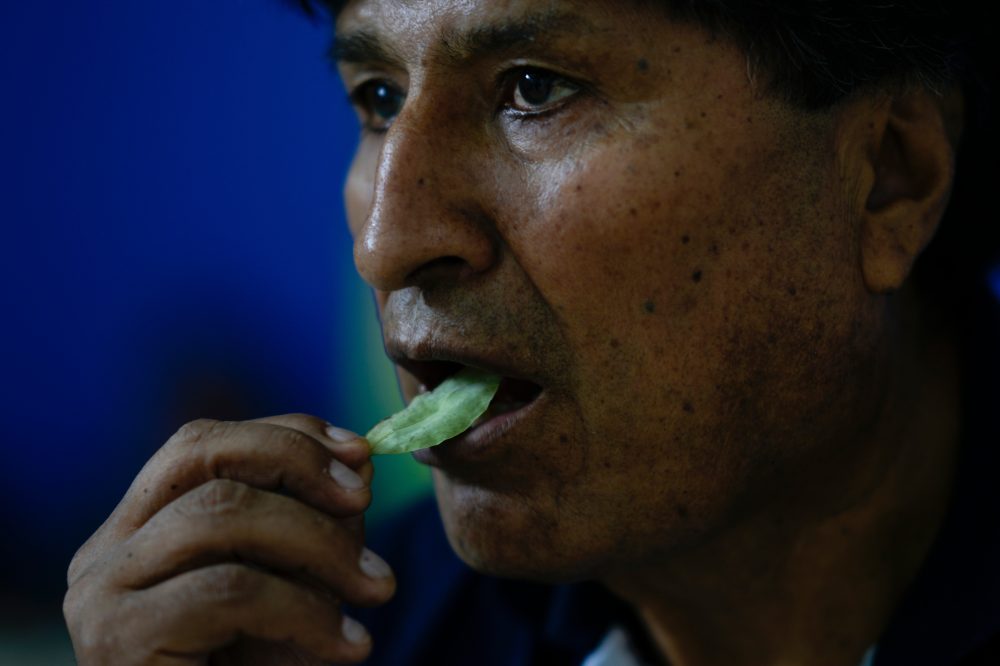

LA PAZ, Bolivia (AP) — Former Bolivian President Evo Morales made his first public appearance Thursday after vanishing from public view for nearly seven weeks, putting to rest widespread speculation about his whereabouts and addressing supporters in his political home base.
The extended absence of Bolivia’s longtime socialist leader had generated intense speculation and rumors that he had left the country following the recent U.S. capture of his Venezuelan ally, former President Nicolás Maduro.
Morales’ lengthy disappearance highlighted how little information flows out of the remote Chapare region, where the ex-president has been hiding for the past year while avoiding arrest on human trafficking charges. It also demonstrated the country’s anxiety about potential future foreign policy moves by U.S. President Donald Trump.
Video released by Radio Kawsachun Coca, the media arm of Morales’ coca farmers’ union, showed the former leader wearing dark sunglasses and smiling as he rode a tractor into a stadium in Chimoré, a town in central Bolivia, to speak with his followers.
The 66-year-old Morales, who became Bolivia’s first Indigenous president and governed from 2006 until his controversial removal from power in 2019 followed by self-imposed exile, revealed he had been battling chikungunya, a mosquito-transmitted disease that brings fever and intense joint pain with no available cure, and experienced unexpected complications.
“Take care of yourselves against chikungunya — it is serious,” Morales told the crowd, looking noticeably weaker than in previous public appearances.
He rejected speculation spread by local political figures and amplified on social media platforms suggesting he might attempt to escape Bolivia, promising to stay in the country despite facing potential detention under conservative President Rodrigo Paz, whose victory last October brought an end to nearly twenty years of governance by Morales’ Movement Toward Socialism party.
“Some media said, ‘Evo is going to leave, Evo is going to flee.’ I said clearly: I am not going to leave. I will stay with the people to defend the homeland,” he declared.
President Paz’s restoration of diplomatic relationships with the United States and recent moves to welcome back the Drug Enforcement Administration — approximately 17 years after Morales kicked out American anti-narcotics officers while building closer ties with China, Russia, Cuba and Iran — have created unease in the coca-farming areas that form Morales’ core support base.
On Thursday, Paz announced he will attend a meeting with Trump in Miami on March 7 for a gathering of ideologically similar Latin American leaders, as the Trump administration works to challenge Chinese influence and strengthen U.S. control in the region.
Prior to announcing his endorsed candidates for Bolivia’s upcoming municipal and regional elections next month, Morales delivered an extended address that echoed his previous frequent criticisms of American imperialism.
“This is geopolitical propaganda on an international scale,” he stated regarding Trump’s efforts to revive the 1823 Monroe Doctrine to reestablish American dominance in the Western Hemisphere. “They want to eliminate every left-wing party in Latin America.”