
From a concealed location somewhere in Bolivia’s Chapare forest region, former president Evo Morales is biding his time — and keeping a close eye on the chaos unfolding across the country.
For 50 days, highway blockades organized by labor unions and indigenous groups have brought Bolivia to a standstill. The disruptions have left at least 14 people dead and pushed the center-right government of Rodrigo Paz dangerously close to collapse.
In an exclusive video interview with Reuters, Morales said he has maintained regular communication with protesters. He acknowledged that the wave of public anger in the streets has “made him think” about re-entering politics — though he insisted he is not actively running for anything.
The blockades have severed critical roadways, leaving trucks stranded and cutting off supplies of fuel, food, and medicine to communities across the country.
The crisis began after Paz made a sudden decision to eliminate long-standing fuel subsidies in an effort to reduce Bolivia’s budget deficit. The country, a major lithium producer, has been struggling with a deepening dollar shortage and is in ongoing negotiations with the International Monetary Fund over a potential rescue package.
Paz later adjusted fuel prices and reversed some unpopular land reform policies, but the blockades continued to grow as frustration expanded beyond fuel costs. Unions are now demanding wage increases, an end to fuel and dollar shortages, and Paz’s resignation.
Paz took office in November 2025 with the support of President Donald Trump, as part of a broader U.S. effort to expand its influence in the region. He has pointed the finger at Morales — who ruled Bolivia for nearly 14 years and remains a towering figure on the political left — for fanning the flames of the unrest.
Andres Arauz of the Center for Economic and Policy Research told Reuters that the government has leaned heavily on casting Morales as the villain in order to shift attention away from the underlying social problems. He said Paz is “trying to spin this and frame it as political confrontation, and thus basically wait it out.”
Morales is currently the subject of an arrest warrant on charges of trafficking a minor, tied to allegations that he fathered a child with a teenager in 2016 while serving as president. Morales denies any wrongdoing, calling the charges “fabricated” and driven by political motives.
In his Reuters interview, Morales rejected any suggestion that he is behind the protests, saying the “indigenous rebellion” is rooted in economic suffering.
“In my experience as a former president, if there is a conflict, it is the fault of the state if it is a social demand,” Morales said, adding that Paz had made “unfulfilled commitments.”
As Paz attempts to negotiate an end to the blockades, Morales’ presence looms large over the talks. On Wednesday, Paz opened dialogue with union leaders in La Paz, striking a conciliatory tone.
“We must build the nation, but we have to build it by accepting diverse ways of thinking,” Paz said, urging both sides to move past mutual distrust.
A Capital Under Siege
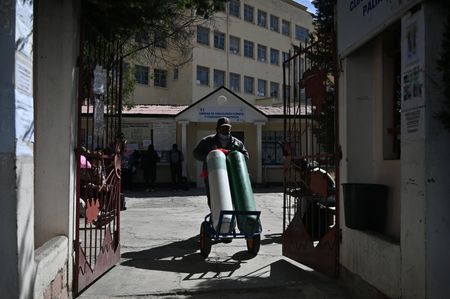
In La Paz, the high-altitude capital, daily life has taken on a grim character. Restaurants sit nearly empty, hospitals are running short on medications, and grocery store shelves in the meat section have gone dark after selling out.
“We feel deeply suffocated,” said Pamela Espada, a regional supermarket manager, explaining that she has resorted to flying meat in from Santa Cruz and waking at 2 a.m. to track down eggs.
The cost of basic foods has skyrocketed since the blockades began — tomato prices have doubled, and chicken has become 70% more expensive.
The economic ripple effects have been severe. Ernesto Olivares, who leads the Gastronomic Association of La Paz, said 42% of the city’s restaurants have been forced to shut down. “The exhaustion has reached its limits,” he said. “La Paz is being held hostage by politics.”
Hospitals have also been pushed to a breaking point. The blockades have made transferring patients between facilities nearly impossible.
Outside La Paz’s main public hospital, cancer patients and their families gathered to chant, “We want to live!”
Erika Alvarez, whose brother is fighting cancer in the mining city of Oruro — roughly 140 miles, or 225 kilometers, south of La Paz — was brought to tears. “They tell me he needs chemo, but in Oruro there is nothing, there are no medicines. With these political problems, with these blockades, I cannot bring my brother here,” she said.
Rosario Calle, president of the Association of Cancer Patients and Families, said she is aware of patients — particularly those in rural areas — who have already died after being unable to receive care in time.
Inside the capital, critical pain medications including morphine and tramadol are in short supply.
“They cry out and they don’t know how to soothe the pain,” Calle said. “What we want are solutions. Enough already.”
Morales has called on Paz to step down and allow new elections to be held. He warned that the standoff could reach a breaking point if his movement is shut out of any future vote — though he said he does not support such an escalation.
“If they don’t want it with votes, it’s with bullets,” he said.