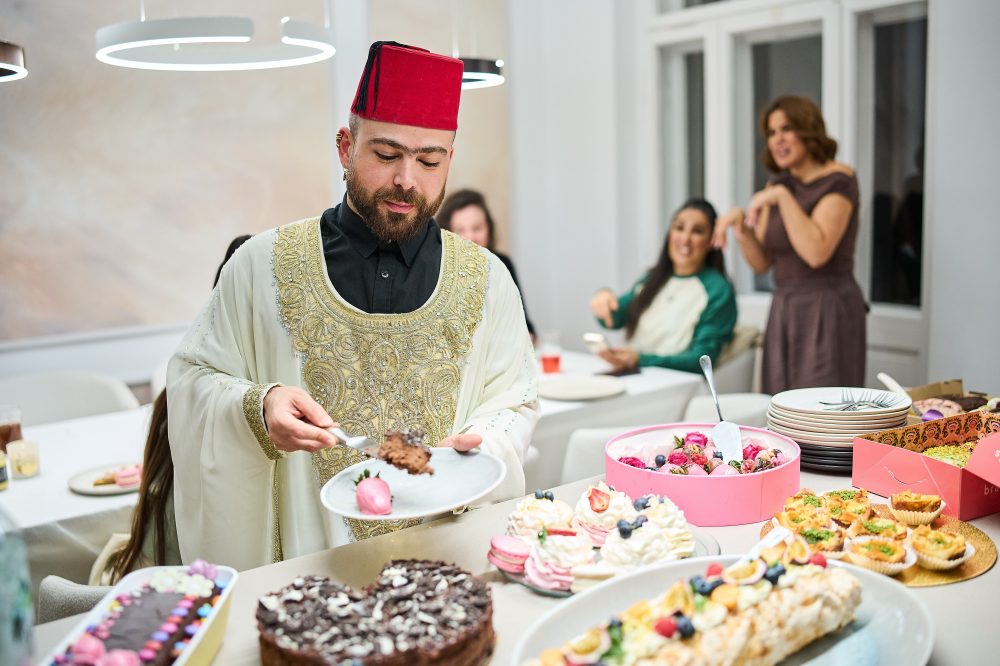

BERLIN (AP) — In a Berlin apartment, Ali Darwich reaches for a date from his dinner plate, drinks some water, and speaks to the 15 guests gathered around his table for an evening Ramadan meal.
The 33-year-old German citizen of Palestinian and Lebanese heritage, known as @alifragt or “Ali asks” on Instagram, has built a rapidly expanding social media presence by highlighting the challenges faced by young, LGBTQ+ Muslims while advocating for greater acceptance and inclusion.
“Tonight we want to send a message that no matter where a person comes from, no matter who that person loves, no matter how queer that person is, they cannot be too queer … because they are exactly as they should be,” Darwich tells the mixed gathering of Muslims and Christians, Germans and immigrants, gay and straight individuals sharing the sunset meal in Berlin.
“I am a believer, I believe in God, and I find Islam beautiful, just like Christianity or Judaism and many other religions,” he explains. However, he acknowledges that acceptance isn’t always easy for homosexuals to find — a challenge that extends beyond Muslim communities to include LGBTQ+ Christians and believers of various faiths.
The gathering takes place amid rising hostility toward LGBTQ+ individuals and gay-friendly venues throughout Germany, including Berlin, a city known for its historically welcoming attitude toward the community.
Recent 2024 data reveals a 40% surge in violence directed at LGBTQ+ individuals across 12 of Germany’s 16 states compared to 2023, according to the Association of Counseling Centers for Victims of Right-Wing, Racist and Antisemitic Violence.
In one Instagram post, Darwich films himself sitting alone at a table during Ramadan, discussing the isolation experienced by Muslim homosexuals who face rejection from their families. This isolation becomes particularly painful during religious holidays traditionally centered on family gatherings, he explains.
He encourages people to welcome queer Muslims into their homes so they won’t spend Iftar, the evening Ramadan meal, in solitude.
To his gay followers, Darwich shares this Instagram message: “You deserve to break your fast surrounded by people who accept you — fully and without conditions.”
Darwich’s own coming-out experience several years ago proved challenging.
His mother initially refused to believe him, then broke down in tears, leading to six months of silence between them. Extended family members also struggled with the revelation.
“From one day to the next, I was no longer invited. Not only to Ramadan, but also to family celebrations, and that was a very difficult time for me,” he shared in an Associated Press interview this week.
Though Darwich and his mother have since reconciled, he credits his friends with becoming a chosen family during that difficult period, providing the support and acceptance he needed.
For this week’s in-person Iftar in Berlin, his friend Randa Weiser, a 40-year-old German-Palestinian influencer who documents family life with her three children and husband under @randa_and_the_gang, opened her home to Ali and their mutual friends.
She prepared an elaborate spread featuring freekeh soup, aromatic yellow rice with almonds, raisins and cardamom, grilled chicken drumsticks, and an assortment of sweet desserts.
“It’s an absolute colorful mix tonight,” she observed, describing the diverse crowd around the Iftar table. While most attendees are German, many trace their family origins to distant countries including Jordan, Lebanon, Morocco, Turkey, Chechnya, Syria, Iran and Peru.
Weiser mentioned receiving “some hate” on Instagram after announcing her plans to host an inclusive Iftar, but noted that most of her followers support the idea that “you can be Muslim and gay or lesbian.”
As the group — many of whom are also social media influencers — enjoyed Weiser’s cooking, they frequently filmed each other and quickly shared content on their accounts.
Among them was Darwich’s close friend Haidar Darwish, a belly dancer and artist who arrived from Syria in 2016, dressed festively in a red fez and white, gold-embroidered gallabiyah for the occasion.
“The hate and crimes against women, Muslim people, Jewish people also, and queers and trans siblings of mine have increased,” said Darwish, who posts as @thedarvishofficial on Instagram.
“But no matter how much the others will show us hate, we can show more love only if we are believing in ourselves,” he continued, emphasizing that they will persevere with “the help of our allies and friends and people that have our backs.”