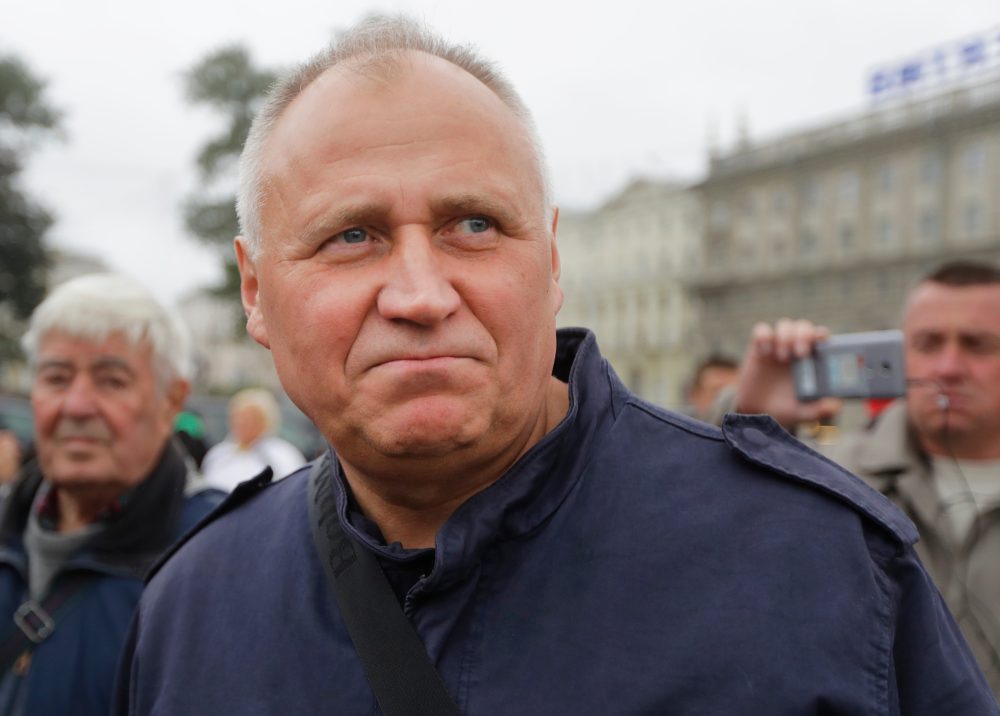

A prominent Belarusian opposition figure who made headlines for rejecting forced exile has been freed from prison following a medical emergency that left him with lasting health complications.
Mikola Statkevich, 69, was released after experiencing a stroke while serving his sentence, according to his wife Maryna Adamovich. Speaking to reporters Friday from Belarus’s capital city, she explained that her husband continues to experience speech difficulties as a result of the medical episode. “Now he’s recovering and gaining strength,” Adamovich stated during a telephone conversation.
The veteran politician’s release came after he made a dramatic stand in September when dictator Alexander Lukashenko granted pardons to 52 political detainees. While other prisoners accepted transport to Lithuania’s border as part of the U.S.-negotiated agreement, Statkevich denounced the arrangement as “forced deportation.” He dramatically exited the transport vehicle and remained in the border zone for hours before Belarusian authorities arrested him and returned him to custody.
Statkevich had been serving a 14-year sentence following his 2020 arrest on accusations of inciting mass disorder, charges that international human rights organizations like Amnesty International have condemned as politically driven.
Government spokesperson Natalia Eismont announced Friday that Lukashenko authorized Statkevich’s freedom due to his medical situation, responding to appeals from his family members.
The authoritarian leader, often called “Europe’s last dictator,” has controlled Belarus for more than 30 years through systematic suppression of opposition voices. After massive demonstrations erupted following disputed 2020 elections, authorities detained over 65,000 individuals, physically assaulted thousands, and shuttered hundreds of independent news organizations and civil society groups.
International sanctions and diplomatic isolation have pressured Belarus for years due to human rights violations and its support for Russia’s 2022 Ukraine invasion. Recently, Lukashenko has attempted to improve Western relations by freeing hundreds of imprisoned dissidents.
Statkevich’s initial release occurred following discussions between Lukashenko and then-President Donald Trump in August, which led to the lifting of restrictions on Belarus’s national carrier, Belavia. An additional 123 political prisoners, including Nobel laureate Ales Bialiatski, gained freedom on December 13 when the U.S. removed certain trade penalties.
However, government persecution of critics continues despite these prisoner exchanges. The Viasna human rights organization reports that 1,146 political prisoners remain in Belarusian custody.
“It’s still unclear what Statkevich’s legal status is and whether the authorities have cleared the accusations against him,” explained Pavel Sapelka from Viasna. “Political repressions in Belarus are continuing, and it means that no government critic can feel secure.”
According to Sapelka, Statkevich required more than a month of intensive medical treatment at a prison hospital following his stroke.
Throughout his lengthy political career, Statkevich, who ran against Lukashenko in the 2010 presidential race, has faced imprisonment three times and spent over 12 years in detention facilities.
Exiled opposition leader Sviatlana Tsikhanouskaya, who fled Belarus in 2020, expressed her emotions about the development. “I feel immense relief that Statkevich is finally free and at home,” she told reporters. “With his courage and bravery, he won a huge moral victory, for which he paid a high price.”