
BEIJING – Chinese government officials on Wednesday dismissed American allegations that Beijing is applying military intimidation tactics against Taiwan, characterizing these accusations as deliberate misrepresentations that reveal “malicious intentions” from Washington.
Beijing has intensified its military operations in the vicinity of Taiwan, a democratically-run island that China considers part of its territory. These activities have included multiple military exercises, with the most recent live-ammunition drills conducted in late December.
“Certain people on the U.S. side are jumping up and down, continuously rehashing the so-called ‘mainland threat’ or ‘military pressure,’” Chen Binhua, a spokesperson for China’s Taiwan Affairs Office, told reporters.
Chen described these characterizations as “a complete distortion of the facts and harbours malicious intentions,” emphasizing that Taiwan represents a domestic Chinese matter that will not tolerate external meddling.
The Chinese official called on Washington to exercise extreme care and manage Taiwan-related issues with careful consideration.
Beijing has consistently called for an end to American arms sales to Taiwan, which serves as the island’s primary international supporter despite the absence of official diplomatic relations between Washington and Taipei.
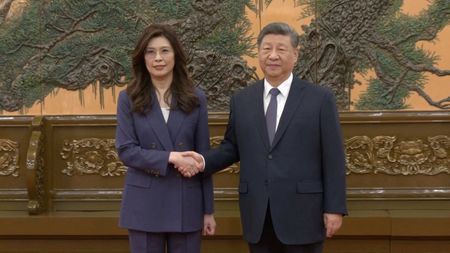
These Wednesday statements followed last week’s State Department appeal for China to engage in dialogue with Taiwan and end its military and other forms of pressure against the island. The timing coincided with Taiwan opposition figure Cheng Li-wun’s meeting with President Xi Jinping in Beijing.
Beijing refuses diplomatic contact with Taiwan President Lai Ching-te, labeling him a “separatist.” Lai dismisses China’s territorial claims, maintaining that only Taiwan’s citizens have the authority to determine their island’s destiny.
Cheng stated her visit aimed to promote peaceful relations, during which China announced measures intended to benefit Taiwan, including relaxed restrictions on food exports. However, Beijing continued its routine military operations around the island throughout her stay.
Taiwan’s administration maintains that government officials, rather than private party representatives, should lead diplomatic engagement with China.
Cheng’s visit occurred one month before a planned trip by U.S. President Donald Trump, with the opposition leader expressing hope for improved Chinese-American relations and cooperation.
“We can definitely go down the path of peace,” Cheng, the chairwoman of Taiwan’s largest opposition party, the Kuomintang, told a Taiwan radio station on Wednesday. “This is the important message I hope to send to Washington.”
While China has not ruled out military action to bring Taiwan under its authority, Beijing states it favors “peaceful reunification,” a message it has emphasized more frequently in recent weeks.
Chen expressed hope that Taiwan’s population would recognize the benefits of such an arrangement, citing reduced living expenses and improved housing conditions.
“In short, national reunification is not only a great moral cause, but also of great benefit,” he added.