
Professional baseball players are making more money than ever before, with a new Associated Press analysis revealing that average salaries have climbed to an unprecedented $5.34 million at the start of this season—a 3.4% jump from last year.
For the fourth year running, the New York Mets are baseball’s biggest spenders, leading all teams with their massive payroll investments.
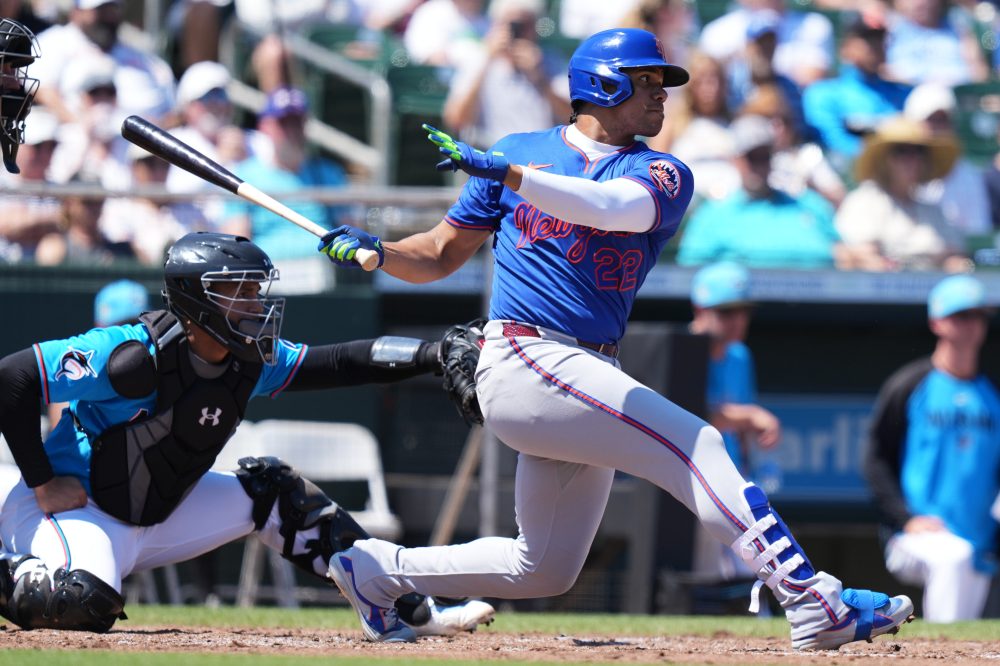
The highest-earning player in baseball remains Mets outfielder Juan Soto, who’s collecting $61.9 million this season for the second year in a row. Behind him is New York Yankees outfielder Cody Bellinger at $42.5 million.
Two players are tied for the third-highest salaries: Philadelphia’s pitcher Zack Wheeler and Mets third baseman Bo Bichette, each earning $42 million. Toronto’s first baseman Vladimir Guerrero Jr. rounds out the top five at $40.2 million, slightly ahead of Yankees outfielder Aaron Judge’s $40 million contract.
The Mets are spending $352.2 million on player salaries this season, which falls just short of their own record of $355.4 million set in 2023 but represents an increase from last year’s $322.6 million. Their spending dwarfs that of the most frugal team—Cleveland manages with just $62.3 million, more than five times less than New York’s investment.
The defending World Series champions, the Los Angeles Dodgers, hold the second position in spending at $316.6 million, a slight decrease from their previous year’s $319.5 million. However, if contracts with delayed payments were calculated at full value rather than present-day worth, the Dodgers’ total would balloon to $395.2 million. The Mets, with fewer deferred payment deals, would see their spending rise to $360 million under the same calculation.
The current average salary of $5,335,966 represents a significant increase from last season’s opening figure of $5,160,245. Under the current collective bargaining agreement set to expire in December, salaries have grown by 28%, averaging 5.6% growth each year.
The top-spending teams remain unchanged from last year’s rankings, with the Yankees in third place at $297.2 million, followed by Philadelphia at $282 million and Toronto at $269 million.
More teams are joining the high-spending ranks, with six clubs now carrying payrolls exceeding $250 million compared to four last year. Ten teams have crossed the $200 million threshold, up from nine previously.
On the other end of the spectrum, eight teams are operating with budgets under $100 million, an increase from five teams in that category last year.
Detroit made the most dramatic spending increase, adding $64.2 million to reach $206.7 million after signing pitcher Framber Valdez, retaining Gleyber Torres through a qualifying offer, and providing ace Tarik Skubal with a substantial arbitration raise. Atlanta boosted spending by $44.1 million, while the Chicago Cubs, Toronto, and the Mets each increased their budgets by approximately $30 million.
Minnesota took the opposite approach, reducing their payroll by $46.3 million from last season’s opening day to $96.5 million.
St. Louis also made significant cuts, dropping from $141.5 million to $100.4 million. The Cardinals’ current spending includes $44 million they’re paying to Arizona and Boston as part of trades involving Nolan Arenado, Sonny Gray, and Willson Contreras, plus $3.4 million in present-day value for Arenado’s $6 million assignment bonus that remains the Cardinals’ responsibility through 2041.
Additional teams making substantial reductions include the Guardians (down $40.2 million), Texas (reduced by $37.3 million), and Washington (cut by $23.3 million).
The salary calculations encompass 942 players listed on opening day rosters and injured lists, but exclude those on restricted lists such as Cleveland pitchers Emmanuel Clase and Luis Ortiz, Atlanta outfielder Jurickson Profar, and Philadelphia outfielder Johan Rojas.
Players assigned to minor league teams at season’s start, including Dodgers second baseman Hyeseong Kim and Toronto pitcher Yariel Rodríguez, are also not reflected in these figures.
The median salary—the midpoint where half of all players earn more and half earn less—increased to $1.4 million from $1.35 million, though it remains below the peak of $1.65 million reached in 2015. Active roster expansion to 26 players occurred in 2021.
Both average and median salaries typically decrease throughout the season as veteran players are released and replaced by younger players earning closer to minimum wage. MLB’s calculation puts the final 2025 average at $4.61 million, while the players’ association estimates $4.72 million.
Currently, 519 players are earning at least $1 million, representing 55% of all players—the same percentage as last year.
Nineteen players are earning $30 million or more, an increase of four from last season. Seventy-four players are making at least $20 million, up from 66, while 168 players earn $10 million or more, down from 177.
Thirty-one players are earning the league minimum of $780,000.
The highest-paid 50 players account for 30% of all salaries, up from 29% in the previous two seasons, while the top 100 earners represent 49% of total compensation, an increase from last year’s 48%.
These figures incorporate base salaries along with prorated portions of signing bonuses and other guaranteed income. The calculations also account for cash adjustments in trades, signing bonuses assigned to the contracting club, option buyouts, and severance payments for released players.
MLB’s official payroll figures are based on 40-man rosters and change daily based on roster transactions.