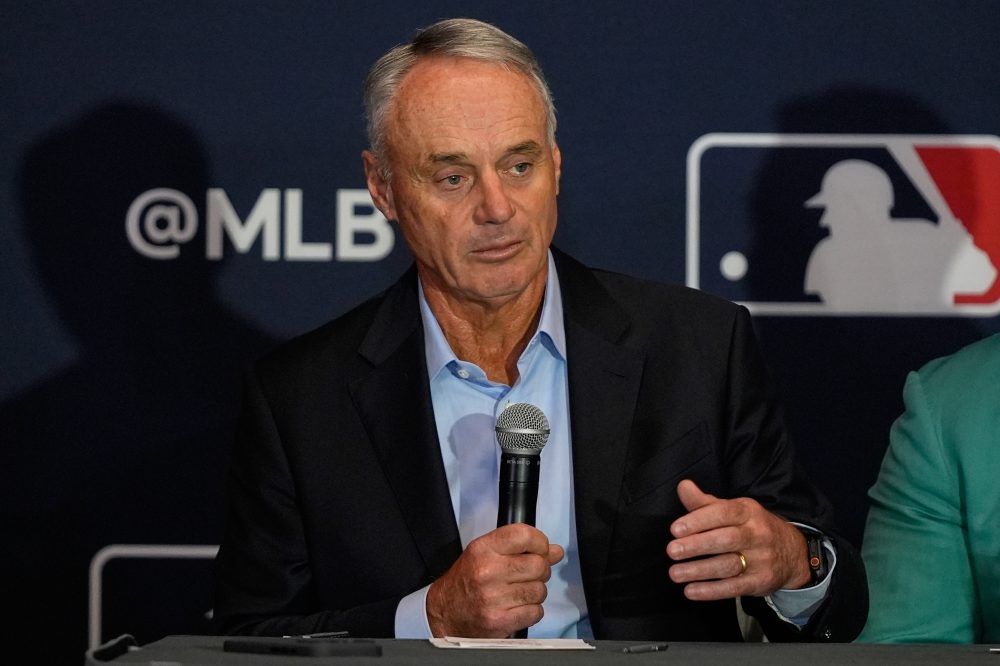

Baseball Commissioner Rob Manfred expressed deep concerns that ownership’s latest salary cap proposal might trigger a work stoppage reminiscent of the devastating 1994-95 strike that led to the World Series cancellation, while defending the plan as necessary due to the failure of the current luxury tax framework that has been in place since 2003.
Team ownership presented their first salary cap proposal since 1994 last week, marking a return to the contentious issue that sparked a 7½-month strike and resulted in the first World Series cancellation in nine decades. During those earlier negotiations, Manfred served as a junior attorney on ownership’s bargaining team.
The players’ union has pledged unwavering opposition to any cap implementation. When questioned about potential parallels to the 1994-95 crisis, Manfred acknowledged his fears, stating: “Of course I do.”
“We’re open to whatever ideas people have, but we need a realistic framework that addresses the fans’ concerns about competitive balance and you just can’t ignore that financial penalties have not gotten it done for us,” Manfred explained during Wednesday’s press conference at an ownership meeting.
The current luxury tax framework began with the 2003 season, with subsequent negotiations increasing penalty rates and adding additional surcharges over the years.
“We have tried mightily over several rounds of bargaining to use a competitive balance tax to address competitive concerns and sometimes you got to admit you failed,” Manfred acknowledged.
Recent seasons have seen increased willingness among franchises to exceed tax thresholds, culminating in a record nine teams facing penalties in both 2024 and 2025. The Dodgers alone received a $169.4 million penalty bill. Overall tax collections jumped dramatically from $78.5 million in 2022 to $222.8 million the next year, then to $311.3 million in 2024 and $402.6 million in 2025.
“We never thought about the CBT as a revenue-generating device,” Manfred explained. “And when you see more and more tax getting paid, you realize that it is not the kind of speed bump that would help on the issue of competitive balance.”
The current five-year collective bargaining agreement, finalized in March 2022 following a 99-day lockout, reaches its expiration on December 1. Industry observers anticipate management will implement a lockout, effectively freezing all free-agent signings and trade activity.
Manfred declined to discuss publicly whether ownership believes a work stoppage would justify achieving their salary cap objectives.
“I’m not going to speculate about work stoppages,” he stated. “I think that the proposal we’ve made is grounds for constructive dialogue and back and forth with the MLBPA about how we can address the number one concern of our fans and that is a lack of competitive balance in the game.”
Under the ownership proposal, spending would be capped at $245.3 million beginning in 2027, calculated using luxury tax payroll figures that incorporate $20.1 million for benefits and the pre-arbitration bonus pool. The plan also includes a spending floor of $171.2 million, requiring some franchises to increase their payrolls. For comparison, the Dodgers operated with a $415.2 million payroll on opening day this season.
The players’ association has countered with demands for expanded free agency and salary arbitration eligibility, nearly doubling the major league minimum wage, and enhanced revenue sharing arrangements.
Since 1972, baseball has experienced nine work stoppages, with the most recent being the 99-day lockout that caused a brief delay to the 2022 season.
Other major professional sports leagues have operated under salary cap systems for years, including the NFL since 1994, the NBA since 1984-85, and the NHL since 2005-06.